Revista Internacional de Educación y Análisis Social Crítico Mañé, Ferrer & Swartz.
ISSN: 2990-0476
Vol. 4 Núm. 1 (2026)
Abuse, incivility, and toxic culture in academia: An emerging area of research?
Abuso, incivismo y cultura tóxica en el ámbito académico: ¿Un área de investigación emergente?
Abuso, falta de civismo e cultura tóxica no meio académico: Uma área de investigação emergente?
Gregorio González Alcaide
Professor. Universitat de València, Spain.
https://orcid.org/0000-0003-3853-5222
gregorio.gonzalez@uv.es
Abstract
Introduction. Abusive, incivility and toxic behavior in the academic sphere are phenomena that have attracted growing interest from researchers, who have highlighted their widespread nature, the specific characteristics they exhibit compared to other work environments, and the difficulties in identifying and addressing them effectively. Methodology. We have identified the specific literature published on all these behaviors, with the aim of determining the emerging nature of this field of knowledge, the topics addressed, the studies cited that have underpinned existing knowledge, and the responses offered by academia. To this end, a literature search was conducted in the Scopus database, quantitatively analyzing scientific output and the cited literature. Results and discussion. Scientific output is moderate in scale (n=253 documents published between 1986 and 2025), although there has been significant growth since the 2010s, driven by an emerging community of researchers. Although a significant proportion of the cited literature underpinning knowledge in this field is based on abuses relating to other occupational or collective contexts, a notable body of specific literature has been identified. The findings presented allow us to characterize the research field under consideration as an emerging area that warrants particular attention, given its importance in ensuring the proper development of the academic careers of lecturers and researchers and in preventing reputational damage to institutions and to science as a whole.
Keywords: Oppression, bullying, sexual abuse, universities, academic teaching personnel, research, mobbing.
Resumen
Introducción. Las conductas abusivas, incívicas y tóxicas en el ámbito académico son fenómenos que han despertado un interés creciente por parte de la investigación, que ha alertado acerca de su carácter extendido, las particularidades que presentan frente a otros ámbitos laborales, así como las dificultades para su identificación y abordaje efectivo. Metodología. Se ha identificado la literatura específica publicada en relación con todas estas conductas, con el propósito de determinar el carácter emergente de esta área de conocimiento, cuáles son las temáticas abordadas, los estudios que referencia que han fundamentado el conocimiento existente y las respuestas ofrecidas por la academia. Para ello, se ha efectuado una búsqueda bibliográfica en la base de datos Scopus, analizando cuantitativamente la producción científica y la literatura citada. Resultados y discusión. La producción científica presenta un carácter moderado (n=253 documentos publicados en el período 1986-2025), aunque con un importante crecimiento a partir de la década del 2010, impulsado por una comunidad incipiente de investigadores. Una parte importante de la literatura citada que fundamenta el conocimiento del área se basa en los abusos referidos a otros ámbitos laborales o colectivos, si bien, se ha identificado un destacado corpus documental específico. Los resultados presentados permiten caracterizar el ámbito de investigación analizado como un área emergente a la que se debe prestar una especial atención, por su relevancia para asegurar un desarrollo digno de la carrera académica de los docentes e investigadores y evitar un daño reputacional de las instituciones y de la ciencia en su conjunto.
Palabras clave: Opresión, acoso, abuso sexual, universidad, personal académico docente, investigación, mobbing.
Resumo
Introdução. Os comportamentos abusivos, antissociais e tóxicos no âmbito académico são fenómenos que têm suscitado um interesse crescente por parte da investigação, a qual tem alertado para a sua ampla disseminação, as particularidades que apresentam em comparação com outros contextos laborais, bem como as dificuldades na sua identificação e abordagem eficaz. Metodologia. Foi identificada a literatura específica publicada em relação a todos estes comportamentos, com o objetivo de determinar o caráter emergente desta área de conhecimento, quais são os temas abordados, os estudos referenciados que fundamentaram o conhecimento existente e as respostas oferecidas pela academia. Para tal, foi realizada uma pesquisa bibliográfica na base de dados Scopus, analisando quantitativamente a produção científica e a literatura citada. Resultados e discussão. A produção científica apresenta um caráter moderado (n=253 documentos publicados no período 1986-2025), embora com um crescimento significativo a partir da década de 2010, impulsionado por uma comunidade incipiente de investigadores. Embora uma parte significativa da literatura citada que fundamenta o conhecimento da área se baseie em abusos referidos a outros âmbitos laborais ou coletivos, foi identificado um corpus documental específico de destaque. Os resultados apresentados permitem caracterizar o domínio de investigação analisado como uma área emergente à qual se deve dedicar especial atenção, dada a sua importância para garantir um desenvolvimento digno da carreira académica de docentes e investigadores e para evitar danos à reputação das instituições e da ciência no seu conjunto.
Palavras-chave: Opressão, assédio, abuso sexual, universidade, corpo docente, investigação, mobbing.
Introduction
Throughout history, universities have been institutions endowed with enormous prestige and social recognition, projecting the image of themselves as beacons illuminating the darkness of ignorance, enabling societal progress, and fostering the critical human spirit in its pursuit of knowledge and excellence (Pee and Vululleh, 2020).
Yet this idealized vision has steadily deteriorated over recent decades, with the emergence of movements and critical voices warning that universities have become excessively intertwined with economic and market interests: the so-called “neoliberal university.” At the same time, the conduct of many academics often falls far short of exemplary standards, being driven by departmental rivalries, personal interests, or an exacerbated competition for recognition and access to resources at any cost, frequently disregarding the principles of academic and research integrity (González, 2024) and elevating scientific publication metrics above every other consideration (Sahagún, 2024).
Numerous studies have warned of the prevalence of abusive practices within academia, whose incidence appears significantly higher than in many other professional environments (Henning et al., 2017; Smith and Fredricks-Lowman, 2020; Tight, 2023). Universities are frequently described as settings characterized by incivility, reinforced by rigid hierarchies and inflated egos that encourage abusive leadership, servility, and complicit silence… traits associated with what has been termed a toxic academic culture, one that damages not only individuals but also teaching quality and scientific progress itself (Mahmoudi, 2023). This raises a disturbing question: is it possible that these “cathedrals of knowledge,” behind closed doors, fail in the most basic lessons of civic coexistence and ethical leadership?
Abuse, mobbing, and bullying.
The work of Henning et al. (2017) constituted one of the earliest systematic reviews specifically focused on harassment in higher education. Analyzing fifty-one studies published between 1994 and 2013, the authors identified an emerging body of research concentrated mainly in the United States and other developed countries. Among the principal variables associated with harassment were gender and failure to fit within organizational culture. Sexual harassment appeared as the most studied form, although other types of abuse linked to toxic organizational structures were also identified, including mobbing -defined as systematic group harassment through unethical or inappropriate communicative practices intended to intimidate- and bullying, understood as repeated offensive behavior and/or social exclusion.
Although these concepts are often used interchangeably, other authors emphasize important distinctions: mobbing tends to possess a systemic dimension aimed at excluding troublesome individuals, rivals, or perceived enemies from the academic career structure, whereas bullying is more closely associated with psychological traits fostered by hierarchical power structures and toxic leaders seeking to maintain control over subordinates through intimidation, exclusion, and withdrawal of support (Coates, 2023). The concept of gaslighting has likewise emerged to describe a subtle form of emotional and psychological abuse designed to make the victim perceive themselves as the problem (Coates, 2023).
Henning et al. (2017) identified five major conclusions regarding harassment in academia: the high prevalence and widespread nature of abusive conduct; the need to develop standardized and cross-culturally valid measurement instruments; the importance of promoting research on the impact of global labor mobility; the necessity of evaluating the effectiveness of anti-harassment policies and programs; and the urgency of conducting contextualized studies in different national settings.
Prevost and Hunt (2018), in their review of the literature on mobbing within academia, analyzed twenty-three studies published between 2004 and 2016. One of their most striking findings concerned prevalence: between 25% and 91% of academics included in the analyzed studies reported having experienced mobbing in their workplace. Common forms of harassment included undermining professional competence, increasing administrative or teaching burdens, restricting access to research and teaching resources, and excluding victims from conversations or social activities. Other practices included forcing the inclusion of supervisors’ or coauthors’ names on publications, spreading rumors, repeated interruptions, denial of promotion, and uncivil conduct during meetings.
The review also identified links between mobbing and both sex and sexual orientation, while noting that perpetrators were predominantly male (63% compared to 26% female). Among the principal physical and psychological consequences were depression, stress, musculoskeletal and digestive disorders, sleep disturbances, changes in eating habits, and increased alcohol and tobacco consumption. Social consequences included resignation from employment, decreased productivity, absenteeism, declining morale and loyalty, and the necessity of working within dysfunctional environments. The authors further emphasized the serious long-term reputational damage such practices may inflict upon institutions themselves. Significantly, many victims chose either silence or departure from the institution rather than formal complaint. The review concluded by stressing the importance of institutional support, legal guidance, and robust anti-harassment policies.
Rojas-Solís et al. (2019), in a systematic review focused specifically on workplace harassment among university personnel, highlighted the conceptual complexity of mobbing, the absence of clear consensus regarding terminology, and the highly variable prevalence rates observed across studies, ranging from 9.6% to 54% of analyzed samples. They identified sexual abuse as the principal manifestation of workplace harassment and emphasized the major role played by sociocultural factors, while depressive disorders emerged as the most frequent consequence.
Lemon and Barnes (2021), in their review of bullying and mobbing within higher education, grouped the causes identified in the literature into three broad categories: characteristics of the aggressor, frequently resembling narcissistic personality traits; institutional structures and abuses of power, often sustained by corrupt leadership lacking either the competence or the willingness to implement change; and organizational cultures based upon systems of rewards and punishments that perpetuate abusive behavior.
Finally, Tight (2023) asked whether bullying should be regarded as an endemic problem in higher education. Reviewing seventy-four key studies, the author concluded that bullying is indeed widespread and particularly favored by the academic environment. Reported prevalence rates ranged between 18% and 68%, with many studies clustering between 25% and 35%, substantially higher than rates observed within the general population. The strongly hierarchical nature of academia, the illusion of autonomy constrained by expectations and responsibilities, the intense competitiveness of academic careers, and certain forms of mentorship and supervision collectively create an ideal environment for the proliferation of bullying.
Albro (2024), reviewing studies on bullying among higher-education employees, identified additional factors associated with the growth of abusive practices: poor social climates, lack of managerial support, exclusion from dominant groups, failure to conform to “prototypical” expectations, role conflicts, workload mismatches, and work environments resistant to innovation. The study emphasized the importance of implementing effective anti-abuse regulations and promoting ethical leadership within academic institutions.
The review conducted by Hodgins et al. (2024) on the literature surrounding academic bullying (including sexual abuse and incivility within its scope) analyzed 140 documents published between 2003 and 2023. The authors highlighted the significant growth in scientific production in this field during the 2019-2023 period; the predominance of prevalence studies based on questionnaires, although qualitative studies (focus groups and interviews) and analyses of mediating or moderating factors also featured prominently; and the concentration of research in more developed countries, particularly the United States and Europe. From their qualitative analysis, they emphasized that the characteristics of academia itself make it an especially vulnerable environment; that the neoliberal model adopted by universities -together with the precarity and competitiveness associated with it- has intensified and increased the risk of bullying, while simultaneously limiting the possibility of confronting it and protecting certain individuals; and that the power dynamics characteristic of academic institutions favor and normalize abusive behavior.
Soltani et al. (2025), after analyzing thirty-seven scientific documents containing definitions of academic bullying, identified four key attributes associated with the concept: intense competitiveness, ongoing hostile and abusive conduct by hierarchical superiors, power imbalances, and a wide range of inappropriate behaviors. On the basis of their analysis, they proposed the following definition:
Academic bullying is defined as abnormal behavior arising from the misuse of power, professional experience, academic rankings, professional status, political relationships, and unhealthy academic competition with colleagues, which may provoke emotional, psychological, social, and sometimes physical problems. In short, it constitutes a struggle for power and prestige within the academic environment for the wrong reasons. (Soltani et al., 2025, p. 6).
With regard to sexual abuse within academia, particular attention should be paid to the systematic review by Bondestam and Lundqvist (2020), who warned about its high prevalence and the severe physical and psychological consequences associated with it, among which anxiety, depression, and post-traumatic stress disorder repeatedly appear throughout the scientific literature. In relation specifically to the workplace, sexual abuse has also been linked to absenteeism, decreased job satisfaction, diminished commitment and productivity, reduced self-confidence and self-esteem, and even resignation from employment.
Toxic Leadership
Some reviews have focused specifically on the concept of toxic leadership as a practice from which numerous abusive behaviors emerge. The work of Smith and Fredricks-Lowman (2020), based on the analysis of twenty documents published between 2007 and 2017, highlighted the widespread presence of this phenomenon within higher education institutions, noting that it is facilitated by organizational culture and affects workers’ physical health, psychological well-being, and professional performance alike.
Baloyi’s review (2020), for its part, emphasized the importance of promoting ethical or service-oriented leadership as the principal mechanism for limiting toxic leadership practices.
Coates (2024), conceptualizing toxic culture as characteristic of organizations defined by systematic and prolonged violations of norms that generate harm, offers a detailed conceptual review of the dimensions associated with this phenomenon within academia. According to the author, these dimensions include: toxic leadership; bullying and mobbing; the establishment of mechanisms to control the work environment; the development of social norms governing individual behavior; the promotion of rapid organizational changes to consolidate control; the manipulation of systems, structures, and processes; and the instrumentalization of labor itself. As consequences of the perpetuation of toxic culture within academia, Coates (2024) identified a series of problems associated with toxic leadership at the individual level: health deterioration, reduced performance and job satisfaction, difficulties in developing meaningful work, the loss of the vocational dimension of labor in favor of purely economic motivations, and growing alienation from -and distrust toward- the values represented by the institution and its future. According to the author, this process ultimately generates irreversible damage to the values educational and research institutions ought to embody and promote.
All of the literature reviews discussed above demonstrate the existence of growing scholarly interest in the study of abusive practices within academia. The present contribution seeks to determine the stage of development reached by research in this field and to identify the intellectual foundations upon which it is based. More specifically, it aims to answer the following questions:
– Is this a line of research that conforms to the patterns and characteristics defining emerging research fields?
– Which reference studies have laid the foundations for existing knowledge in this area?
– Does there exist, in Spain, a research line specifically addressing abusive practices within academia?
Methodology
The analysis was based upon the scientific literature indexed in the Scopus database, chosen because it offers broad thematic coverage of journals across all scientific disciplines -particularly the social sciences- while also providing relevant features for the study, such as bibliographic references and citation data. The process followed was as follows:
A) Bibliographic searches. In order to identify scientific literature specifically addressing any form of abusive, uncivil, or toxic conduct within academia, the terminology employed in published literature reviews was used, together with other relevant terms appearing in the titles or keywords of initially retrieved documents. The search process combined terms related to the object of study with others intended to restrict results to the context of higher education and academia. The search strategy, executed within title, abstract, and keyword fields, was defined as follows:
“Toxic leadership” OR Toxicity OR “Toxic culture” OR “Toxic Leader” OR “Authoritarian Leadership” OR Bull* OR Mobbing* OR “colleagues as enablers” OR “toxic social norms” OR “toxic norms” OR “chaotic change” OR manipulation OR weaponization OR “Academic abuse” OR Harassment OR “Abusive Behaviors” OR “Academic Violence” OR “Abuse of Power” OR “Workplace Violence” OR “Abusive supervision” OR “Emotional Abuse” OR Gaslight* OR Incivility
AND
Academic* OR Universit* OR “Higher Education”
No chronological restrictions were established for the search, beyond limiting the results obtained to articles and review papers.
B) Downloading, reviewing, and processing bibliographic information.
Once the bibliographic records had been downloaded, titles, abstracts, and, where necessary, full texts were manually reviewed in order to determine their inclusion in the study. The purpose was to focus the analysis specifically on works addressing abuses directed at administrative staff, academics, teachers, or researchers within universities or research centers, as well as uncivil or toxic behaviors occurring in such environments.
The most common reasons for excluding documents were that they concerned abusive behavior directed at undergraduate students, focused on other professional settings such as hospitals or libraries, consisted merely of editorials or letters rather than research studies, or -more occasionally- represented documentary noise.
Subsequently, the homogeneity and quality of the data were reviewed, particularly the bibliographic references, since scientific journals frequently present multiple variants of the same reference due to differing citation styles, the publication of postprints prior to final article versions, or the existence of reprints and revised editions in the case of books, all of which may generate multiple publication dates for a single work.
C) Obtaining, analyzing, and interpreting indicators.
Characterization of abusive conduct in academia as an emerging research field: analysis of scientific production and impact.
An emerging research field (emerging topic) refers to a coherent and novel theme attracting growing scholarly interest, characterized by significant scientific growth and impact aimed at reducing uncertainty or ambiguity concerning existing knowledge or examining the implications of the phenomenon under study (Rotolo et al., 2015; Small et al., 2014).
In order to analyze the development of research and determine the emerging character of the topic under examination, the study evaluated the evolution of scientific production over time, researcher productivity, the existence of a consolidated research community within the field, and citation rates of published documents. Specific bibliometric indicators used to determine the extent to which research on abusive, toxic, and uncivil academic conduct constitutes an emerging field included the growth rate in the number of publications across different periods, the percentage of transient authors (authors who had published only one document), and the degree to which the distribution of authors by productivity thresholds conformed to Lotka’s Law (González et al., 2016; González et al., 2018).
Cognitive foundations of research on abusive conduct in academia: analysis of cited literature.
In order to identify the reference works providing the cognitive foundations of the field, a co-citation analysis was carried out. This methodology is based on identifying and quantifying citation links established between documents, whose graphical representation makes it possible to determine thematic clusters, the most influential works, and the interrelationships between them (González-Alcaide et al., 2016).
The analysis followed the following procedure:
a) Standardization of bibliographic data by uniquely identifying each bibliographic reference appearing in the reference lists of the retrieved documents (surname of the first author and year of publication, adding an alphabetical letter when multiple works shared the same first author and year);
b) Generation of a symmetric co-occurrence matrix identifying the co-citation frequency of documents (the number of times each pair of documents appeared together in bibliographies);
c) Execution of a community-detection (clustering) algorithm and network visualization process using the software Pajek (where nodes represent documents and links represent the relationships established between them through frequent joint citation);
e) Interpretation of results, since the resulting clusters reflect thematic areas, schools of thought, or research fronts within the field, while also making it possible to determine which documents occupy the most central and influential positions within the network.
Results
Analysis of scientific production and impact.
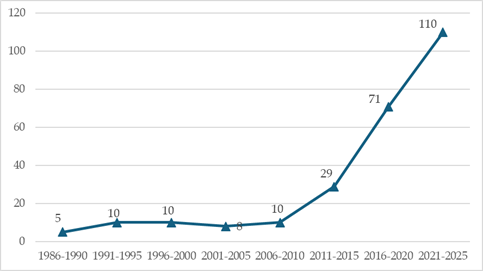
A total of 253 documents specifically focused on the analysis of abusive conduct among academic staff were identified, containing 11,905 distinct bibliographic references. The evolution in the number of published documents over time (Figure 1) demonstrates that this constitutes a field of study attracting steadily increasing attention in recent years. Thus, after a latency period throughout the 1980s, 1990s, and 2000s -during which publication levels never exceeded ten documents per five-year period- there has been a substantial explosion in the number of studies, surpassing one hundred works in the most recent period (2021-2025). Growth rates reached 190% during the 2011-2015 period, 144% during 2016-2020, and 55% during 2021-2025.
Figure 1.
Evolution in the number of documents published per five-year period on abusive conduct within academia.
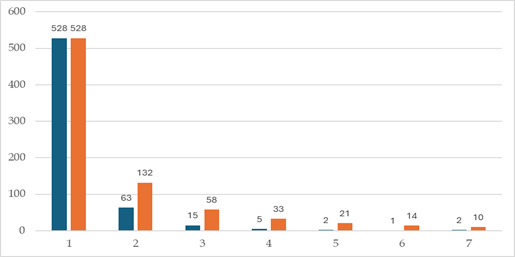
Several researchers stand out for having produced a moderate body of scientific work on the subject. Nevertheless, the distribution of researcher productivity falls noticeably below the parameters established by Lotka's law (Figure 2), due to the very high percentage of transient authors — that is, authors who have published only a single document — which amounts to 85.7% of the identified authors.
Figure 2.
Observed distribution (blue) and distribution adjusted to Lotka's law (orange) of scientific production on abusive conduct within academia.
With regard to the scientific journals in which these studies have been published, several of the most productive outlets are journals focused on occupational health, public health, and workers’ rights (International Journal of Environmental Research and Public Health, n=6; Employee Responsibilities and Rights Journal, n=4). Also prominent are journals centered on the field of education (International Journal of Educational Management, n=4; International Journal of Leadership in Education, n=3), gender roles (Sex Roles, n=5; Journal of Gender Studies, n=3; Gender and Education, n=3), general social sciences (Annales Series Historia et Sociologia, n=3; SAGE Open, n=3; Social Sciences, n=3), and medicine (eClinicalMedicine, n=3; BioImpacts, n=3; Academic Medicine, n=3; and International Journal of Workplace Health Management, n=3).
The analysis of the types of abuse addressed in the studies examined (Table 1) demonstrates that sexual abuse constitutes, in quantitative terms, the principal field of attention within the research literature (39.9% of the documents), ahead of other terms referring to abusive or harassing conduct, such as bullying (31.2%) or mobbing (7.1%). More specifically, additional concepts receiving notable attention include incivility (6.7%) and toxic leadership (6.3%).
Table 1.
Main types of abusive conduct in academia addressed within the research literature.
|
Topic |
N docs |
% |
|
Sexual abuse |
101 |
39,92 |
|
Bullying |
79 |
31,22 |
|
Generic terms (abuse/harassment/violence) |
20 |
7,9 |
|
Mobbing |
18 |
7,11 |
|
Incivility |
17 |
6,72 |
|
Toxic leadership |
16 |
6,32 |
|
Gendered harassment |
10 |
3,95 |
|
Psychological manipulation (gaslighting) |
1 |
0,39 |
Analysis of the cited literature.
The co-citation analysis was based on quantifying the links established among the 11,905 bibliographic references included within the 253 identified documents concerning abusive conduct in academia, with the aim of determining how the various research themes are articulated and which documents and authors provide the principal cognitive foundations of the field (Figure 3).
Figure 3.
Thematic clusters of documents identified through the co-citation analysis of bibliographic references cited in the scientific literature on abusive conduct within academia.
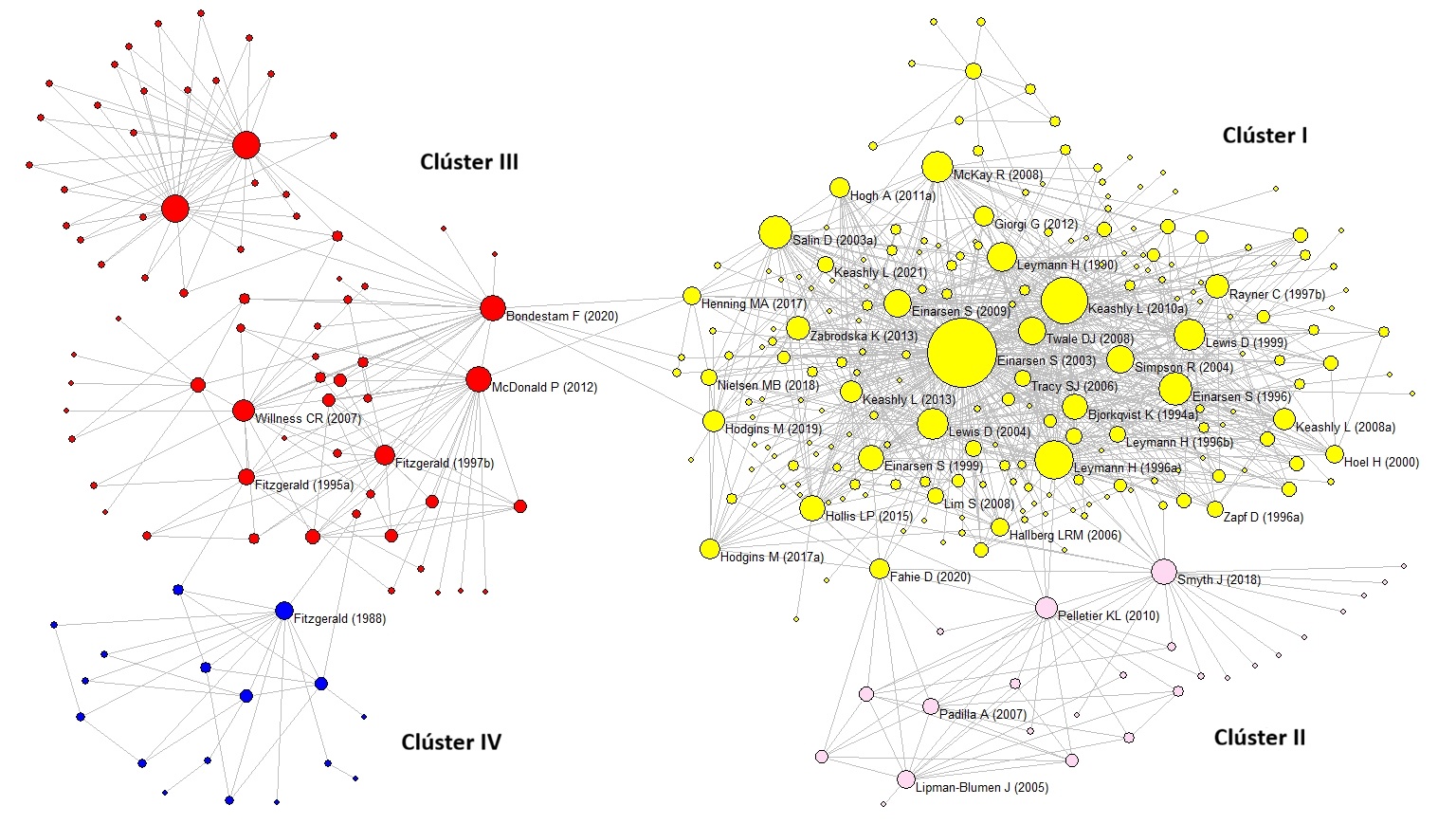
Four major research clusters were identified. Figure 3 shows (Cluster I, yellow nodes) that the central core of the reference literature -with the highest degree of co-citations and a large number of strongly interconnected studies- is constituted by works on bullying/mobbing. Among these, an emerging body of literature specifically focused on academia stands out (Björkqvist et al., 1994; Fahie, 2020; Giorgi, 2012; Hodgins and Mannix McNamara, 2019; Hollis, 2015; Keashly and Neuman, 2010; Keashly and Neuman, 2013; Lewis, 1999; Lewis, 2004; Mckay et al., 2008; Simpson and Cohen, 2004; Twale and De Luca, 2008; Zabrodska and Kveton, 2013), alongside studies examining abusive practices in other workplace settings, including several influential monographs (Einarsen et al., 2003; Hoel and Cooper, 2000) and literature reviews (Nielsen and Einarsen, 2018; Salin, 2003).
In the lower section (Cluster II, pink nodes), a subset of documents can be distinguished that focus specifically on the concept of toxic leadership (Lipman-Blumen, 2005, 2005b; Padilla et al., 2007; Pelletier, 2010; Smith and Fredricks-Lowman, 2020; Smyth, 2017).
On the left side of the figure appear several much less dense and more dispersed groupings of documents. At the center, two literature reviews -one generic review concerning workplace environments (McDonald, 2012), and another focused specifically on educational contexts (Bondestam and Lundqvist, 2020)- organize around themselves a series of contributions related to sexual abuse (Cluster III, red nodes). Particularly notable among these are the works of Fitzgerald et al. (1995) concerning its measurement, as well as the contributions of Fitzgerald et al. (1997) and Willness et al. (2007) regarding the consequences of this form of abuse. In the upper part of the cluster appears a grouping of documents composed of regulations, guidelines, and ethical codes aimed at preventing and managing such abuses in workplace settings.
Several significant contributions focused specifically on sexual abuse within academia (Cluster IV, blue nodes) are located in the lower section of this group of documents (Benson and Thomson, 1982; Dziech and Weiner, 1990; Fitzgerald et al., 1988).
Table 2 compiles all documents identified and assigned to the different clusters in the co-citation analysis, together with the number of citations they received from the 253 documents analyzed in the present study. Documents not assigned to any cluster, despite receiving a substantial number of citations, failed to reach the minimum threshold of stable links with other documents required for integration into the network.
Table 2.
Most frequently cited documents in the co-citation analysis of the literature on abusive conduct within academia.
|
Document label |
Cluster |
Bibliographic reference |
N citations |
|
I |
Einarsen, S., Hoel, H., & Cooper, C. (2003). Bullying and emotional abuse in the workplace: International perspectives in research and practice. CRC Press. |
50 |
|
|
Keashly L (2010a) |
I |
Keashly, L., & Neuman, J. H. (2010). Faculty experiences with bullying in higher education. Administrative Theory and Praxis, 32(1), 48-70. https://doi.org/10.2753/ATP1084-1806320103. |
43 |
|
Leymann H (1996a) |
I |
Leymann, H. (1996). The content and development of mobbing at work. European Journal of Work and Organizational Psychology, 5(2), 165-184. https://doi.org/10.1080/13594329608414853. |
32 |
|
Bondestam F (2020) |
III |
Bondestam, F., & Lundqvist, M. (2020). Sexual harassment in higher education: A systematic review. European Journal of Higher Education, 10(4), 397-419. https://doi.org/10.1080/21568235.2020.1729833. |
28 |
|
Leymann (1990) |
I |
Leymann, H. (1990). Mobbing and psychological terror at workplaces. Violence and Victims, 5(2), 119-126. |
25 |
|
Twale DJ (2008) |
I |
Twale, D. J., & De Luca, B. M. (2008). Faculty incivility: The rise of the academic bully culture and what to do about it. Jossey-Bass. |
25 |
|
Einarsen S (1996) |
I |
Einarsen, S., & Skogstad, A. (1996). Bullying at work: Epidemiological findings in public and private organizations. European Work and Organizational Psychologist, 5(2), 185-201. https://doi.org/10.1080/13594329608414854. |
24 |
|
McKay R (2008) |
I |
McKay, R., Arnold, D. H., Fratzl, J., & Thomas, R. (2008). Workplace bullying in academia: A Canadian study. Employee Responsibilities and Rights Journal, 20(2), 77-100. https://doi.org/10.1007/s10672-008-9073-3. |
21 |
|
Salin D (2003a) |
I |
Salin, D. (2003). Ways of explaining workplace bullying: A review of enabling, motivating and precipitating structures and processes in the work environment. Human Relations, 56(10), 1213-1232. 10.1177/00187267035610003. |
20 |
|
Lewis D (1999) |
I
|
Lewis, D. (1999). Workplace bullying: Interim findings of a study in further and higher education in Wales. International Journal of Manpower, 20(1-2), 106-119. https://doi.org/10.1108/01437729910268696. |
20 |
|
- |
- |
Johnson, P. A., Widnall, S. E., & Benya, F. F. (Eds.) (2018). Sexual Harassment of Women: Climate, Culture, and Consequences in Academic Sciences, Engineering, and Medicine. National Academic of Sciences, Engineering, and Medicine. |
20 |
|
Einarsen S (2009) |
I
|
Einarsen, S., Hoel, H., & Notelaers, G. (2009). Measuring exposure to bullying and harassment at work: Validity, factor structure and psychometric properties of the Negative Acts Questionnaire-Revised. Work & Stress, 23(1), 24-44. https://doi.org/10.1080/02678370902815673. |
19 |
|
Fitzgerald (1988) |
IV |
Fitzgerald, L. F., Shullman, S. L., Bailey, N., Richards, M., Swecker, J., Gold, Y., Ormero, D. M., & Weitzman, L. (1988). The incidence and dimensions of sexual harassment in academia and the workplace. Journal of Vocational Behavior, 32(2), 152-175. https://doi.org/10.1016/0001-8791(88)90012-7. |
19 |
|
Fitzgerald (1995a) |
III |
Fitzgerald, L. F., Gelfand, M. J., & Drasgow, F. (1995). Measuring sexual harassment: Theoretical and psychometric advances. Basic and Applied Social Psychology ,17(4), 425-445. https://doi.org/10.1207/s15324834basp1704_2. |
19 |
|
McDonald P (2012) |
II |
McDonald, P. (2012). Workplace sexual harassment 30 years on: A review of the literature. International Journal of Management Reviews, 14(1), 1-17. https://doi.org/10.1111/j.1468-2370.2011.00300.x. |
19 |
|
Simpson R (2004) |
I |
Simpson, R., & Cohen, C. (2004). Dangerous work: The gendered nature of bullying in the context of higher education. Gender, Work & Organization, 11(2), 163-186. https://doi.org/10.1111/j.1468-0432.2004.00227.x. |
19 |
|
Hollis LP (2015) |
I |
Hollis, L. P. (2015). Bully university? The cost of workplace bullying and employee disengagement in American higher education. SAGE Open, 5(2). https://doi.org/10.1177/2158244015589997. |
18 |
|
Björkqvist K (1994a) |
I |
Björkqvist, K., Österman, K., & Hjelt-Bäck, M. (1994). Aggression among university employees. Aggressive Behavior, 20(3), 173-184. https://doi.org/10.1002/1098-2337(1994)20:3<173::AID-AB2480200304>3.0.CO;2-D. |
17 |
|
Willness CR (2007) |
III
|
Willness, C. R., Steel, P., & Lee, K. (2007). A meta-analysis of the antecedents and consequences of workplace sexual harassment. Personnel Psychology, 60(1), 127-162. https://doi.org/10.1111/j.1744-6570.2007.00067.x. |
17 |
|
Lewis D (2004) |
I |
Lewis, D. (2004). Bullying at work: The impact of shame among university and college lecturers. British Journal of Guidance & Counselling, 32(3), 281-299. https://doi.org/10.1080/03069880410001723521. |
16 |
|
Einarsen S (1999) |
I |
Einarsen, S. (1999). The nature and causes of bullying at work. International Journal of Manpower, 20(1-2), 16-27. https://doi.org/10.1108/01437729910268588. |
15 |
|
Hodgins M (2019) |
I |
Hodgins, M., & Mannix-McNamara, P. (2019). An enlightened environment? Workplace bullying and incivility in Irish higher education. Sage Open, 9, 1-13 https://doi.org/10.1177/2158244019894278. |
15 |
|
Zabrodska K (2013) |
I |
Zabrodska, K., & Kveton, P. (2013). Prevalence and forms of workplace bullying among university employees. Employee Responsibilities and Rights Journal, 25(2), 89-108. https://doi.org/10.1007/s10672-012-9210-x. |
15 |
|
Henning MA (2017) |
I |
Henning, M. A., Zhou, C., Adams, P., Moir, F., Hobson, J., Hallett, C., & Webster, C. S. (2017). Workplace harassment among staff in higher education: A systematic review. Asia Pacific Education Review, 18(4), 521-539. https://doi.org/10.1007/s12564-017-9499-0. |
14 |
|
Fitzgerald (1997b) |
III |
Fitzgerald, L. F., Drasgow, F., Hulin, C. L., Gelfand, M. J., & Magley V. J. (1997). Antecedents and consequences of sexual harassment in organizations: A test of an integrated model. Journal of Applied Psychology, 82(4), 578-589. https://doi.org/10.1037/0021-9010.82.4.578. |
13 |
|
- |
- |
MacKinnon, C. A. (1979). Sexual harassment of working women: A case of sex discrimination. Yale University Press. |
13 |
|
Pelletier KL (2010) |
II |
Pelletier, K. L. (2010). Leader toxicity: An empirical investigation of toxic behavior and rhetoric. Leadership, 6(4), 373-389. https://doi.org/10.1177/1742715010379308. |
13 |
|
Rayner C (1997b) |
I |
Rayner, C. (1997). The incidence of workplace bullying. Journal of Community and Applied Social Psychology, 7(3), 199-208. https://doi.org/10.1002/(SICI)1099-1298(199706)7:3<199::AID-CASP418>3.0.CO;2-H. |
13 |
|
Keashly L (2013) |
I |
Keashly, L., & Neuman, J. H. (2013). Bullying in higher education: What current research, theorizing, and practice tell us. En L. Keashly & J. H. Neuman (Eds.), Workplace Bullying in Higher Education (pp. 1-22). Routledge. |
13 |
|
- |
- |
Gutek, B. A. (1985). Sex and the workplace: Impact of sexual behavior and harassment on women, men, and organizations. Jossey-Bass. |
12 |
|
- |
- |
Benson, D. J., & Thomson, G. E. (1982). Sexual harassment on a university campus: the confluence of authority relations, sexual interest and gender stratification. Social Problems, 29(3), 236-251. https://doi.org/10.2307/800157. |
11 |
|
- |
- |
Cortina, L. M., Magley V. J., Williams J. H., & Langhout R. D. (2001). Incivility in the workplace: Incidence and impact. Journal of Occupational Health Psychology, 6(1), 64-80. https://doi.org/10.1037/1076-8998.6.1.64. |
11 |
|
Fahie D (2020) |
I |
Fahie, D. (2020). The lived experience of toxic leadership in Irish higher education. International Journal of Workplace Health Management, 13(3), 341-355. https://doi.org/10.1108/IJWHM-07-2019-0096. |
11 |
|
- |
- |
Keashly, L. (2019). Workplace bullying, mobbing and harassment in academe: Faculty experience. En P. D’Cruz, E. Noronha, L. Keashly, S. Tye-Williams (Eds.), Special topics and particular occupations, professions and sectors. Handbooks of Workplace Bullying, Emotional Abuse and Harassment 4, (pp. 1-77). Springer. |
11 |
|
Padilla A (2007) |
II |
Padilla, A., Hogan, R., & Kaiser, R. B. (2007). The toxic triangle: Destructive leaders, susceptible followers and conducive environments. The Leadership Quarterly, 18(3), 176-194. https://doi.org/10.1016/j.leaqua.2007.03.001. |
11 |
|
- |
- |
Till, F. J. (1980). Sexual harassment: A report on the sexual harassment of students. National Advisory Council on Women's Educational Programs. |
11 |
|
Leymann H (1996b) |
I |
Leymann, H., & Gustafsson A. (1996). Mobbing at work and the development of post-traumatic stress disorders. European Journal of Work and Organizational Psychology, 5(2), 251-275. https://doi.org/10.1080/13594329608414858. |
11 |
|
- |
- |
Andersson, L. M., & Pearson, C. M. (1999). Tit for tat: The spiraling effect of incivility in the workplace. Academy of Management Review, 24(3), 452-471. https://doi.org/10.2307/259136. |
10 |
|
- |
- |
Bowling, N. A., & Beehr, T. A. (2006). Workplace harassment from the victim’s perspective: A theoretical model and meta-analysis. Journal of Applied Psychology, 91(5), 998-1012. https://doi.org/10.1037/0021-9010.91.5.998. |
10 |
|
- |
- |
Berdahl, J. L. (2007). Harassment based on sex: Protecting social status in the context of gender hierarchy. Academy of Management Review, 32(2), 641-658. http://www.jstor.org/stable/20159319. |
10 |
|
Zapf D (1996a) |
I |
Zapf, D., Knorz, C., & Kulla, M. (1996). On the relationship between mobbing factors and job content, social work environment and health outcomes. European Journal of Work and Organizational Psychology, 5(2), 215-237. https://doi.org/10.1080/13594329608414856. |
10 |
|
Keashly L (2021) |
I |
Bjorklund, C., Vaez, M., & Jensen, I. (2021). Early work-environmental indicators of bullying in an academic setting: A longitudinal study of staff in a medical university. Studies in Higher Education, 46(12), 2556-2567. https://doi.org/10.1080/03075079.2020.1729114. |
10 |
|
- |
- |
Davenport, N., Schwartz R. D., & Elliot G. P. (1999). Mobbing: Emotional abuse in the American workplace. Civil Society Publishing. |
10 |
|
Hodgins M (2017a) |
I |
Hodgins, M., & Mannix McNamara, P. (2017). Bullying and incivility in higher education workplaces: Micropolitics and the abuse of power. Qualitative Research in Organizations and Management: An International Journal, 12(3), 190-206. https://doi.org/10.1108/QROM-03-2017-1508. |
10 |
|
Keashly L (2008a) |
I |
Keashly, L., & Neuman, J. H. (2008). Final report: Workplace behavior (bullying) project survey. |
10 |
|
Giorgi G (2012) |
I |
Giorgi, G. (2012). Workplace bullying in academia creates a negative work environment: An Italian study. Employee Responsibilities and Rights Journal, 24(4), 261-275. https://doi.org/10.1007/s10672-012-9193-7. |
10 |
|
Nielsen MB (2018) |
I |
Nielsen, M. B., & Einarsen, S. V. (2018). What we know, what we do not know, and what we should and could have known about workplace bullying: An overview of the literature and agenda for future research. Aggression and Violent Behavior, 42, 71-83. https://doi.org/10.1016/j.avb.2018.06.007. |
10 |
|
Lipman-Blumen J (2005) |
I |
Lipman-Blumen, J. (2005a). The allure of toxic leaders: Why we follow destructive bosses and corrupt politicians – and how we can survive them. Oxford Academic. |
10 |
|
Hoel H (2000) |
I |
Hoel, H., & Cooper, C. (2000). Destructive conflict and bullying at work. Manchester School of Management. |
10 |
|
Lim S (2008) |
I |
Lim, S., Cortina, L., & Magley V. (2008). Personal and workgroup incivility: Impact on work and health outcomes. Journal of Applied Psychology, 93(1), 95-107. https://doi.org/10.1037/0021-9010.93.1.95. |
8 |
|
Smyth J (2018) |
II |
Smyth, J. (2017). The toxic university: Zombie leadership, academic rock stars, and neoliberal ideology. Springer. |
8 |
|
Tracy SJ (2006) |
I |
Tracy, S. J., Lutgen-Sandvik, P., & Alberts, J. K. (2006). Nightmares, demons, and slaves: exploring the painful metaphors of workplace bullying. Management Communication Quarterly, 20, 148-185. |
7 |
|
Hogh A (2011a) |
I |
Hogh A., Mikklesen E. G., & Hansen, A. M. (2011). Individual consequences of workplace bullying/mobbing. En S. Einarsen, H. Hoel, D. Zapf, C. Cooper (Eds.), Bullying and Harassment in the Workplace (pp. 107-128). CRC Press. https://doi.org/10.1201/EBK1439804896. |
6 |
|
Hallberg LRM (2006) |
I |
Hallberg, L. R. M., & Strandmark, M. K. (2006). Health consequences of workplace bullying: Experiences from the perspective of employees in the public service sector. International Journal of Qualitative Studies on Health and Well-being, 1(2), 109-119. https://doi.org/10.1080/17482620600555664. |
5 |
Discussion
Two notable features observed in relation to the field under analysis are the substantial growth in scientific production beginning in the 2010s, following a long latency period characterized by only sporadic publications, together with the existence of several reference documents and authors concentrating a significant degree of citation. Consequently, although there is not yet a fully established and consolidated scientific community comparable to what has been observed in other research areas (González, 2016a; González et al., 2018), the first of the questions posed in the introduction can nevertheless be answered affirmatively: we are facing an emerging field of research, albeit one that remains incipient and still in the process of defining the boundaries of its object of study.
Although the concept of mobbing was proposed by Heinz Leymann in the 1990s (Leymann, 1990), academia remained “blind” or indifferent to the problem for decades, systematically ignoring it -in many contexts and institutions even to this day- under what may be described as a culture of “academic silence” (Keashly, 2019). The scientific explosion observed from the mid-2010s onward parallels the growing interest in this topic within workplace studies more generally (Alper Ay, 2025), which may be associated, among other factors, with the increasing relevance accorded to mental health in occupational environments, particularly following the COVID-19 pandemic (World Health Organization & International Labour Organization, 2022), as well as with more specific developments such as the #ScienceToo movement, which seeks to expose the prevalence of sexual abuse, the underrepresentation of women in science, and the abusive power dynamics that continue to persist within many universities and laboratories (Johnson et al., 2018).
Particularly noteworthy is the large number of literature reviews identified. In addition to those discussed in the state-of-the-art section of the present contribution, numerous other reviews have been published in specific disciplines and contexts (Averbuch et al., 2021; Fontenot et al., 2024; Penconek et al., 2024), supporting the idea that a turning point has been reached in which academics themselves increasingly demand that this problem cease to be ignored and instead be properly characterized and addressed.
The phenomenon of abusive practices in academia constitutes a multidisciplinary and cross-cutting research field, as demonstrated by the thematic and disciplinary diversity of the most productive journals identified. Thus, beyond being a problem internal to universities -one that has drawn the attention of educational journals analyzing issues such as rigid hierarchical structures and the widespread prevalence of toxic leadership (Hollis, 2015)- the fact that abusive conduct also represents a major public health problem because of its prevalence and its severe consequences for the physical and mental health of those affected, together with the rigid master-apprentice structures characteristic of clinical medicine that may facilitate abuse, explains the attention devoted to the issue by journals in these fields (Manuel et al., 2023). At the same time, abusive conduct frequently constitutes a manifestation of systemic sexism, a dimension emphasized by the identified journals specializing in gender studies, with sexual abuse emerging as the principal form of abuse documented within the literature and addressed by research.
Although sexual abuse accounts for the largest number of publications within the analysis performed, it is striking that fewer reference researchers and studies were identified through the co-citation analysis. This may reflect the more fragmented character of research in this area, dominated by descriptive studies tied to different national and cultural contexts in which sexual abuse occurs, where it tends to be understood as a structural, social, and labor-related problem influenced less by the specific characteristics of academia itself and more by national legislation, regulatory frameworks, or legal systems (Bondestam and Lundgren, 2020).
By contrast, other forms of abuse and abusive conduct possess a more consolidated body of research specifically focused on academic and research environments, with several authors and contributions repeatedly cited in the literature, making it possible to define with much greater precision the characteristics and broader implications of phenomena such as incivility and toxic leadership (Heffernan and Bosetti, 2021; Smith et al., 2020). The more cohesive character of research on bullying/mobbing in academia may be explained by the fact that this theoretical-conceptual area has been strongly shaped by prominent reference authors within behavioral psychology (Keashly, 2019). The earliest documents identified within the co-citation network concerning abusive conduct in academia -which may be considered the foundational core of researchers in the field- already demonstrated that the phenomenon constituted a widespread cultural reality. Several seminal contributions published during the 1990s and 2000s applied psychometric scales used to measure workplace harassment in general occupational contexts to the academic environment, drawing attention to the institutionalization of the phenomenon and to the culture of silence defining it (Björkqvist et al., 1994; Lewis, 1999; 2004; Twale and De Luca, 2008). A later research line emphasized harassment as a systemic phenomenon aggravated by the development of neoliberal universities, highlighting the role of competitiveness, precariousness, pressure to publish, and academic hierarchies (Hollis, 2015; Hodgins and Mannix-McNamara, 2019; Keashly and Neuman, 2010; 2013; Zabrodska and Kveton, 2013). Parallel to this line emerged the notion of toxic culture and toxic leadership, which seeks to explain the individual tolerance (seduction by the intellectual leader) and institutional tolerance (benefits obtained) of abusive behavior through the interaction between destructive leaders, conformist followers, and conducive organizational environments (Lipman-Blumen, 2005a, 2005b; Padilla et al., 2007). These research lines, together with the reference authors and studies underpinning them, provide an answer to the second of the questions posed at the outset by establishing the cognitive foundations of the field under analysis.
Ethnography as Research Methodology and Therapeutic Tool
It should be noted that several publications based on autoethnographic approaches to abuse and harassment in academia were identified. These studies consistently emphasize both the significant therapeutic effect experienced by their authors and the value such contributions may have for victims (Higgins, 2024; Pheko, 2018). It has also been argued that this methodological approach may constitute an emancipatory or critical strategy for confronting discourses associated with power and with the development of the neoliberal university, characterized by increasing demands linked to performance indicators. Such approaches may empower researchers and readers alike, creating spaces for dialogue and debate capable of initiating social change (Sambrook, 2024; Zawadzki and Jensen, 2020), while also enabling the discussion of taboo subjects that everyone knows and experiences but rarely comments upon or questions (Valentim, 2018), thereby highlighting the importance of ethics -or the lack thereof- within academia itself (Higgins, 2024).
Spanish Research on Abusive Conduct in Academia
In the case of Spain, addressing the third question posed at the beginning of the study, the analysis identified several contributions specifically examining abusive conduct affecting higher-education academic staff (both teaching and administrative personnel). These works focus primarily on sexual abuse and gender-based discrimination, attempting to measure their prevalence and analyze the policies and protocols implemented to confront such situations (Ferrer-Pérez & Bosch-Fiol, 2014, 2020; Lombardo & Bustelo, 2022; Madrid, 2019; Navarro-Guzmán et al., 2016; O’Connor et al., 2021; Ríos et al., 2023; Rodriguez-Rodriguez & Heras-González, 2020a; 2020b; Valenzuela & Sánchez, 2022; Villar et al., 2023). Other forms of abusive conduct have only been addressed sporadically. Particularly noteworthy in this regard is the work of Justicia et al. (2007), which studied workplace violence comprehensively using a sample of 325 workers at the University of Granada (teaching staff and administrative personnel), revealing that 24.1% of respondents perceived themselves as having been victims of workplace harassment at some point, while 11% reported experiencing it with high frequency (at least once per week) and duration (continuously for at least six months). Other significant findings included the predominance of harassment directed toward women and the fact that, although downward harassment by superiors predominated (76.3%), harassment among colleagues of equal status was also highly widespread (55.3%). The study warned of the numerous individual dimensions affected by workplace harassment, grouping them into four areas: emotional health, physical health, social relationships, and professional activity. It also emphasized that workplace harassment must be understood as a major institutional harm, since its effects on the professional performance of academic staff and other personnel ultimately undermine the quality of higher education itself.
Given the framework described by Justicia et al. (2007), it is striking that the topic has not generated greater institutional or research interest. Some progress nevertheless appears to have been made in the development of protocols. As highlighted in the Conference of Rectors of Spanish Universities report Diagnóstico de la gestión de riesgos psicosociales (2023), 90% of universities now possess workplace harassment protocols. Yet their activation remains exceptional, since the report itself acknowledges that “activation has rarely been requested,” a circumstance sharply contrasting with the high prevalence documented in published studies, particularly regarding sexual abuse, which appears to continue proliferating within a framework of impunity sustained by institutional inaction and neglect that only reacts following the social and media impact of certain cases (Bolaños, 2025).
Sáez (2024) offers an interesting contribution analyzing mobbing or workplace harassment through several categories drawn from the metaphysical anthropology of Julián Marías, particularly the notion of personal vocation or life project characterizing every academic, emphasizing that mobbing constitutes an attack upon that vocation or project against which individuals must reposition themselves.
Abusive conduct, understood as a major dysfunction of Spanish universities, has likewise attracted attention within several important monographic contributions adopting a critical perspective toward the functioning of the university academic system (Abril, 2017, 2019; Anta, 2023; Arias, 2023; Espejo, 2025; Fernández, 2024; González, 2024; Hernández et al., 2013; Llovet, 2011; López, 2019; Morón, 2013; Obarrio & Piquer, 2015; Sosa, 2019).
As limitations of the present study, it should be noted that the analysis has provided a quantitative overview of research, which must be complemented by qualitative approaches capable of examining with much greater precision aspects such as methodologies, variables considered, and the implications of studies addressing the different forms of abusive conduct in academia. Likewise, the use of a single database, despite its broad coverage of international and national social-science literature, may have excluded relevant contributions, particularly documentary formats other than journal articles, such as books or book chapters. Nevertheless, the present contribution helps increase the visibility of a field of special relevance while underscoring the need to promote further research and implement policies capable of fostering a more just, respectful, and ethically grounded professional environment.
References
Abril, Á. (2017). Personalidades múltiples, (des)honestidad, ciencia y una tesis fracasada con Salvador Ruiz de Maya e Inés López López. Amazon.
Abril, Á. (2019). Manzanas podridas: Malas prácticas de investigación y ciencia descuidada. Amazon.
Albro, M. (2024). A review of research trends in the bullying of higher education employees, 2012-2022. Journal of Aggression, Conflict and Peace Research, 16(3), 236-248. https://doi.org/10.1108/JACPR-10-2023-0846.
Alper Ay, F. (2025). Workplace mobbing as a form of serious workplace conflict: A bibliometric analysis of studies from 1990 to 2024. Trauma, Violence & Abuse, 15248380251349772. https://doi.org/10.1177/15248380251349772
Andersson, L. M., & Pearson, C. M. (1999). Tit for tat: The spiraling effect of incivility in the workplace. Academy of Management Review, 24(3), 452-471. https://doi.org/10.2307/259136.
Anta, J. L. (2023). Crítica de la razón universitaria: Un manifiesto etnográfico de las bases simbólicas de un sistema de educación superior. Asociación Cultural de Acción Social y Arte.
Arias, D. (2023). Querido alumno, te estamos engañando: Un sincero y necesario análisis del sistema educativo y de la universidad. Temas de Hoy.
Averbuch, T., Eliya, Y., & Van Spall, H. G. C. (2021). Systematic review of academic bullying in medical settings: Dynamics and consequences. BMJ open, 11(7), e043256. https://doi.org/10.1136/bmjopen-2020-043256.
Baloyi, G. T. (2020). Toxicity of leadership and its impact on employees: Exploring the dynamics of leadership in academic setting. HTS Theological Studies, 76(2), 1-8. https://doi.org/10.4102/hts.v76i2.5949.
Benson, D. J., & Thomson, G. E. (1982). Sexual harassment on a university campus: The confluence of authority relations, sexual interest and gender stratification. Social Problems, 29(3), 236-251. https://doi.org/10.2307/800157.
Berdahl, J. L. (2007). Harassment based on sex: Protecting social status in the context of gender hierarchy. Academy of Management Review, 32(2), 641-658. http://www.jstor.org/stable/20159319.
Bjorklund, C., Vaez, M., & Jensen, I. (2021). Early work-environmental indicators of bullying in an academic setting: A longitudinal study of staff in a medical university. Studies in Higher Education, 46(12), 2556-2567. https://doi.org/10.1080/03075079.2020.1729114.
Björkqvist, K., Österman, K., & Hjelt-Bäck, M. (1994). Aggression among university employees. Aggressive Behavior, 20(3), 173-184. https://doi.org/10.1002/1098-2337(1994)20:3<173::AID-AB2480200304>3.0.CO;2-D.
Bolaños, V. (2025). Acabar con la impunidad del abuso sexual en la universidad: El caso Flecha-CREA. Revista Internacional de Educación y Análisis Social Crítico Mañé, Ferrer & Swartz, 3(2), 1-27. https://doi.org/10.51896/easc.v3i2.1070
Bondestam, F., & Lundqvist, M. (2020). Sexual harassment in higher education: A systematic review. European Journal of Higher Education, 10(4), 397-419. https://doi.org/10.1080/21568235.2020.1729833.
Bowling, N. A., & Beehr, T. A. (2006). Workplace harassment from the victim’s perspective: A theoretical model and meta-analysis. Journal of Applied Psychology, 91(5), 998-1012. https://doi.org/10.1037/0021-9010.91.5.998.
Coates, T. K. L. (2024). Academic abuse: A conceptual framework of the dimensions of toxic culture in higher education and the impact on the meaning of work. Higher Education Quarterly, 78(4), e12536. https://doi.org/10.1111/hequ.12536.
Conferencia de Rectores de las Universidades Españolas. (CRUE). (2023). Diagnóstico de la gestión de riesgos psicosociales en las Universidades españolas. Grupo de Trabajo de Prevención de Riesgos Laborales (Comisión Sectorial Crue-Sostenibilidad). https://www.crue.org/wp-content/uploads/2023/07/INFORME_RIESGOS_PSICOSOCIALES2023.pdf.
Cortina, L. M., Magley V. J., Williams J. H., & Langhout R. D. (2001). Incivility in the workplace: Incidence and impact. Journal of Occupational Health Psychology, 6(1), 64-80. https://doi.org/10.1037/1076-8998.6.1.64.
Davenport, N., Schwartz R. D., & Elliot G. P. (1999). Mobbing: Emotional abuse in the American workplace. Civil Society Publishing.
Dziech, B. W., & Weiner L. (1990). The lecherous professor: Sexual harassment on campus. University of Illinois Press.
Einarsen, S., Hoel, H., & Notelaers, G. (2009). Measuring exposure to bullying and harassment at work: Validity, factor structure and psychometric properties of the Negative Acts Questionnaire-Revised. Work & Stress, 23(1), 24-44. https://doi.org/10.1080/02678370902815673.
Einarsen, S., & Skogstad, A. (1996). Bullying at work: Epidemiological findings in public and private organizations. European Work and Organizational Psychologist, 5(2), 185-201. https://doi.org/10.1080/13594329608414854.
Einarsen, S. (1999). The nature and causes of bullying at work. International Journal of Manpower, 20(1-2), 16-27. https://doi.org/10.1108/01437729910268588.
Einarsen, S., Hoel, H., & Cooper, C. (2003). Bullying and emotional abuse in the workplace: International perspectives in research and practice. CRC Press.
Espejo, R. (2025). El laberinto educativo y el aprendizaje Fake. Editorial Brief.
Fahie, D. (2020). The lived experience of toxic leadership in Irish higher education. International Journal of Workplace Health Management, 13(3), 341-355. https://doi.org/10.1108/IJWHM-07-2019-0096.
Fernández, A. (2024). Parasitismo académico: Una revisión de tipos y modalidades. Torres Editores.
Ferrer-Pérez, V. A., & Bosch-Fiol, E. (2014). The perception of sexual harassment at university / La percepción del acoso sexual en el ámbito universitario. Revista de Psicologia Social, 29(3), 462-501. https://doi.org/10.1080/02134748.2014.972709.
Ferrer-Pérez, V. A., & Bosch-Fiol, E. (2020). Sexual harassment at a Spanish public university: An examination of victims’ experiences by gender and campus status. Journal of Gender-Based Violence, 4(1), 41–58. https://doi.org/10.1332/239868019X15764491770571.
Fitzgerald, L. F., Drasgow, F., Hulin, C. L., Gelfand, M. J., & Magley V. J. (1997). Antecedents and consequences of sexual harassment in organizations: A test of an integrated model. Journal of Applied Psychology, 82(4), 578-589. https://doi.org/10.1037/0021-9010.82.4.578.
Fitzgerald, L. F., Gelfand, M. J., & Drasgow, F. (1995). Measuring sexual harassment: Theoretical and psychometric advances. Basic and Applied Social Psychology ,17(4), 425-445. https://doi.org/10.1207/s15324834basp1704_2.
Fitzgerald, L. F., Shullman, S. L., Bailey, N., Richards, M., Swecker, J., Gold, Y., Ormero, D. M., & Weitzman, L. (1988). The incidence and dimensions of sexual harassment in academia and the workplace. Journal of Vocational Behavior, 32(2), 152-175. https://doi.org/10.1016/0001-8791(88)90012-7.
Fontenot, J., Hebert, M., Stefanski, R., & Morris, D. (2024). Systemic antecedents of academic incivility in nursing: An integrative review. Teaching and Learning in Nursing, 19(2), 192-201. https://doi.org/10.1016/j.teln.2024.01.015.
Giorgi, G. (2012). Workplace bullying in academia creates a negative work environment: An Italian study. Employee Responsibilities and Rights Journal, 24(4), 261-275. https://doi.org/10.1007/s10672-012-9193-7.
González, G. (2024). Mediocres en la academia: El área de conocimiento de Biblioteconomía y Documentación del departamento de Historia de la Ciencia y Documentación como caso de estudio. Amazon.
González, G., Gorraiz, J., & Hervás-Oliver, J. L. (2018). On the use of bibliometric indicators for the analysis of emerging topics and their evolution: Spin-offs as a case study. El Profesional de la Información, 27(3), 493-510. https://doi.org/10.1111/j.1467-9310.2012.00680.x.
González, G., Llorente, P., & Ramos, J. M. (2016). Bibliometric indicators to identify emerging research fields: Publications on mass gatherings. Scientometrics, 109(2), 1283-1298. https://doi.org/10.1007/s11192-016-2083-2.
González-Alcaide, G., Calafat, A., Becoña, E., Thijs, B., & Glänzel, W. (2016). Co-citation analysis of articles published in Substance Abuse journals: Intellectual structure and research fields (2001–2012). Journal of Studies on Alcohol and Drugs, 77(5), 710-722. https://doi.org/10.15288/jsad.2016.77.710.
Gutek, B. A. (1985). Sex and the workplace: Impact of sexual behavior and harassment on women, men, and organizations. Jossey-Bass.
Hallberg, L. R. M., & Strandmark, M. K. (2006). Health consequences of workplace bullying: Experiences from the perspective of employees in the public service sector. International Journal of Qualitative Studies on Health and Well-being, 1(2), 109-119. https://doi.org/10.1080/17482620600555664.
Heffernan, T., & Bosetti, L. (2021). Incivility: The new type of bullying in higher education. Cambridge Journal of Education, 51(5), 641–652. https://doi.org/10.1080/0305764X.2021.1897524.
Henning, M. A., Zhou, C., Adams, P., Moir, F., Hobson, J., Hallett, C., & Webster, C. S. (2017). Workplace harassment among staff in higher education: A systematic review. Asia Pacific Education Review, 18(4), 521-539. https://doi.org/10.1007/s12564-017-9499-0.
Hernández, J., Delgado-Gal, Á., & Pericay, X. (Eds.) (2013). La universidad cercada: Testimonios de un naufragio. Anagrama.
Higgins, P. (2024). “I don’t even recognize myself anymore”: An autoethnography of workplace bullying in higher education. Power and Education, 16(1), 29-41. https://doi.org/10.1177/17577438231163041.
Hodgins, M., & Mannix-McNamara, P. (2019). An enlightened environment? Workplace bullying and incivility in Irish higher education. Sage Open, 9, 1-13 https://doi.org/10.1177/2158244019894278.
Hodgins, M., & Mannix McNamara, P. (2017). Bullying and incivility in higher education workplaces: Micropolitics and the abuse of power. Qualitative Research in Organizations and Management: An International Journal, 12(3), 190-206. https://doi.org/10.1108/QROM-03-2017-1508.
Hodgins, M., Kane, R., Itzkovich, Y., & Fahie, D. (2024). Workplace bullying and harassment in higher education institutions: A scoping review. International Journal of Environmental Research and Public Health, 21(9), 1173. https://doi.org/10.3390/ijerph21091173.
Hoel, H., & Cooper, C. (2000). Destructive conflict and bullying at work. Manchester School of Management.
Hogh A., Mikklesen E. G., & Hansen, A. M. (2011). Individual consequences of workplace bullying/mobbing. En S. Einarsen, H. Hoel, D. Zapf, C. Cooper (Eds.), Bullying and Harassment in the Workplace (pp. 107-128). CRC Press. https://doi.org/10.1201/EBK1439804896.
Hollis, L. P. (2015). Bully university? The cost of workplace bullying and employee disengagement in American higher education. SAGE Open, 5(2). https://doi.org/10.1177/2158244015589997.
Johnson, P. A., Widnall, S. E., & Benya, F. F. (Eds.) (2018). Sexual Harassment of Women: Climate, Culture, and Consequences in Academic Sciences, Engineering, and Medicine. National Academic of Sciences, Engineering, and Medicine.
Justicia, F., Benítez, J. L., Fernández de Haro, E., & Berbén, A. G. (2007). El fenómeno del acoso laboral entre los trabajadores de la universidad. Psicologia em Estudo, 12(3), 457-463. https://doi.org/10.1590/S1413-73722007000300002.
Keashly, L. (2019). Workplace bullying, mobbing and harassment in academe: Faculty experience. En P. D’Cruz, E. Noronha, L. Keashly, S. Tye-Williams (Eds.), Special topics and particular occupations, professions and sectors. Handbooks of Workplace Bullying, Emotional Abuse and Harassment 4 (pp. 1-77). Springer.
Keashly, L., & Neuman, J. H. (2008). Final report: Workplace behavior (bullying) project survey.
Keashly, L., & Neuman, J. H. (2010). Faculty experiences with bullying in higher education. Administrative Theory and Praxis, 32(1), 48-70. https://doi.org/10.2753/ATP1084-1806320103.
Keashly, L., & Neuman, J. H. (2013). Bullying in higher education: What current research, theorizing, and practice tell us. En L. Keashly & J. H. Neuman (Eds.), Workplace Bullying in Higher Education (pp. 1-22). Routledge.
Lemon, K., & Barnes, K. (2021). Workplace bullying among higher education faculty: A review of the theoretical and empirical literature. Journal of Higher Education Theory and Practice, 21(9), 203-216. https://doi.org/10.33423/jhetp.v21i9.4601.
Lewis, D. (1999). Workplace bullying: Interim findings of a study in further and higher education in Wales. International Journal of Manpower, 20(1-2), 106-119. https://doi.org/10.1108/01437729910268696.
Lewis, D. (2004). Bullying at work: The impact of shame among university and college lecturers. British Journal of Guidance & Counselling, 32(3), 281-299. https://doi.org/10.1080/03069880410001723521.
Leymann, H. (1990). Mobbing and psychological terror at workplaces. Violence and Victims, 5(2), 119-126.
Leymann, H., & Gustafsson A. (1996). Mobbing at work and the development of post-traumatic stress disorders. European Journal of Work and Organizational Psychology, 5(2), 251-275. https://doi.org/10.1080/13594329608414858.
Leymann, H. (1996). The content and development of mobbing at work. European Journal of Work and Organizational Psychology, 5(2), 165-184. https://doi.org/10.1080/13594329608414853.
Lim, S., Cortina, L., & Magley V. (2008). Personal and workgroup incivility: Impact on work and health outcomes. Journal of Applied Psychology, 93(1), 95-107. https://doi.org/10.1037/0021-9010.93.1.95.
Lipman-Blumen, J. (2005a). The allure of toxic leaders: Why we follow destructive bosses and corrupt politicians – and how we can survive them. Oxford Academic.
Lipman-Blumen, J. (2005b). Toxic leadership: When grand illusions masquerade as noble visions. Leader to Leader, 36, 29-38. https://doi.org/10.1002/ltl.125.
Llovet, J. (2011). Adiós a la universidad: el eclipse de las Humanidades. Galaxia Guterberg.
Lombardo, E., & Bustelo, M. (2022). Sexual and sexist harassment in Spanish universities: Policy implementation and resistances against gender equality measures. Journal of Gender Studies, 31(1), 8-22. https://doi.org/10.1080/09589236.2021.1924643.
López, J. (2019). Crítica de la razón precaria: La vida intelectual ante la obligación de lo extraordinario. Catarata.
MacKinnon, C. A. (1979). Sexual harassment of working women: A case of sex discrimination. Yale University Press.
Madrid, A. (2019). La obligación de poner en conocimiento: la función pública ante la prevención, detección e intervención frente al acoso sexual en las universidades españolas. Cuadernos Electrónicos de Filosofía del Derecho, 42, 184-208. https://doi.org/10.7203/CEFD.42.16286.
Mahmoudi, M. (2023). Academic bullying slows the evolution of science. Nature Reviews Materials, 8(5), 301-303. https://doi.org/10.1038/s41578-023-00549-x
Manuel, P., Tang, G. H., Weyand, A., James, P., & Sholzberg, M. (2023). Academic bullying in science and medicine: The need for reform. Research and Practice in Thrombosis and Haemostasis, 8(1), 102270. https://doi.org/10.1016/j.rpth.2023.102270.
McDonald, P. (2012). Workplace sexual harassment 30 years on: A review of the literature. International Journal of Management Reviews, 14(1), 1-17. https://doi.org/10.1111/j.1468-2370.2011.00300.x.
McKay, R., Arnold, D. H., Fratzl, J., & Thomas, R. (2008). Workplace bullying in academia: A Canadian study. Employee Responsibilities and Rights Journal, 20(2), 77-100. https://doi.org/10.1007/s10672-008-9073-3.
Morón, A. C. (2013). Ahora los esclavos. Editorial Fundamentos.
Navarro-Guzmán, C., Ferrer-Pérez, V. A., & Bosch-Fiol, E. (2016). El acoso sexual en el ámbito universitario: Análisis de una escala de medida. Universitas Psychologica, 15(2), 371-381. https://doi.org/10.11144/Javeriana.upsy.15-2.asau.
Nielsen, M. B., & Einarsen, S. V. (2018). What we know, what we do not know, and what we should and could have known about workplace bullying: An overview of the literature and agenda for future research. Aggression and Violent Behavior, 42, 71-83. https://doi.org/10.1016/j.avb.2018.06.007.
Obarrio, J. A., & Piquer, J. M. (2015). Repensar la Universidad. Dykinson.
O’Connor, P., Hodgins, M., Woods, D., Wallwaey, E., Palmen, R., van den Brink, M. C. L., & Kalpazidou Schmidt, E. (2021). Organisational characteristics that facilitate gender-based violence and harassment in higher education? Administrative Sciences, 11(4), 1-13. https://doi.org/10.3390/admsci11040138.
Padilla, A., Hogan, R., & Kaiser, R. B. (2007). The toxic triangle: Destructive leaders, susceptible followers and conducive environments. The Leadership Quarterly, 18(3), 176-194. https://doi.org/10.1016/j.leaqua.2007.03.001.
Pee, S., & Vululleh, N. (2020). Role of universities in transforming society: Challenges and practices. En E. Sengupta, P. Blesinger, C. Mahoney (Eds.), International perspectives on policies, practices & pedagogies for promoting social responsability in higher education (Chapter 6). Emerald Publishing Limited. https://doi.org/10.1108/s2055-364120200000032005.
Pelletier, K. L. (2010). Leader toxicity: An empirical investigation of toxic behavior and rhetoric. Leadership, 6(4), 373-389. https://doi.org/10.1177/1742715010379308.
Penconek, T., Hayduk, L., Kunyk, D., & Cummings, G. G. (2024). A nursing perspective on the antecedents and consequences of incivility in higher education: A scoping review. International Journal of Nursing Studies Advances, 6, 100204. https://doi.org/10.1016/j.ijnsa.2024.100204.
Pheko, M. M. (2018). Autoethnography and cognitive adaptation: Two powerful buffers against the negative consequences of workplace bullying and academic mobbing. International Journal of Qualitative Studies on Health and Well-being, 13(1), 1459134. https://doi.org/10.1080/17482631.2018.1459134.
Prevost, C., & Hunt, E. (2018). Bullying and mobbing in academe: A literature review. European Scientific Journal, 14(8), 1-15. https://doi.org/10.19044/esj.2018.v14n8p1.
Rayner, C. (1997). The incidence of workplace bullying. Journal of Community and Applied Social Psychology, 7(3), 199-208. https://doi.org/10.1002/(SICI)1099-1298(199706)7:3<199::AID-CASP418>3.0.CO;2-H.
Ríos, X., Ventura, C., & Prat, M. (2023). “We’ve never studied bullying at university:” Bullying-related beliefs, training, and strategies among physical education preservice teachers. Journal of Teaching in Physical Education, 42(3), 556–562. https://doi.org/10.1123/jtpe.2022-0124.
Rodriguez-Rodriguez, I., & Heras-González, P. (2020a). A study of the protocols for action on sexual harassment in public universities: Proposals for improvement. Social Sciences (Basel), 9(8), 128. https://doi.org/10.3390/socsci9080128.
Rodríguez-Rodríguez, I., & Heras-González, P. (2020b). How are universities using Information and Communication Technologies to face sexual harassment and how can they improve? Technology in Society, 62, Article 101274. https://doi.org/10.1016/j.techsoc.2020.101274.
Rojas-Solís, J. L., Bernardino García-Ramírez, B. E., & Hernández-Corona, M. E. (2018). Mobbing on university staff: A systematic review. Propósitos y Representaciones, 7(3), 354-382. https://doi.org/10.20511/pyr2019.v7n3.369.
Rotolo, D., Hicks, D., & Martin, B. (2015). What is an emerging technology? Research Policy, 44(10), 1827-1843. https://doi.org/10.1016/j.respol.2015.06.006.
Sáez, J. (2024). Vocación y circunstancia: análisis antropológico del mobbing o acoso laboral en la docencia universitaria y en la investigación científica experimental. Quién (Madrid, Spain), 20, 189-214. https://doi.org/10.69873/aep.i20.283.
Sahagún, E. (2024). El singular deterioro de la publicación científica. Revista Internacional de Educación y Análisis Social Crítico Mañé, Ferrer & Swartz, 2(2), 1-20. https://doi.org/10.51896/easc.v2i2.708
Salin, D. (2003). Ways of explaining workplace bullying: A review of enabling, motivating and precipitating structures and processes in the work environment. Human Relations, 56(10), 1213-1232. https://doi.org/10.1177/00187267035610003
Sambrook, S. (2025). An organisational autoethnography of learning to manage academic workplace bullying through micro-resistance and activism. Management Learning, 56(4), 684-702. https://doi.org/10.1177/13505076241289174.
Simpson, R., & Cohen, C. (2004). Dangerous work: The gendered nature of bullying in the context of higher education. Gender, Work & Organization, 11(2), 163-186. https://doi.org/10.1111/j.1468-0432.2004.00227.x.
Small, H., Boyack, K. W., & Klavans, R. (2014). Identifying emerging topics in science and technology. Research Policy, 43(8), 1450-1467. https://doi.org/10.1016/j.respol.2014.02.005.
Smith, N., & Fredricks-Lowman, I. (2020). Conflict in the workplace: a 10-year review of toxic leadership in higher education. International Journal of Leadership in Education, 23(5), 538-551. https://doi.org/10.1080/13603124.2019.1591512.
Smyth, J. (2017). The toxic university: Zombie leadership, academic rock stars, and neoliberal ideology. Springer.
Soltani, R., Hayat, A. A., Keshavarzi, M. H., Faghihi, S. A. A., & Zare, S. (2025). Academic bullying: A concept analysis via Walker and Avant’s Method. Strides in Development of Medical Education, 22(1), e1426. https://doi.org/10.22062/sdme.2025.200204.1426.
Sosa, F. (2019). Novela ácida universitaria: aventuras, donaires y pendencias en los claustros (cualquier parecido con la realidad no es pura coincidencia). Editorial Funambulista.
Tight, M. (2023). Bullying in higher education: An endemic problem? Tertiary Education and Management, 29, 123-137. https://doi.org/10.1007/s11233-023-09124-z.
Till, F. J. (1980). Sexual harassment: A report on the sexual harassment of students. National Advisory Council on Women's Educational Programs.
Tracy, S. J., Lutgen-Sandvik, P., & Alberts, J. K. (2006). Nightmares, demons, and slaves: Exploring the painful metaphors of workplace bullying. Management Communication Quarterly, 20, 148-185.
Twale, D. J., & De Luca, B. M. (2008). Faculty incivility: The rise of the academic bully culture and what to do about it. Jossey-Bass.
Valentim, I. V. L. (2018). Between academic pimping and moral harassment in higher education: An autoethnography in a Brazilian public university. Journal of Academic Ethics, 16(2), 151-171. https://doi.org/10.1007/s10805-018-9300-y.
Valenzuela, N., & Sánchez, C. (2022). El acoso invisibilizado sobre la población femenina universitaria andaluza. Victimización, secuelas y reacción. Revista Española de Investigación Criminológica, 20(2), e647. https://doi.org/10.46381/reic.v20i2.647
Villar, M., Barreiro, F., & Méndez-Lois, M. J. (2023). ¿Es probable sufrir acoso en la academia? Percepciones de la comunidad universitaria. Aula Abierta, 52(2), 195-202. https://doi.org/10.17811/rifie.52.2.2023.195-202.
Willness, C. R., Steel, P., & Lee, K. (2007). A meta-analysis of the antecedents and consequences of workplace sexual harassment. Personnel Psychology, 60(1), 127-162. https://doi.org/10.1111/j.1744-6570.2007.00067.x.
World Health Organization & International Labour Organization. (2022). Mental health at work: Policy brief. World Health Organization.
Zabrodska, K., & Kveton, P. (2013). Prevalence and forms of workplace bullying among university employees. Employee Responsibilities and Rights Journal, 25(2), 89-108. https://doi.org/10.1007/s10672-012-9210-x.
Zapf, D., Knorz, C., & Kulla, M. (1996). On the relationship between mobbing factors and job content, social work environment and health outcomes. European Journal of Work and Organizational Psychology, 5(2), 215-237. https://doi.org/10.1080/13594329608414856.
Zawadzki, M., & Jensen, T. (2020). Bullying and the neoliberal university: A co-authored autoethnography. Management Learning, 51(4), 398-413. https://doi.org/10.1177/1350507620920532.