Revista Internacional de Educación y Análisis Social Crítico Mañé, Ferrer & Swartz.
ISSN: 2990-0476
Vol. 4 Núm. 1 (2026)
Communicative action and immunity in the face of sexual abuse in the CREA academic cult: an anthropological analysis
Acción comunicativa e inmunidad frente al abuso sexual en la secta académica CREA: un análisis antropológico
Ação comunicativa e imunidade face ao abuso sexual na seita acadêmica CREA: uma análise antropológica
Ramón González-Piñal Pacheco
INSPÉ, Académie de Reims, CÉREP Research Unit, France
University of Reims Champagne Ardenne
https://orcid.org/0000-0001-8901-7068
ramon.pacheco@univ-reims.fr
Abstract
This article analyzes the communicative strategy developed by CREA, a research group founded and led by Ramón Flecha at the University of Barcelona, in relation to the accusations of sexual abuse, coercion, and sectarian practices leveled against its leader. Drawing on an examination of the group’s historical narrative, its discursive mechanisms, and its communicative deployment across mainstream media, social networks, and its own publications, the paper argues that CREA, under Flecha’s leadership, has constructed a sophisticated apparatus designed to secure his immunity from sexual abuse allegations. The analysis identifies a strategy based on the systematic dissolution of boundaries between the public and private spheres, the production of a unilineal and self-referential discourse, the recurrent appeal to supposed “scientific evidence” legitimized by a vague “International Scientific Community,” and the creation of foundational myths serving an immunizing function. It also examines the role of CREA’s own pseudo-media outlets and social networks in legitimizing the leader, including mechanisms for purging dissenting and critical voices. The article interprets these mechanisms through perspectives drawn from studies on coercive groups, highlighting the structuring dimension of communication within CREA. It concludes that the group’s communicative strategy does not respond to improvised dynamics of academic self-promotion, but rather constitutes a coherent project of power centralization and the creation of conditions for the normalization of Flecha’s sexual access to women within the organization.
Keywords: Sexual abuse, sexual harassment at university, coercion, university corruption, institutional impunity, CREA research group, sects, communicative action, sexual consent, gender-based violence.
Resumen
Este artículo analiza la estrategia comunicativa desarrollada por CREA, grupo de investigación fundado y liderado por Ramón Flecha en la Universidad de Barcelona, en relación con las denuncias por abuso sexual, coerción y funcionamiento sectario formuladas contra su líder. A partir del estudio de la narrativa histórica del grupo, de sus mecanismos discursivos y de su despliegue comunicativo en medios, redes sociales y publicaciones propias, el trabajo sostiene que CREA, bajo el liderazgo de Flecha, habría construido una maquinaria para éste, orientada a la obtención de inmunidad frente al abuso sexual. El análisis identifica una estrategia basada en la disolución de las fronteras entre lo público y lo privado, la producción de un discurso unilineal y autorreferencial, la apelación recurrente a supuestas “evidencias científicas” legitimadas por una difusa “Comunidad Científica Internacional,” y la creación de mitos fundacionales con función inmunitaria. Asimismo, se examina el papel de los pseudo-medios de comunicación propios de CREA, y de las redes sociales en la legitimación del líder, incluyendo los mecanismos de depuración de voces discordantes y críticas. El artículo interpreta estos mecanismos desde perspectivas relacionadas con los estudios sobre grupos coercitivos, subrayando la dimensión estructurante de la comunicación en CREA. Se concluye que la estrategia comunicativa del grupo no responde a dinámicas improvisadas de autopromoción académica, sino a un proyecto coherente de centralización del poder y creación de condiciones para la normalización del acceso sexual a mujeres dentro de la organización por parte de Flecha.
Palabras clave: abuso sexual, acoso sexual en la universidad, coerción, corrupción universitaria, impunidad institucional, grupo de investigación CREA, sectas, acción comunicativa, consentimiento sexual, violencia de género.
Resumo
Este artigo analisa a estratégia comunicativa desenvolvida pelo CREA, grupo de investigação fundado e liderado por Ramón Flecha na Universidade de Barcelona, em relação às denúncias de abuso sexual, coerção e funcionamento sectário formuladas contra o seu líder. A partir do estudo da narrativa histórica do grupo, dos seus mecanismos discursivos e do seu despliegue comunicativo em meios de comunicação, redes sociais e publicações próprias, o trabalho sustenta que o CREA, sob a liderança de Flecha, teria construído uma maquinaria orientada para a obtenção de imunidade para este face ao abuso sexual.A análise identifica uma estratégia baseada na dissolução das fronteiras entre o público e o privado, na produção de um discurso unilineal e autorreferencial, na apelação recorrente a supostas “evidências científicas” legitimadas por uma difusa “Comunidade Científica Internacional” e na criação de mitos fundacionais com função imunitária. Do mesmo modo, examina o papel dos pseudo-meios de comunicação próprios do CREA e das redes sociais na legitimação do líder, incluindo os mecanismos de depuração de vozes discordantes e críticas.O artigo interpreta estes mecanismos a partir de perspetivas relacionadas com os estudos sobre grupos coercivos, sublinhando a dimensão estruturante da comunicação no CREA. Conclui-se que a estratégia comunicativa do grupo não responde a dinâmicas improvisadas de autopromoção académica, mas sim a um projeto coerente de centralização do poder e de criação de condições para a normalização do acesso sexual a mulheres dentro da organização por parte de Flecha.
Palavras-chave: abuso sexual, assédio sexual na universidade, coação, corrupção universitária, impunidade institucional, grupo de investigação CREA, seitas, ação comunicativa, consentimento sexual, violência de género.
Introduction
In July 2025, four media outlets jointly published fourteen allegations of sexual abuse and various forms of coercion against Ramón Flecha, then Emeritus Professor at the University of Barcelona and leader of the CREA research group. This would constitute the third wave of public reproach he has faced, following those of 2004 and 2016. Subsequently, these allegations would rise to the current total of sixteen.
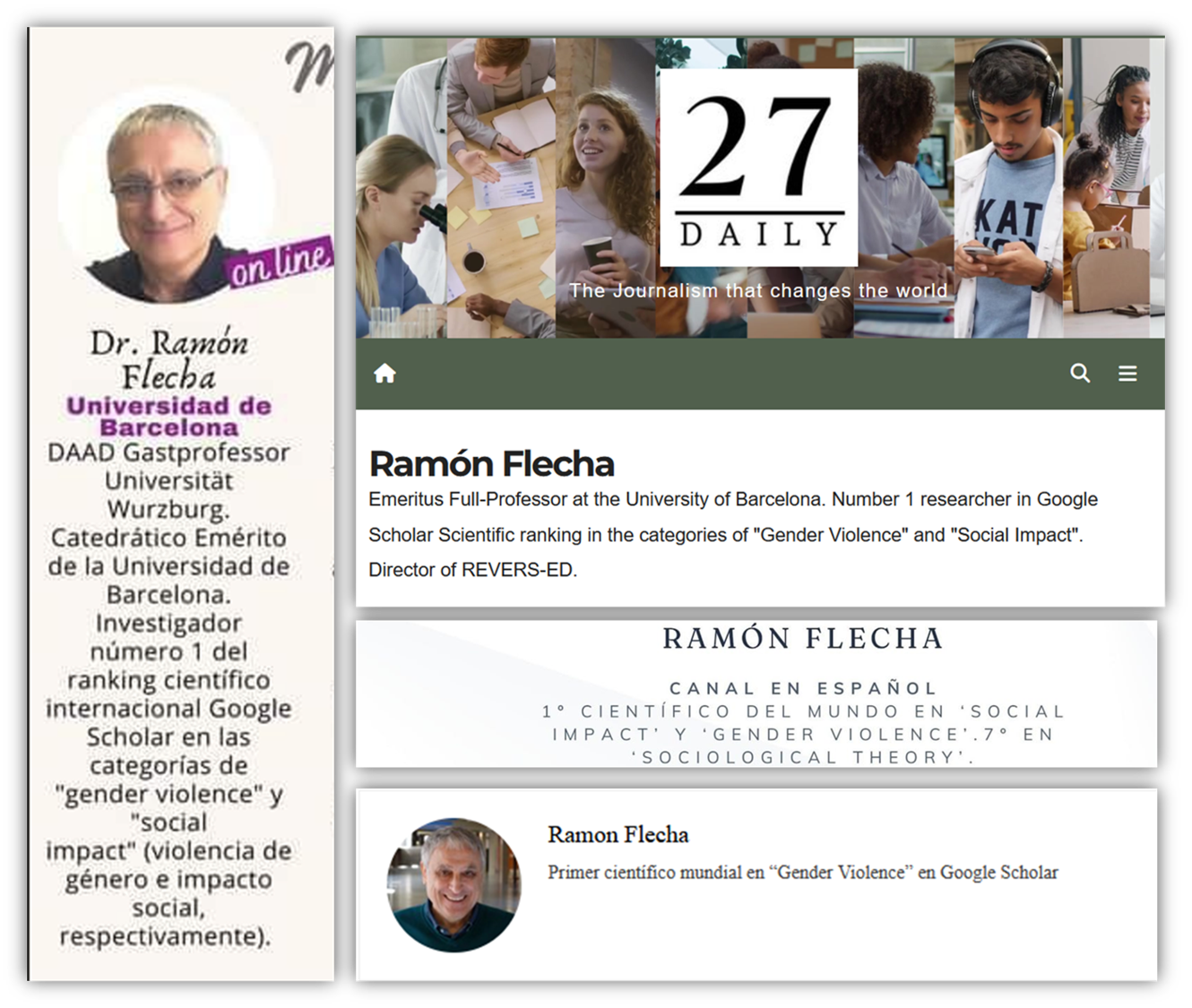
Flecha, who in recent years has publicly and repeatedly presented himself as the “number one in the world in gender violence [sic]”[1][2] (Figure 1), has maintained continuity as a professor at the University of Barcelona since the 1986–1987 academic year. In 1991, he founded CREA under the name Center of Research for Education of Adults, a group of which he formally served as director until September 2006. At that time, he was compelled to resign from his position following a formal request from the then President of the University of Barcelona, who warned him that CREA’s internal functioning up to that point could potentially be unlawful (Bolaños, 2025a). This request was issued after various complaints submitted by former group members in 2004 had been examined, a process that included the production of a report dated May 2005.
Figure 1
Ramón Flecha using the false credential of “World’s Leading Scientist in Gender-Based Violence” across different online contexts
Note. Own elaboration based on various public sources.
As indicated by its acronym in English and Catalan, CREA initially specialized in adult education. Subsequently, roughly at a decade-long rhythm, its name evolved towards more general definitions—while retaining the original acronym—first as Centro Especial de Investigación en Teorías y Prácticas Superadoras de Desigualdades[3], and ultimately adopting its latest official designation, again in English: Community of Research on Excellence for All. The preservation of the acronym from the group’s founding to its self-dissolution in the final days of 2025—spanning 35 years—suggests, at a preliminary level, a branding strategy. Indeed, the anchoring of the acronym becomes inseparable from the evolution of the group’s object, as well as from the redefinition of its subject. Specifically, the group’s object undergoes a progressive generalization (from lifelong learners to all audiences, including individuals experiencing inequality), ultimately diluting the specificity of its original vocation—research on adult education—into much broader concerns. At the same time, the subject of CREA’s actions in relation to these various objects also evolves, shifting from a “research centre” to an enhanced variant (“special research centre”), culminating in its designation as a “research community” until December 2025, when it was legally dissolved[4].
Whether as a “centre,” “special centre”, “community”, or simply a “research group”, CREA has, from its inception, placed strong emphasis on communication. One might assume this to be in order to ensure the dissemination of its work, as is the case for many research groups. However, in this instance, the scope extends far beyond that: as this article will seek to demonstrate, within CREA communication possesses a distinctly strategic character that transcends mere publicity. Its nature is also structural and structuring, rendering communication the foundation of a particular habitus.
Any branding strategy reveals two facets: an internal and an external one, a private and a public dimension (Davies and Chun, 2002). This distinction between interiority and exteriority also frequently appears in descriptions of sects and coercive groups (Bosch, 1993). The analogy might seem inappropriate were it not for rigorous analyses such as that of Fernández-Enguita (2014), who described CREA’s research practices —practices that translate into its public activity— as a “search for data capable of justifying pre-existing convictions, since the desired outcomes have already been decided”, an “exercise in self-satisfied self-contemplation”, or a “happy fairy tale written by self-proclaimed fairies”. The dissemination of its results has been described by the same author as a “fury of evangelization” (Fernández-Enguita, 2014). At the same time, with regard to its internal organization —that is, its private dimension— the group has been directly labelled a “sect” (Jorro, 2024), having already faced two waves of complaints concerning its internal functioning (2004 and 2016) prior to this third wave in 2025 (more focused on sexual coercion by its leader). The University of Barcelona itself has acknowledged that the accounts provided by the complainants “could fit within the possible existence of a highly controlling coercive group”[5]. In a document issued 20 years earlier, the same institution explicitly referred to “practices and behaviors of a sectarian nature” (Bolaños, 2025a). Fernández-Enguita (2026) has further asserted that “CREA is an ideological sect” and that Ramón Flecha is its guru. Moreover, several well-established authors formerly affiliated with CREA had already provided detailed descriptions of the group’s sect-like functioning (Ayuste et al., 2016).
As should be evident, determining whether CREA is or is not a sect is not among the aims of this analysis. First, this is unnecessary, as the group’s historical narrative is already highly revealing in this regard. Second, we consider that dwelling on a question already resolved (or, in other contexts, on a right already established) reflects a conservative stance that is incompatible with social justice, insofar as it fossilizes debate around a surpassed —and therefore no longer valid— issue, ultimately hindering or preventing the discovery of the realities or possibilities that such indeterminacy might otherwise enable. Furthermore, such a stance risks establishing and reinforcing an equivalent level of responsibility between those who present themselves as victims and those who must defend themselves against these accusations, potentially resulting in a tacit alignment with the latter. Additionally, in academic environments —where complainants and the accused remain almost inevitably in contact unless one party, typically the more vulnerable, abandons their career— it is essential to avoid opening the door to power mechanisms that may facilitate reprisals against complainants, a concern already expressed by the latter in this case (Bolaños, 2025a).
We perceive in Flecha’s narrative a clear intention not merely to fossilize the debate over whether CREA constitutes a sect, but to revert to it, despite the fact that such a debate has long been surpassed. In light of judicial rulings, internal documents from the University of Barcelona, and numerous widely disseminated testimonies over the years, we are in a position to assert not only that CREA constitutes a sect in the sense of a coercive group, but above all that Ramón Flecha is its guru. Revisiting this debate would therefore only serve to undermine the rights of complainants and to reinforce Flecha’s protection under the clear shield provided by the unregulated status of sects in Spain (Pacheco, 2026a), of which Flecha must be fully aware given the numerous legal proceedings —most of them documented in Bolaños (2025a)— that have not yielded outcomes favorable to his interests. Finally, focusing on the sect as such risks subsuming individual responsibilities into a collective framework, thereby diluting them. Indeed, since the second wave of complaints, Flecha has actively sought to do precisely this, alongside frequent diversionary tactics (Bolaños, 2025a). Of course, recognizing CREA as a consolidated sect and Flecha as its guru also entails acknowledging his considerable capacity to exert manipulation over individuals —predominantly young women— as well as the existence of beneficiaries of this complex coercive structure. These beneficiaries, mostly men, arise from the need to control expanding domains that exceed Flecha’s direct capacity. It is also worth noting that at the time of CREA’s dissolution in late December 2025, 84% of the most precarious academic positions were held by young women (Bolaños, 2025a).
Ramón Flecha deserves to be judged with full procedural guarantees in accordance with the Spanish legal system, which may result —as has thus far been the case— in his unusual leadership of CREA not leading to criminal consequences. However, such guarantees must also extend to the complainants, which cannot be ensured when the sect is analyzed solely as an end in itself. Its unregulated status may serve to cloak the organization in opacity, concealing potentially criminal activities within.
Judging Flecha with full guarantees also entails considering CREA as a possible means, as numerous other cases suggest that sects are conceived, structured, or used as instruments for the commission of offenses, particularly those involving sexual abuse (Dayan, 2018). Indeed, in sectarian environments, sexual abuse often appears normalized, insofar as women report having given consent that is, evidently, called into question by their membership in such groups (Dayan, 2018).
Although we cannot address here the conceptual framework developed and sustained by Flecha, it must be acknowledged without equivocation that his insistence on developing concepts related to sexual violence —such as consent itself— requires thorough investigation, given that such concepts might serve to whitewash the practices attributed to him, should they prove to be accurate. Likewise, as a preventive measure, we consider it necessary to activate appropriate mechanisms to suspend the dissemination of these concepts across academic spaces until the nature —criminal or not— of the acts attributed to Flecha has been clarified.
The analyses developed in the following pages suggest that Flecha may have been preparing to confront future allegations of sexual abuse, that is, he anticipated them and sought to neutralize them through human, material, legal, and cognitive structures, many of which appear to have been specifically constructed for this purpose. Put more plainly, as explicitly stated in its title, this work seeks to account for Ramón Flecha’s rational and structured pursuit of immunity through a particular form of communicative action governing CREA both internally and externally. This does not, under any circumstances, constitute an assertion on our part that Flecha committed any of the offenses attributed to him. The pursuit of immunity in a given domain may respond to reasons unrelated to the commission or planning of criminal acts.
The Strategic Role of Communication in CREA
The communication strategy implemented by CREA and fed by Flecha through his discourse serves, on the one hand, to standardize—through repetitive affirmation—the group’s staging. This staging draws attention both for its orchestration and for the extraordinary degree of public exposure to which its members are subjected. Whether in a conference presentation, teaching at any level, a journalistic interview, a social media interaction, or an academic or popular publication, it is easy to observe the widespread reproduction of patterns. These include, for instance, boasting of intellectual or personal proximity (in Flecha’s case, these two elements are frequently conflated) to certain international figures —always the same (Apple, Habermas, Freire, Merton, Beck, Giroux, Butler, Touraine, Searle)— or repudiating, sometimes in defamatory terms, others, typically (and this nuance is important) those who are already deceased (Foucault, de Beauvoir, Arendt, Heidegger, Bourdieu, Althusser, Ausubel), except when they are Spanish (Trilla, Fernández-Enguita). This is commonly carried out through the creation of a transcendental atmosphere, also distinctive of CREA, within which the supposed closeness to certain figures and the rejection of others function as arguments from authority to project an allegedly irreproachable personal conduct. Even Sari Hanafi (2025), a Syrian-Palestinian sociologist who traditionality presents himself close to CREA[6], has openly criticized this stance in his review of The Dialogic Society (2022), promoted by CREA and Flecha himself —who, incidentally, count its free downloads as “readings,”[7] presenting the work as the masterpiece of a genius:
Flecha considers the case of a mismatch prompting people to differentiate between art and artist, or “the author’s works” and “the author’s life,” respectively. He criticizes such separation, using the example of Michel Foucault, who, according to Flecha, ‘defended the depenalization of pederasty and rape’. Likewise, Anthony Giddens moved from being a sociologist to being a politician supporting Blair’s ‘third way,’ which ‘ended in failure politically and intellectually.’ […] In the same vein, he criticizes Althusser, who strangled his wife. All these critiques are calls not to engage with the work of these scholars. I think this issue is much more complex, as I cannot establish a direct correspondence between the author’s thoughts and the author’s life. We need to acknowledge that scholars have positionality, inducing some blind spots, and strive for power, and in both cases, we need to reveal this and not throw away their thoughts entirely. (Hanafi, 2025, pp. 103-104).
Hanafi is mistaken in suggesting that Flecha is merely appealing to the discrediting of these authors on the basis of their alleged personal shortcomings. What Flecha actually does operates on a much deeper level, beyond the apparent simplicity of the maneuver: he dissolves the boundary between the personal and the intellectual until the two become equivalent. Indeed, the procedure is rather rudimentary: when unable to refute a significant author’s argument, he delves into their past in search of questionable conduct, at times distorting it or —even— fabricating it when necessary. This, to some extent, shields him within the academic field, as any critical analysis of his work is compelled to take into account this very mechanism (as is being done here), which runs counter to fundamental principles of intellectual inquiry. Thus, when he asserts that Ulrich Beck was a great sociologist, he is also implicitly asserting that Beck was a morally exemplary individual. Likewise, when he widely publicizes his status as the world’s leading scientist in gender-based violence (Figure 1), he simultaneously equates this claim with his presumed personal integrity and incorruptibility regarding such matters.
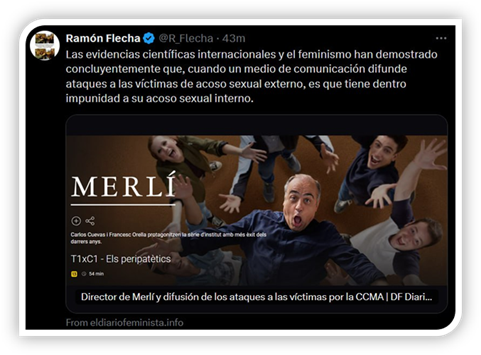
This gives rise to a derivative claim: anyone who questions Flecha or CREA does so in order to conceal precisely that which motivates their critique, or something of comparable gravity. This constitutes a clear procedure for attaining immunity, what Flecha has displayed extensively, particularly during the year spanning the last mass departure of CREA members in the summer of 2024 and the publication of the latest wave of allegations in 2025. In October 2024, Flecha published a convoluted tweet targeting TV3 (Figure 2), in which he used allegations of sexual harassment against Eduard Cortés, director of a series produced by that network, as “evidence” that the broadcaster —having covered a previous wave of allegations against Flecha nearly a decade earlier, prompting an unsuccessful lawsuit on his part— was attempting to mask its own internal sexual misconduct issues.
Figure 2
Flecha’s tweet targeting TV3 in relation to the allegations against Eduard Cortés[8]
Some days later, journalist Ignasi Jorro (2024) expressed his astonishment after covering a CREA event ostensibly in defense of children:
During the presentation, it was repeatedly asserted that anyone linking CREA to a sect is a child abuser. Yes, you read that correctly: Flecha’s research group used the presentation of a philanthropic association to attempt to launder its image. […] At the end of the event, and out of respect for those present, I approached Ramón Flecha, introduced myself, and asked whether he would grant us an interview in a neutral setting with full transparency. Angrily, almost beside himself, he refused, raising his voice and telling me that “he does not speak with accomplices of aggressors.” In doing so, Professor Flecha inadvertently revealed the true nature of the event: CREA will label as abusers and harassers anyone who questions its research methods.
Jaume Trilla satirizes this pattern in Flecha’s discourse through one of his recurrent pseudo-concepts of self-immunization: “second-order harassment,” which effectively means “if you criticize me, you are a sexual harasser” (Trilla, 2025).
This immunological armor has clear deterrent effects on current complainants, as Flecha commonly involves CREA members in his personal campaigns, for instance, his ongoing crusade against Michel Foucault, who has been “unable” to respond for 42 years[9]. While all CREA members are, of course, adults, none of the ten signatories to the article referenced in the corresponding footnote would find it easy to accuse Flecha of pedophilia —even if justified grounds existed— largely because they have themselves signed texts condemning it through Flecha’s own pseudo-arguments. This situation is entirely consistent with the group’s orchestrated response following the publication of the latest allegations in July 2025: Flecha, as guru, and his sect, CREA, reacted in unison, without dissenting voices, by imputing criminal conduct to former colleagues who had come forward as complainants. In short, the degree of immunity attained by Ramón Flecha is such that only “criminals” could conceivably accuse him (the irony is intended).
Returning to staging as an integral component of CREA’s communication strategy, it is worth noting the creation and maintenance of a particular atmosphere, accessed through the formalization of “communicative action” via specific standards: adherence to an internal dress code, use of uniform discursive genres, a consistent tone of voice, the deployment of a form of newspeak (Trilla, 2025), the imposition of criteria reinforced through arguments from authority, and reverence for CREA’s foundational myths—frequently substantiated by those same myths. All of these elements, but especially the myths (to which we will return later), enable CREA to project itself into the future in a particular manner; in other words, they perform a structuring function.
It is the second time I use the term “structuring,” and I assure the reader this is not an attempt to avenge Bourdieu. Rather, it refers to the unilinearity along which CREA’s discourse unfolds and develops. Indeed, this unilinearity—which is readily apparent and would, one might suggest, have delighted nineteenth-century evolutionary anthropology (the same tradition that served to “legitimize” colonialism through the “optimization” of coercion via new forms of symbolic and administrative domination) points to the existence of a single, univocal discursive subject.
In the realm of large organizations, studies such as McGrath-Champ & Rosewarne (2009) have associated unilinear discourse with models of industrial production management based on corporate restructuring, entailing the devaluation of interorganizational relations.
Although CREA has concentrated processes that might be described as industrial-like within a small number of individuals[10], the group cannot, strictly speaking, be considered an industrial organization, nor even a conventional research organization. Consequently, its unilinear discourse cannot be attributed to production management. Rather, CREA’s unilinear discourse expresses an informal mode of governance that intrudes into the domain of spontaneity and is, moreover, markedly authoritarian. It is structuring insofar as it ensures that members collectively sustain and project their spontaneous interactions according to a single valid model, that is, a univocal framework.
We thus return to a crucial issue: one of the most significant achievements of CREA’s leadership is the blurring of all boundaries between the public and private spheres. This has far-reaching consequences, including the homogenization of socialization practices necessary for integration into the group[11], the absence of a need to reconcile personal and professional life among its members[12], and the already noted inseparability of the personal and professional in academic readings of other authors[13].
The organization of a unilinear and univocal discourse oriented toward the future requires that such a future be projected in advance, thereby enabling the pursuit of a strategy with defined objectives. It must also draw upon a source of legitimacy (in CREA’s case, as will be shown, the recurrent invocation of the “International Scientific Community”). However, the successful implementation of such a strategy necessitates a robust scaffolding capable of channeling foreseeable individual divergences, particularly given that academic groups bring together different generations and rhythms in the performance of a relatively autonomous activity such as research. At its peak, CREA comprised more than 70 members (Bolaños, 2025a), alongside a considerable floating membership.
This scaffolding must possess both material and immaterial dimensions in order to ensure a controlled communicative deployment across the many individual actors within the group, even if such deployment ultimately occurs, metaphorically speaking, through a “narrow channel.” In CREA, the material scaffolding is provided by the dense network of organizations established by Ramón Flecha to orbit around the group[14], while the immaterial dimension is cognitive in nature and rests fundamentally on myths. In this respect, Flecha is not incorrect in claiming that his model draws upon “communicative action”.
An appropriative discourse once again culminating in immunity
CREA’s public discourse cannot be spontaneous, and indeed it does not appear to be so. Nor does it diversify over time into a plurality of opinions, initiatives, leaderships, or theoretical or methodological alignments, contrary to what would be expected of any research group whose trajectory extends long enough to leave a discernible imprint.
Rather, it is a univocal discourse, characteristic of a cult, which does not claim legitimacy through argumentation expressed in professional jargon or similar means; instead, it asserts privileged access to a source of revealed truth, and thus allegedly incontestable, through such ethereal constructs as the “International Scientific Community,” which is said to produce “international scientific evidence” —a distorted use of the term (Fernández Enguita, 2014)— that would, strictu sensu, consecrate practices such as “successful actions,” which in turn allegedly lead to the self-congratulatory notion of “social impact,” among other fanciful obsessions[15].
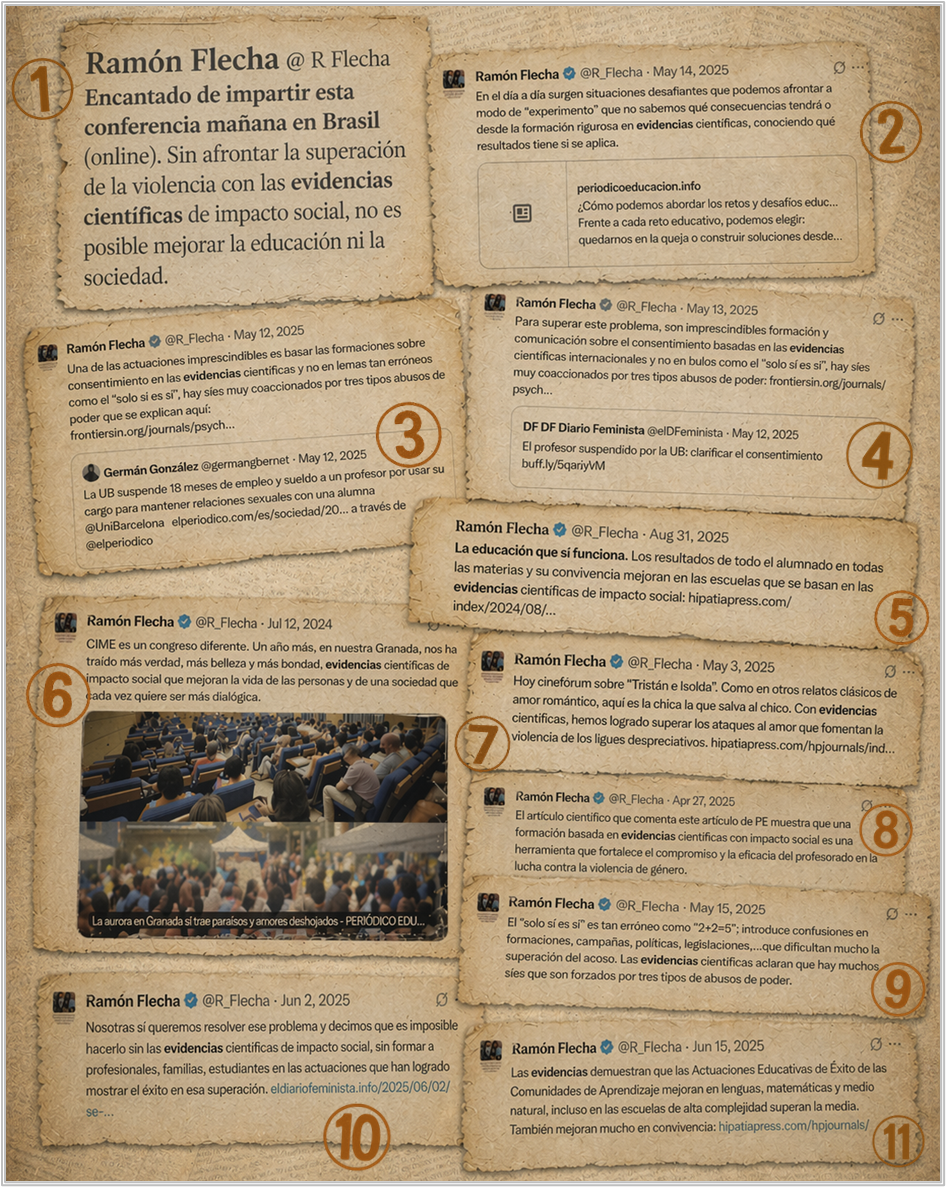
The analysis of the publications included in Figure 3 reveals several circular argumentative mechanisms employed for apparent purposes of proselytism and the dissemination of slogans through Twitter, one of the group’s preferred channels. As can be observed, there is a proliferation of tweets in which “scientific evidence” is introduced not only as a means to achieve improvements (2, 5, 6, 8, 11), but as the sole remedy in response to issues framed through negative conditionals of the type: “If such a problem is not addressed in such a way, then a more or less apocalyptic scenario will persist” (1, 3, 4, 7, 10). Rhetorically, the use of negative conditional constructions serves to introduce the remedy —namely, the purported scientific evidence— thereby prompting questions regarding where such a remedy is held and the procedures through which it is produced. From this, it can be inferred that whoever possesses and is able to generate this remedy assumes a providential role in resolving or addressing the problem.
Figure 3
Non-exhaustive collage of tweets on “scientific evidence”[16]
This technique is similar to those widely used in persuasive advertising, such as those derived from fear appeal theory (Williams, 2012), in which a hypothetical negative consequence is presented (in this case, by means of a communicative act analogous to an advertisement) and potential audiences are then directed toward the “solution,” with a single authoritative voice acting as guarantor of both the problem and its resolution (one might think of the typical toothpaste advertisement featuring a dentist introduced by surname and preceded by the title “Doctor,” prominently displayed as a marker of authority). The solution rhetorically adopts the form of a recommendation but is grounded in a previously posited negative consequence, all endorsed by an authoritative voice; thus, it may more accurately be described as a prophecy countered by an exhortation. This maneuver can be explained in terms of variation in illocutionary force within directive speech acts (Searle, 1976).
Although Flecha’s strength does not lie precisely in the theoretical appropriation of other authors[17], Searle is indeed among those he references. In this case, it is evident that the escalation toward providential roles —what Trilla (2025) situates within a “Ministry of Truth”— is considerably more subtle than in advertising discourse, given that CREA addresses real social problems of great complexity, which need not be artificially constructed and whose scale renders them difficult to attribute directly to any single agent.
The providential role assumed by Flecha in his tweets would confer upon him a certain degree of immunity, insofar as these publications place him, at least ostensibly, at the opposite extreme of complicity in, or participation in, the very problems his “scientific evidence” claims to solve. It should be emphasized that among these issues are recurring themes such as sexual consent (3 and 4), sexual harassment (9), gender-based violence (7, 8), and abuses of power (3, 4, 9), precisely the kinds of conduct for which he would shortly thereafter be accused by sixteen complainants, most of whom had left CREA only a few months earlier (Bolaños, 2025b)[18]. It does not seem unreasonable to consider that Flecha may have been fully aware that such tweets could have an exculpatory effect in the face of potential accusations, an eventuality he would, in that case, necessarily have contemplated. Nor does it seem implausible that the complainants themselves perceived these publications as actions capable of providing Flecha with a form of immunity, with the resulting deterrent effect this may have entailed.
CREA members —primarily young female academics— together with Ramón Flecha himself dominate global historical tweet search results when terms —in Spanish— such as “evidence consent”[19] are entered into the platform’s search engine, with somewhat lower but still notable visibility for searches including “evidence gender-based violence,”[20] “evidence harassment,”[21] and “evidence abuse of power”[22] (in the latter two cases, tweets originate almost exclusively from Flecha’s account). A similar pattern emerges on social media platforms more oriented toward personal and private interactions, such as Facebook. When a global search is conducted using the term “scientific evidence”[23] on this platform, the results are predominantly posts by Ramón Flecha, either from his personal account or as administrator of the group “Actuaciones Educativas de Éxito – Comunidades de Aprendizaje”. When the search is further refined to include additional terms —such as “scientific evidence sexual consent”[24]— the outcome remains the same, though with a predominance of posts referring to child sexual abuse.
A circular machinery of “knowledge” legitimation
What has been outlined above would largely go unnoticed if these scientific evidences were actually available. As noted, however, they are promoted to such an extent that they manage to overshadow, in media terms, publications external to CREA that prioritize similar terminology. We use the term “promoted” advisedly, because when one attempts to locate these evidences, requests them directly from the group, or inquires about the conditions under which they were produced, the responses systematically refer back to a kind of closed circuit entirely owned by CREA. Fernández-Enguita (2014) dismisses CREA’s “evidence” outright, emphasizing that it stems from “little more than a few conveniently selected readings, superficially read tables, or a couple of small ‘heroic’ schools that they themselves promote [Learning Communities].”
As illustrated in the lower section of Figure 4, this closed circuit —or local network— connects a series of nodes corresponding to CREA’s pseudo-media outlets[25]. The channels linking these nodes are the various platforms and social networks in which the group maintains an active presence (Twitter, YouTube, Facebook, Instagram…). Once encapsulated, the evidences are intensively and frenetically circulated within these channels, to the point of monopolizing them, as has already been observed in other domains of the internet. Within this system, the role of the nodes (Diario Feminista, Periódico Educación, Daily27, Kaiera) is twofold: to safeguard the evidences and to attest to their existence, before disseminating them outward. They also contribute to reinforcing the legitimating role of science in relation to certain figures, particularly Ramón Flecha, to whom publications are sometimes devoted that are compatible with what may be described as a cult of personality[26].
Figure 4
Circular Dynamics of “Knowledge” Legitimation in CREA
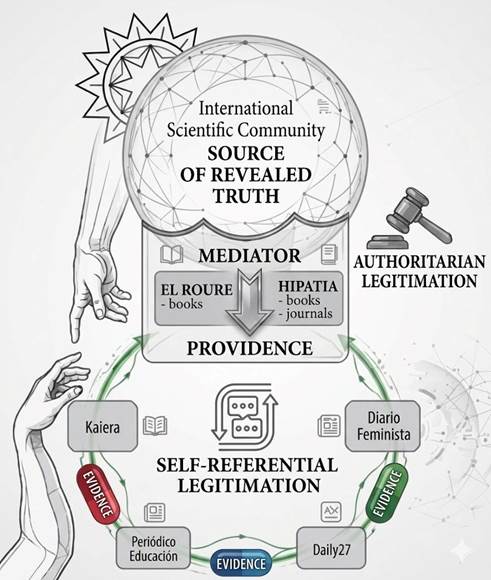
The role of CREA’s pseudo-media does not end there. The metaphor of encapsulation is introduced to illustrate the fact that no one outside CREA has access to these evidences and, therefore, cannot verify whether they actually exist. Yet the encapsulation to which they are subjected allows them to be invoked—especially in short-form messages such as those on Twitter—while their presence in pseudo-media outlets, despite marginal levels of readership, enables them to be referenced and amplified through the very channels that sustain the circuit. Another strategy for closing the circuit consists in republishing in one pseudo-media outlet articles originally published in another[27], thereby suggesting the possibility of relaunching older publications authored by current complainants, with the potentially deterrent effect that this entails. In this way, in the absence of direct access to the alleged evidences, the perception of their circulation becomes, for the general public, the best proof of their existence. Moreover, by using digital platforms as channels, these evidences are kept in perpetual motion precisely where they ought to be subject to replication. The absence of replication confers upon them a conclusive character, and they are therefore commonly transformed into arguments from authority—something CREA frequently exploits.
In reality, the only way to receive CREA’s “scientific evidence” from outside the group is through faith in it. For this reason, we argue that CREA’s closed-circuit communicative machinery functions fundamentally as a generator of belief, paradoxically relying on science as a pretext for its alleged veracity. CREA’s myths are designed to be assimilated through faith, which renders them non-replicable: Flecha is purportedly persecuted and subjected to three waves of allegations because of his unwavering commitment to combating gender-based violence, and this assertion is presented as final.
A key element in maintaining the closed circuit is intragroup discursive self-referentiality, leading us to speak of self-referential legitimation. Thus, the absurd self-immunizing concept of “isolating gender-based violence,” which portrays Ramón Flecha as a victim of gender-based violence on the grounds that he allegedly “protected” women from harassment and sexual abuse (many of whom are now among his accusers), is established within this closed circuit through testimonies from CREA women. These testimonies circulate through CREA’s own channels and are disseminated outward via its pseudo-media outlets. A similar process applies to the concept of sexual consent, although, for obvious reasons, CREA has not been able to fully appropriate it. More generally, it can be observed that concepts promoted by women within CREA serve to shield Flecha from the very behaviors for which he is later accused. Regardless of whether these accusations lead to criminal consequences, CREA has developed an extensive apparatus of immunity for its leader, one that spans multiple domains.
The upper section of Figure 4 aims to illustrate the conditions under which “evidences” are produced within CREA’s worldview, as well as the processing that allows them to feed into the lower circuit described above. At this level, it is no longer appropriate to speak of a circuit, but rather of vertical directionality. The “International Scientific Community” is a recurring entity in CREA’s discourse. Its configuration is ethereal and diffuse, reinforced by an imprecise geographical anchoring, often associated with major institutions in the Anglophone world. Yet this very ambiguity facilitates its constant invocation by CREA as a figure of authority, as though its existence were embedded within a form of mystical theology: the “International Scientific Community” is thus presented as unknowable, seemingly inaccessible through positive concepts and instead defined through negations —that is, by emphasizing what it is not— thereby becoming, precisely for this reason, a source of revealed truth.
At this point, the question is not so much who legitimizes these processes —since all revealed truth entails authoritarian legitimation— but rather what kinds of interconnections exist between this mystical realm, where evidences are produced, and the earthly world in which they must be reproduced in order to acquire meaning.
It is not the purpose of this article to determine whether the relationship between Ramón Flecha and the “International Scientific Community” is mystical or transcendental in nature. What can be observed, however, is that the group often treats prominent scientists almost as deities. Figure 5, for example, shows several posts on Twitter and LinkedIn celebrating, with considerable enthusiasm, the fact that Katalin Karikó —recipient of the 2023 Nobel Prize in Physiology or Medicine— once gave a simple “like” to a post about the book The Dialogic Society on another platform, Instagram. Some of these posts include a photograph of Flecha alongside the scientist. Judging by the dates of the posts, the celebration lasted more than a month. The episode, shared, celebrated, and repeatedly revisited primarily by CREA members, exemplifies the dynamics of self-referential legitimation described above. Be that as it may, while Karikó’s sociological knowledge is unknown, her contributions to biochemistry are well established. It is not difficult to imagine Flecha first requesting the photograph and then encouraging her to provide the “like,” possibly invoking his credential as the “World's Number 1 in the Google Scholar ranking in Gender Violence [sic]” (Figure 1). The scene might even elicit a smile were it not for the fact that Flecha has been widely accused of abuse and sexual coercion. In any case, the anecdote offers insight into the existence within CREA of a communication strategy oriented toward vertical legitimation, as well as, once again, the pursuit of immunity, this time through proximity to, appropriation of, or direct immersion in a source of authority.
Figure 5
CREA posts related to Katalin Karikó[28]

As in other monotheistic cults, the fundamental challenge lies in connecting the celestial and the earthly realms, a task that requires more than a mere vehicle. In some such systems, this problem is resolved through the introduction of a mediating institution. A similar solution appears here, with CREA positioned as that mediating institution and Flecha, its uncontested leader, as the sole legitimate representative of the “International Scientific Community” within the field of education in Spain. His role as exclusive representative is reinforced by his “scientific” publications, while the bidirectional flow between realms is facilitated by control over in-house publishing structures capable of generating ad hoc concepts —such as the aforementioned “isolating gender-based violence”— that serve to shield him from the alleged practices for which he now stands accused (let us recall that Flecha is widely accused of abuse in his everyday conduct).
In this way, Flecha asserts himself as a full-fledged member of the constellation represented by the “International Scientific Community,” descending, when necessary, into the Spanish educational reality already cast as a providential figure. Trilla (2025) directly links the self-referentiality of the lower level to membership in the “International Scientific Community.” As if this were not sufficient, Flecha also assumes a providential role in the personal and social domains, since —within this framework— theories endorsed by the “International Scientific Community” are taken to prescribe such a role. The principal advantage afforded by his position as sole mediator is the centralization of power around his figure in the earthly realm, a dynamic openly displayed within CREA and eloquently described by Foucault (1975) in Discipline and Punish through the metaphor of the panopticon. The centralization of power entails its concentration, and this circumstance is decisive in diminishing the capacity of victims or witnesses of potential abuses to perceive them as such, potentially leading them to interpret abuse as a form of privilege. Within this framework, once again, the providential role confers immunity.
The theological parallels do not end there: within CREA’s worldview, a realm of darkness is also delineated, a falsified “International Scientific Community,” allegedly governed by representatives (the familiar repertoire cited above) of bad science in general and bad sociology in particular. This construct serves to expand the scope for psychological control.
Medieval rhetorical mechanisms (anti-scientific, anti-democratic, estamental, mythical) for the attainment of immunity
What one would expect from a group that relentlessly expresses its intention to monopolize the scientific evidence that would legitimize its methods is that it would privilege epistemological relations with those who are to engage with such evidence. However, it does not appear that Flecha experiences any ambiguity regarding the boundaries between epistemic reason and faith, as was already the case in the nineteenth century for genuine thinkers —albeit less “familiar” with empirical data— such as Kierkegaard. Indeed, what CREA proposes falls short even of a theological reason, as it does not even begin from revealed truths that must be accepted prior to being understood, something which, in any case, would already be highly problematic within a university context. CREA merely presents itself as the custodian of these —by now evidently highly questionable— scientific evidences, as though they constituted revealed truth. From this follows an ambition to monopolize the legitimacy required to transform the world in a specific direction[29], which in itself constitutes an ideological rather than a scientific project. This characterization is fully consistent with Fernández-Enguita’s (2026) description of the group as an “ideological sect,” with which we entirely concur. In the face of such ambitions, it would seem that the rest of us are left only with the option of having —and demonstrating— faith in the “scientific evidence produced by the ‘International Scientific Community’ and safeguarded by CREA,” under threat of severe sanctions for questioning it, such as harassment and public shaming[30]. Moreover, although Flecha frequently portrays himself as the victim of an inquisitorial persecution[31], it is no exaggeration to state that CREA’s reprisals against voices deemed hostile take on the form of a kind of autos-da-fé.
As the sole custodian and mediator of revealed truth, CREA also asserts itself as an estate, which gives coherence to its characteristic classist discourse, consistently grounded in “international” arguments from authority. This suggests that the entity referred to as the “International Scientific Community” is composed of other CREA-like groups, thereby inaugurating a policy of territorialization. This feature is essential for understanding CREA’s expansion strategy, without which the group could not have persisted for three and a half decades.
“Scientific” knowledge is thus rendered unquestionable, as it is presumed to derive from a source of revealed truth mediated exclusively by CREA. In doing so, the group implicitly advocates for an estate-based social order that stands in stark opposition not only to the university as an institution, but also to democracy and to any notion of public service. At the same time, it claims the right to impose itself authoritatively through procedures that are, moreover, profoundly anti-scientific. Such a description bears little resemblance to that of a university research group and instead corresponds closely to that of a church, that is, a cult, specifically a monotheistic one, highly institutionalized through doctrines, sacraments, rituals, and norms, embedded within a proselytizing machinery that exploits —while distorting— the powerful channels for dissemination made available by the information society.
Unlike in feudal societies, in an information society the monopolization of a set of concepts —regardless of their validity— requires the activation of mechanisms capable of forming and consolidating a privileged estate. The “struggle against feudalism” is a recurring motif in Ramón Flecha’s work, offering yet another opportunity to test the predictability of one of the many lost causes present in his discourse. In our view, the hypothesis is more than plausible: by virtue of its anti-democratic, anti-scientific, and elitist orientation, and its clear estate-like aspirations, CREA behaves more like an institution of the Ancien Régime. We again turn to The Dialogic Society (2022), a 171-page work in which Flecha reiterates his historical allusions to feudalism. For instance:
- “Before the expansion and democratization of ideal love, women were obliged to engage in sexual relations (right of the first night) with the feudal lord of the territory; only thereafter could they marry” (p. 39).
Beyond displaying a deficient historical reasoning (presenting the Middle Ages as though it were characterized by a form of globalization akin to that of contemporary societies), this passage constructs a false opposition. The objective appears clear: to insinuate the “scientific” validation of a doctrinal concept of CREA (“ideal love”) through hyperbolic contrast with something that provokes strong rejection yet is itself fallacious, in this case, a pseudo-historiographical concept (the “right of the first night”). The choice of this pseudo-concept does not seem incidental, as it situates in a temporally distant context —the Middle Age— a reality that, as historian Ana Ortega Baún shows, has clear contemporary parallels: in present-day society, the “right of the first night” refers to “men who use their position to obtain sexual favors from their subordinates” (2013). Here, this phenomenon is not only relegated to a distant past, but CREA also rather casually claims responsibility for its alleged eradication[32]. One might argue that it would have been far more honest to acknowledge that such practices persist, and that the most compelling evidence of this lies in the testimonies of the women who now accuse Flecha of sexual abuse. Moreover, there is no solid evidence —only tenuous indications— that the historical form of the practice described by Flecha ever existed with any degree of regularity (Ortega, 2013). What Flecha proposes, once again, is the “scientific” validation of an ideologized concept that would exculpate him from future allegations, by contrast with a widely circulated but unproven myth.
In another passage, he asserts that meritocracy “partially overcomes sexual harassment and the mediocrity of feudal evaluations” (p. 98), adding that “the feudal critique of meritocracy is governed by harassers and mediocre academics” (p. 99).
- “Feudal powers, such as the Catholic Church, imposed geocentrism. Copernicus’s contribution was to demonstrate that mathematical calculations based on the Sun being at the center coincided with empirical observations of the movements of celestial bodies” (p. 59).
- “The conflict was not between scientific and religious individuals, as Copernicus himself was both. Rather, it was between science and a feudal conception of religion that denied and attacked scientific discoveries contradicting its interpretations of sacred texts” (p. 60).
Major scientific figures such as Copernicus are recurrent in Flecha’s discourse, as he persistently presents himself as a scientist capable of transforming the world[33], thereby positioning himself as a target of persecution by reactionary sectors. In this instance, the opposition between Copernicus and the religious intolerance of his time appears transposed onto a resolute Flecha besieged by figures of the “feudal university,” which indirectly serves to immunize him against accusations of reproducing feudal behaviors, such as positioning himself as the guru of a sect.
- “Not a single feudal lord of Spanish sociology dared to present any argument, yet the FES[34] continued to censor the debate” (p. 98).
Another rhetorical mechanism compatible with the pursuit of immunity consists in defining one’s adversaries —generally men— by the very traits against which immunity is claimed through opposition. In Flecha’s case, this mechanism extends well beyond the domain of feudal practices.
As might be expected, Ramón Flecha is also a staunch defender of mythic thinking. In The Dialogic Society, for instance, he criticizes the association of the “word ‘myth’ with falsehood” (p. 15). At that point, I took the liberty, elsewhere, of expressing my disagreement with the individual who once presented himself as the world’s leading expert in gender-based violence: mythic thinking is premodern and therefore incapable of grounding equality, while serving effectively to sustain privilege (Del Río and Pacheco, 2023). Indeed, within a knowledge society, myth operates as a cognitive instrument that enables regression toward a mode of reasoning grounded in privilege, as opposed to the right to participation.
CREA deploys an extensive array of myths (Figure 6 provides only a few examples), many of which are retrospectively presented as foundational while being continuously adjusted for convenience. These myths are frequently invoked —once again— as proof of immunity against various types of accusations[35]. They also function as mechanisms for preventing allegations of abuse (due to their deterrent effect on potential complainants) and, more broadly, serve to redirect the group’s past trajectory as needed. Furthermore, they enable the implementation of organized actions that would protect Flecha from potential accusations. The most striking example is likely Me Too University[36], a movement ostensibly aimed at combating sexual harassment in academia, which remains under the complete control of CREA and has historically functioned as a protective shield for Flecha, while exerting a significant immobilizing, intimidating, and deterrent effect on those presenting themselves as his victims. Thus, a group like CREA —which between 1991 and 2002 did not publish a single significant article on gender-related topics, reaching only 10 by 2008 and 15 by 2011 (equivalent to approximately 0.75 articles per year since its founding, increasing to a modest 1.5 per year in its second decade)— at a certain moment begins to introduce myths abruptly through its dissemination channels (Figure 6):
- an alleged complaint (claiming to be the first) of sexual harassment in a university, supposedly filed by Ramón Flecha in 1995[37];
- the first survey on gender-based violence in universities, conducted by CREA; the first protocol against sexual harassment in Spanish universities[38];
- a CREA member allegedly winning the first such case in a Spanish university[39];
- a CREA leader who publicly presents herself with the “credential” of participation in the 1976 Catalan feminist conferences[40], as well as “principal investigator of the first R&D study on gender-based violence in Spanish universities”[41]. This last case is particularly noteworthy, given that this professor did not publish her first significant article on gender until 2007, despite having completed her doctoral thesis in 2000, suggesting a kind of retroactive feminist positioning.
Figura 6
Introduction and dissemination of myths in CREA
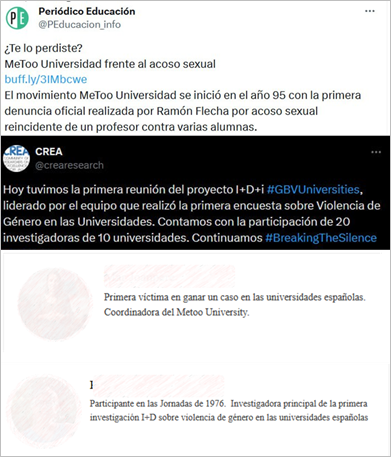
Based on CREA’s narrative, one might assume these are opportunistic myths, and therefore devoid of real foundation. However, this issue lies beyond the scope of the present analysis, mainly because little would change if they were proven accurate. What is relevant for future research is to determine the role of these myths within CREA’s discourse, the conditions of their production, their modes of transmission both within and beyond the group, and, above all, the political intentionality underlying them, particularly the timing of their introduction and dissemination, given the importance the group places on persistently overlaying its actual trajectory with a specific pattern that confers a monolithic identity upon its members (which has, in recent times, suddenly become feminist).
Certain classical authors readily address the preliminary aspects of this analysis, although further development must be reserved for future work. Cassirer (1946) examines the extent to which modern political myths replace rational argumentation with closed narratives that legitimize power and neutralize critique, presenting the “technique of political myth” as a means of governing without debate. Barthes (1957) links the production of myths to depoliticizing discourse, capable of transforming historical constructs into naturalized realities, thereby rendering them irrefutable (his well-known assertion that “myth is a form of speech that steals history” appears almost prophetic in relation to CREA, as it highlights how symbolic authority can lead to coercion that suppresses dissent). For Arendt (1951) —an author consistently rejected by CREA[42]— internal mythic coherence eliminates the need for persuasion by embedding itself within closed narrative systems that eradicate space for disagreement. Girardet (1986) demonstrates how myths replace political debate with emotional adherence. Finally, Keum (2025) defines myth as a “narrative opaque to critical scrutiny,” identifying it as a tool of resistance to democratic deliberation.
Conclusions
This study has analyzed the historical narrative of the sect CREA within its communicative project aimed at securing immunity for its leader, Professor Ramón Flecha, in the face of allegations of sexual abuse. Several related issues remain to be explored, such as those concerning the processes of territorialization surrounding CREA, or the problem of sexual consent within the framework of a psychologically coercive group; these will be addressed in future publications. The introduction of myths, as a means of reinforcing the narrative through an unquestionable and unappealable account, likewise warrants further in-depth analysis.
Closely related issues remain unaddressed, including what we have termed “negative prevention,” which would concern the internal development of the CREA brand (this study has focused primarily on its external dimension), and which would amount to the institutionalization of coercion. This would lead us into an examination of psychological manipulation deployed in the guru’s “preventive” defense, that is, without the mediation of formal accusations. This includes the appropriation of social movements such as Me Too University, the creation of “whitelists” of journalists, the harassment of dissenters or individuals not aligned with the CREA cause, the instrumentalization of pseudo-media outlets to denigrate, discredit, and undermine the legitimacy of those considered enemies, and the incitement of adherents (particularly women) to commit illicit acts, an analysis that has been introduced in Pacheco (2026d). The sheer magnitude of the case also necessitates consideration of additional dimensions, such as organizational structure, governance and administration, recruitment, maintenance, transition, and exit rituals, as well as the profanation of democratic institutions, including fraud and corruption.
We contend that our study has demonstrated that CREA, under the direction of its cult leader, pursues a highly deliberate communication strategy aimed at securing his immunity. Its main characteristics include the dissolution of the boundary between public and private spheres, the establishment of standards governing the group’s staging, and the construction of a “realm of darkness” to which dissenters are relegated, accompanied by a simple procedure for identifying them: those who question Flecha or CREA are presumed to do so in order to conceal the very conduct they denounce. CREA’s communication strategy is also deployed in a unilinear manner, shielded by a monological discourse (mirroring the guru’s own monologue), devoid of fissures, nuance, or complexity, unwilling to acknowledge contradictions, deeply dogmatic, unforgiving of criticism, and strongly teleological. Furthermore, we have sought to demonstrate that CREA’s communicative deployment rests upon both material and immaterial scaffolding, which has enabled its long-term sustainability.
With regard to the content of this discourse, our analysis points to a circular cognitive machinery for the legitimation of “knowledge.” This machinery draws not from any defined epistemology but from a source of revealed truth, sustaining itself through cycles of self-referentiality made possible by absolute control over both the nodes and the channels that connect them. It constitutes a two-tier system linked vertically, in which the guru assumes the role of sole mediator with the source of revealed truth —the “International Scientific Community”— a role that translates into a providential authority when projected onto everyday and professional life. This monopolization of legitimate knowledge by the guru, and its recognition by those who sustain the self-referential cycles of reproduction (CREA members), emerges as another clear pathway to the attainment of immunity.
Ultimately, the communication strategy operates at the rhetorical level, promoting among CREA members mechanisms characteristic of premodern societies, that is to say mechanisms incapable of problematizing issues such as equality. In conclusion, CREA’s communication strategy actively contributes to the creation and maintenance of the conditions that legitimize the guru Ramón Flecha’s sexual access to women, while simultaneously projecting outward an interpretive framework aligned with this purported legitimacy.
References
Arendt, H. (1951). The origins of totalitarianism. Harcourt, Brace & Company.
Ayuste, A., Cabeza, M. A., Caramé, A., García-Alzórriz, O., López, F., Lleras, J. & Trilla, J. (2016). La comunidad científica universal o “yo me lo guiso, yo me lo como”: el caso CREA de la Universidad de Barcelona. https://afectadoscrea.org/wp-content/uploads/2016/07/SobreAmistadDeseada.2016.pdf
Barthes, R. (1957). Mythologies. Éditions du Seuil.
Bolaños, V. (2025a). Acabar con la impunidad del abuso sexual en la universidad: El caso Flecha-CREA. Revista Internacional de Educación y Análisis Social Crítico Mañé, Ferrer & Swartz, 3(2), 1-54. https://doi.org/10.51896/easc.v3i2.1070
Bolaños, V. (2025b, July 2). Catorce mujeres denuncian ante la Universidad de Barcelona a un catedrático por mantener relaciones sexuales con becarias. RTVE Noticias. https://www.rtve.es/noticias/20250702/catorce-mujeres-denuncian-ante-universidad-barcelona-a-catedratico-por-mantener-relaciones-sexuales-con-becarias/16647067.shtml
Bosch, J. (1993). Para conocer las sectas: Panorámica de la nueva religiosidad marginal. EVD.
Cassirer, E. (1946). The myth of the state. Yale University Press.
Davies, G., & Chun, R. (2002). Gaps between the internal and external perceptions of the corporate brand. Corporate reputation review, 5(2-3), 144-158. https://doi.org/10.1057/palgrave.crr.1540171
Dayan, H. (2018). Sexual abuse and charismatic cults. Aggression and violent behavior, 41, 25-31. https://doi.org/10.1016/j.avb.2018.04.004
Del Río, D. & Pacheco, R. (2023, October 19). Paradojas de la izquierda frente a las lenguas cooficiales. Nuevatribuna. https://www.nuevatribuna.es/articulo/sociedad/paradojas-izquierda-frente-lenguas-cooficiales/2023101914510218351.html
Fernández-Enguita, M. (2014). De la información al conocimiento... pero en serio. Participación Educativa, 3(5), 51-58. https://www.libreria.educacion.gob.es/libro/participacion-educativa-revista-del-consejo-escolar-del-estado-segunda-epoca-vol-3-no-5-2014-conocimiento-politicas-y-practicas-educativas_179571/
Fernández-Enguita, M. (2026, April 22). El CREA y el detector de chorradas. El País. https://elpais.com/educacion/2026-04-21/el-crea-y-el-detector-de-chorradas.html
Foucault, M. (1975). Surveiller et punir: naissance de la prison. Gallimard.
Girardet, R. (1986). Mythes et mythologies politiques. Éditions du Seuil.
Gutiérrez, P. (2026, April 14). “He visto explotación”: cuatro exmiembros de CREA hablan de su experiencia. El Diario de la Educación. https://eldiariodelaeducacion.com/2026/04/14/crea-denuncias-explotacion-laboral-universidad/
Hanafi, S. (2025). The dialogic society: The sociology scientists and citizens like and use. European Journal of Cultural and Political Sociology, 12(1), 99-106. https://doi.org/10.1162/ecps_r_00006
Jorro, I. (2024, November 14). Una "secta" en el Colegio de Periodistas. Crónica Global. https://cronicaglobal.elespanol.com/pensamiento/20241114/una-secta-en-el-colegio-de-periodistas/901039893_13.html
Keum, T.-Y. (2025). Blumenberg and Habermas on political myths. Political Theory, 53(1), 3-33. https://doi.org/10.1177/00905917241288497
McGrath-Champ, S., & Rosewarne, S. (2009). Organizational change in Australian building and construction: Rethinking a unilinear ‘leaning’ discourse. Construction Management and Economics, 27(11), 1111-1128. https://doi.org/10.1080/01446190903236361
Ortega, A. (2013). Su belleza es su perdición: Mujer y sexualidad: el ejemplo de Castilla, 1200–1350. In M. I. del Val Valdivieso & J. F. Jiménez Alcázar (Eds.), Las mujeres en la Edad Media (pp. 363-374). Editum.
Pacheco, A. (2016, June 13). La supuesta secta de carácter feminista dentro de la Universidad de Barcelona. VICE. https://www.vice.com/es/article/crea-secta-universidad-ub-barcelona/
Pacheco, R. (2026a, January 3). Hermano, yo no es que no te CREA. Crónica Global. https://cronicaglobal.elespanol.com/pensamiento/20260103/hermano-no-crea/1003742720448_12.html
Pacheco, R. (2026b, Mars 24). Qué es CREA y por qué me lo pregunto en presente de indicativo. El Periódico. https://www.elperiodico.com/es/opinion/20260324/crea-grupo-investigacion-abusos-catedratico-flecha-ub-128172790
Pacheco, R. (2026c, April 17). CREA o el secuestro universitario de la libertad individual. El Diario de la Educación. https://eldiariodelaeducacion.com/2026/04/17/libertad-individual-coercion-instituciones-crea-flecha/
Pacheco, R. (2026d, May 14). Ramón Flecha y el periodismo. Sin Permiso. https://www.sinpermiso.info/textos/ramon-flecha-y-el-periodismo
Searle, J. (1976). A Classification of Illocutionary Acts. Language in Society, 5(1), 1-23. http://www.jstor.org/stable/4166848
Trilla, J. (2025). El acoso sexual, el CREA y yo. El Diario de la Educación. https://eldiariodelaeducacion.com/wp-content/uploads/2025/12/Acoso-sexual-CREA-y-yo.pdf
Williams, K. C. (2012). Fear appeal theory. Research in Business and Economics Journal, 5 (1), 1-21. https://www.aabri.com/manuscripts/11907.pdf