Revista Internacional de Educación y Análisis Social Crítico Mañé, Ferrer & Swartz.
ISSN: 2990-0476
Vol. 4 Núm. 1 (2026)
Silence in the classrooms: how teacher abuses come to light
El silencio en las aulas: cómo los abusos docentes salen a la luz
O silêncio nas salas de aula: como os abusos de professores são revelados
Ana Herán Ventanas
Faculty of Education. University of Malaga, Spain
ana.heran@uma.es
https://orcid.org/0009-0002-1330-8453
Laura Martínez Sánchez
Faculty of Education. University of Malaga, Spain
Laurams2007@uma.es
https://orcid.org/0009-0003-0130-9181
Abstract
This research analyses sexual abuse within educational environments by teachers in Spain, to identify patterns, institutional factors, and the current role of the media within this problem. The methodology is based on the qualitative analysis of different news sources in Spain. Specifically, it focuses on two cases in the cities of Madrid and Malaga; however, it also includes a deeper investigation into other relevant cases, in addition to other ones known thanks to social networks, and finally, a specific case of how this problem is shown in audiovisual media. The research has found common patterns, identifying the lack of prevention and security within the schools, and the visibility given by the media, making more and more cases visible… and more victims recognizing and identifying these crimes. In conclusion, this research highlights the need to review and strengthen prevention policies in educational institutions, as well as improve action protocols. In addition, the importance of the media is emphasised due to their social impact.
Keywords: Child abuse, sexual abuse in education, impact of communication, teacher impunity, pederasty, pedophilia, educational theory.
Resumen
Esta investigación analiza los abusos sexuales dentro de entornos educativos por parte del profesorado en España, con el objetivo de identificar patrones, factores institucionales y el papel actual de los medios de comunicación dentro de esta problemática. La metodología se basa en el análisis cualitativo de distintas noticias en España. En concreto, se centra en dos casos de las ciudades de Madrid y Málaga; sin embargo, también se incluye una investigación más profunda sobre otros casos relevantes. Se analizan noticias que han sido muy reconocidas últimamente, además de otras conocidas gracias a las redes sociales y, por último, un caso específico de cómo este problema se muestra en medios audiovisuales. La investigación encuentra patrones comunes, identifica la falta de prevención y seguridad dentro de los centros, y la visibilidad que dan los medios de comunicación y redes sociales ante este problema, haciendo que cada vez se conozcan más casos, y más víctimas reconozcan e identifiquen estos comportamientos. En conclusión, esta investigación destaca la necesidad de revisar y reforzar las políticas de prevención en las instituciones educativas, así como mejorar los protocolos de actuación. Además, se destaca la importancia de los medios de comunicación por su exposición mediática.
Palabras clave: Abuso de menores, abuso sexual en educación, impacto de la comunicación, impunidad docente, pederastia, pedofilia, teoría de la educación.
Resumo
Esta investigação analisa os abusos sexuais em ambientes educativos cometidos por membros do corpo docente em Espanha, com o objetivo de identificar padrões, fatores institucionais e o papel atual dos meios de comunicação nesta problemática. A metodologia baseia-se na análise qualitativa de diversas notícias em Espanha. Especificamente, centra-se em dois casos das cidades de Madrid e Málaga; no entanto, também inclui uma investigação mais aprofundada sobre outros casos relevantes. Analisa notícias que ganharam grande reconhecimento recentemente, bem como outras que se tornaram conhecidas através das redes sociais e, por fim, um caso específico de como este problema é apresentado nos meios audiovisuais. A investigação resulta na identificação de padrões comuns, na falta de prevenção e segurança nos centros educativos e na visibilidade que os meios de comunicação e as redes sociais dão a este problema, fazendo com que cada vez mais casos sejam conhecidos e mais vítimas reconheçam e identifiquem estes comportamentos. Em conclusão, esta investigação destaca a necessidade de rever e reforçar as políticas de prevenção nas instituições educativas, bem como melhorar os protocolos de atuação. Além disso, destaca-se a importância dos meios de comunicação devido à sua exposição mediática.
Palavras-chave: Abuso de crianças, abuso sexual na educação, impacto da comunicação, impunidade docente, pedofilia, pederastia, teoria da educação.
Introduction
In recent decades, sexual abuse within educational settings has become more visible in the media and also more frequent within society (Campo, 2025; Columba, 2024; Curiel, 2025; Díaz, 2025; Federación de Asociaciones para la Prevención del Maltrato Infantil, 2025; Martínez, 2024; Ormazabal, 2025; Pérez, 2025; Quirante y Cano, 2025; Zapata, 2026). This situation is particularly serious because it involves minors and professionals in positions of authority, such as teachers. All of this generates a significant psychological, social, and educational impact on both the victim and the entire educational community. Rather than being seen as isolated incidents, these are the clearest evidence of potential shortcomings in prevention systems, power dynamics, and the difficulty in reporting abuse.
Thanks to the public dissemination surrounding these cases, many more are coming to light (Figure 1), allowing victims and their families to speak out. However, this has also generated considerable controversy, especially when legal proceedings do not conclude with clear consequences, making it difficult to prove these types of crimes.
Figure 1.
These abuses are not isolated incidents. Infographic using information from various Spanish media outlets.
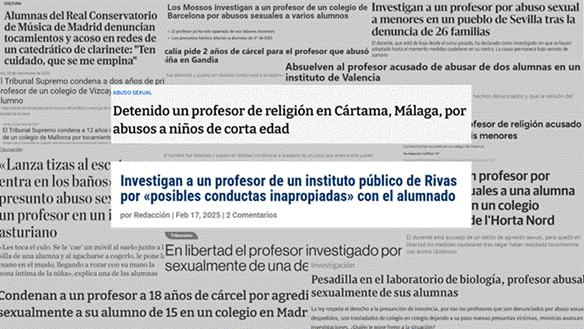
The importance of this issue lies not only in its social impact but also in its significant effect on education. Schools are expected to be safe spaces where students have the opportunity to grow academically and personally. Therefore, the presence of abuse in these contexts raises concerns about the lack or failure of the aforementioned institutional protocols and responsibilities.
More TV series are including topics such as sexual abuse in schools. To complete the analysis of real cases, and given its impact at the local and global level -more than 25 million views (Bello, 2024; Netflix, 2024; Solá, 2024)-, the analysis of the series Raising Voices (Lorenzo & Sáez, 2024) is included: a story where there is an abuser within a school. This perspective allows for a deeper understanding of how society perceives and interprets these situations, as well as their psychological and social consequences.
This problem raises questions about the nature of prevention and identification protocols and whether they are actually being implemented correctly in practice. Furthermore, the patterns to be followed are very similar in many cases, making the lack of identification seem strange if these patterns are already known. To this end, this research aims to contribute to a better understanding of this problem and underscore the importance of ensuring safe environments for all students.
Methodology
This research employed a qualitative methodology based on the collection and analysis of various sources, including news reports, testimonies, audiovisual material (in this case, a television series), and official court updates (Nicolau, 2021). The study was conducted in several phases to ensure a thorough understanding of sexual abuse in educational settings.
First, a systematic review of news reports was conducted. The selected cases were chosen based on proximity, relevance, and recency bias. Additionally, situations of public interest that provided detailed accounts of abuses, institutional responses, and societal reactions were considered.
Secondly, this study includes the analysis of testimonies and interviews published online or shared by students and family members. These testimonies allow for the identification of patterns in the perpetrators' behavior, such as manipulation, discretion, and abuse of power.
Third, the Netflix series Raising Voices (Lorenzo & Sáez, 2024) was also analyzed. This series depicts a case of sexual abuse in education, along with other challenges adolescents face, such as mental health issues, interpersonal relationships, and institutional response. The series was analyzed to understand how these behaviors are portrayed on television, the consequences for victims, and the role of peer groups, family, and authorities in managing the situation.
Finally, updates on court outcomes were reviewed, including cases dismissed for lack of evidence, to assess the challenges of legal proceedings and institutional actions. Using these sources (news reports, audiovisual material, and court documents), we were able to identify recurring patterns, structural gaps, and the social and psychological impact of abuse.
Results. Case analysis
The case analysis focuses primarily on two cases that garnered particular attention due to where they occurred and how they became known. However, there are several other cases we have compiled regarding this serious situation. This is a selection based on an intentional, non-probabilistic criterion, typical of qualitative research. We chose cases that had elements relevant to their analysis, such as geographic diversity, media coverage, documented legal proceedings, and recurring patterns of abuse of power or manipulation. Similarly, cases with diverse social and educational responses were prioritized.
The choice to add the series Raising Voices to the article is in response to the need to analyze the audiovisual and social representation of this issue. Through audiovisual fiction, we can observe how certain social imaginaries contribute to making these cases visible or interpreting them.
Rivas-Vaciamadrid (Madrid) Case
Social media has not only made these cases more widely known but has also brought to light cases that might otherwise go undiscovered. A famous YouTuber named Melías (2026), who has also appeared in series such as HIT (Ibarra y Pina, 2025) and Raising Voices, made a video about Rivas-Vaciamadrid Case (@melias, 2025). He created a YouTube series where people contact him to tell him that an adult is engaging in inappropriate or sexually suggestive behavior with them. This series is called: Hunting Pedophiles.
In this case, a high school student contacted him to tell him that a teacher of ethical values had pedophilic attitudes and was making obscene comments to students, especially girls, and was also speaking explicitly with second-year ESO students. It all started when one of her students contacted Melias:
"Hi, I am here to tell you about something I consider dangerous, and you, with your brilliant work, could help. Last year, we had a strange teacher who always wanted physical contact; he said, for example, that he could not stop staring at a student's chest. This went on until he told another student on Instagram that he wanted to see her naked. The students did not say anything, and because of the problems he caused, he transferred to another school." (@melias, 2025).
A 17-year-old girl contacted Melias and told him that this teacher spoke to her in a sexually suggestive way, even on Instagram: "At what age did you lose your virginity?", "I want to see your breasts." He also wanted to meet her in person. Furthermore, he said things to his students like, "If you come to class in short dresses, I will give you a 10..." there are more shocking comments (@melias, 2025). This teacher worked as a professor of philosophy, ethics, and psychology. Melias spent a month researching him, and emphasized the importance of being careful about who we talk to, what we see on social media, and how it is used.
The video claimed that the teacher did not work at a school, but it was later revealed that he did. They decided to set up a fake date with one of the girls he was talking to on social media to surprise him and allow Melias to speak with him. The YouTuber began by acting as if he were conducting interviews about public education when he "surprised" the teacher. Once they found him, he acted as if Melias had been his student in the past. He started with some general questions until he surprised the teacher by asking about the girl, these kinds of situations, and the information he had about him. After that, the teacher started to run away: "What is it like talking to a 17-year-old girl?" He replied that what he was doing was not illegal, and Melias responded: that is why he did not want to see her. Melias showed him all the information, screenshots of conversations, and photos he had collected about him, and he began to regret it… (@melias, 2025).
This video went viral, and that is when some students started talking about the situations they experienced in this teacher's classes. The city council alerted the Department of Education about the incidents, and the teacher was expelled from the school. At the end of the video, the teacher apologized for everything he had done and said he was going to therapy to address the problem. But is that enough to fix the situation? What is his punishment? How is it possible that teachers like this are still teaching? How is it possible that these situations were not brought to light sooner? Only the YouTuber achieved what the entire educational environment had previously left unpunished (Cañellas, 2025).
Cártama (Málaga)
The Cártama area and its surroundings were deeply shocked after this news broke in November 2025. The events took place in a neighboring municipality of barely 1,500 inhabitants, located a few minutes away by car, where a school that educates children from kindergarten to the second year of ESO (Spanish secondary school) became the center of a judicial investigation (Rocha, 2025).
The case involved a religion teacher who had worked at the school for over thirty years. The teacher was arrested for alleged sexual abuse of his students and, although later released, remained under investigation. The situation came to light when four families decided to file a complaint after noticing strange behavior in their children. The trigger was a sexually suggestive word that one of the students used at home, which alarmed her parents. Upon speaking with other families, they discovered that the children were mentioning a stuffed animal (Rosado, 2025), which allowed the parents to connect the dots and proceed with the legal complaint.
According to testimonies from that time, the teacher allegedly used this stuffed animal to commit the abuse and then tried to gain the children's trust by giving them bracelets or other gifts. He also insisted that everything had to be kept secret and that they could not tell anyone what was happening. Following the initial complaints, more families joined the legal process as they learned the details of what had occurred (Adarme, 2025).
This incident brought the school's management under scrutiny. Parents tried to contact the school before going to the authorities, but received no effective response. It was not until the Civil Guard intervened that real measures began to be taken, highlighting the shortcomings of educational institutions in managing and making decisions in the face of problems of this magnitude. The concern even reached nearby high schools, where older students who had attended the school years before expressed their worry, believing they too could have been in danger during their childhood (Adarme, 2025).
The Court of Instruction number 2 of Málaga issued a provisional dismissal of the case, and both the Public Prosecutor's Office and the lawyers for the 17 families have filed appeals with the Provincial Court of Málaga to prevent the case from being closed (Cano, 2026). This case would not be included within the general count of the organization accused of abuse: “The bishops acknowledge for the first time that they have a thousand clergymen accused of sexual abuse” (Giovio, 2026).
Case in Mallorca
Recently, in Mallorca, a math teacher was sentenced to 12 years in prison for sexually assaulting several female students, all minors, inside their clothing at school. Three of the girls were just 12 years old, and the fourth was 16. These incidents occurred repeatedly between 2016 and 2018. Furthermore, it was stated that he did this to satisfy his sexual desires. If a person, including within the school environment, is capable of viewing their students to satisfy their sexual desire, they should not be teaching classes, much less children, whose safety depends precisely on them.
The high court has accepted the appeal filed by the prosecution and the religious order against the previous ruling, which had classified the acts as a minor offense of coercion rather than sexual abuse, removing the prison sentence and imposing only a fine. Subsequently, these four offenses were reclassified as sexual abuse. However, the case of a fifth student was dismissed due to lack of evidence, upholding her acquittal.
He was ultimately convicted of these four offenses, in addition to three other minor coercion offenses against female students, for which he received fines. These latter offenses involved touching their clothing.
The school where the teacher committed the abuse belongs to a religious order that joined the case as a plaintiff, and its appeal was crucial in the Supreme Court's decision to reclassify the crime as sexual abuse. The final sentence was three years for each of the four victims, in addition to a ban on working with minors (Consejo General del Poder Judicial, 2024; Ribot, 2024).
Litigation was necessary to reach the Supreme Court. Anyone can consider what happens when the victims of pedophilia are humble people who lack financial resources and legal knowledge, and who, in addition to the suffering caused by the abuse, must dedicate their time and livelihood to trying to obtain "justice" (Ruiz, 2025; Save the Children, 2012, 2025).
Valladolid (also in the Spanish state)
San Juan de la Cruz (Saint John of the Cross) school run by the Discalced Carmelites in Medina del Campo. A teacher was sentenced to 13 years (previously 11) for sexually abusing a 10-year-old boy in the summer of 2020 (Consejo General del Poder Judicial, 2026). His sentence includes charges of continuous child abuse, child pornography, and child grooming. The court found that the teacher emotionally manipulated the boy, increasing his contact with him during the lockdown and obtaining sexually explicit photos and videos of him. However, these acts did not come to light until two years later. The same teacher had a previous 14-year sentence for similar acts with a seminarian, although that sentence was later overturned by the High Court of Justice of Castile and León (Núñez y Navarro, 2023).
In addition to the prison sentence, he was given measures such as being prohibited from approaching or communicating with the victim for the next 5 years, supervised release after sentencing, and, most surprisingly, a ban on working with minors for 5 years. How is it possible that, knowing his record, it's only 5 years?
Case in Boadilla del Monte (Madrid)
Another case to add to the list is that of a teacher at a private school in Boadilla del Monte (Ibáñez, 2024): Antonio Maestu, the art and audiovisual teacher at the Virgen de Europa (Virgin of Europe) school for over 30 years, was arrested on June 29, 2022 (EuropaMedia, 2022). He is also the son of the school's founder and the brother of the current headmaster. The case began in June 2022 when a resident of Valdemorillo found a backpack containing a camera in the street. The shock came when, upon reviewing the contents of the memory card, she discovered images of minors in their underwear. Upon this discovery, she decided to hand it over to the Civil Guard, leading to the teacher's arrest 10 days later. The subsequent investigation revealed that this teacher had convinced upper elementary school students to change their clothes in his office before attending physical education classes, where he had installed hidden recording devices. Another camera was also discovered in the audiovisual classrooms. Analysis of the seized materials identified three more victims, one of them from two decades prior. A search of their home uncovered several computers and numerous hard drives, some of which had been drilled. Consequently, the crime was also considered to be possession of child pornography, disclosure of secrets, and corruption of minors (Peinado, 2024).
Finally, the teacher was arrested in 2022, but is currently free on bail with restrictions such as staying away from schools, both the school in Boadilla and two nurseries in Madrid where he was listed as an administrator, and appearing periodically in court. But is this enough? Is this his only “punishment”? The case remains under the jurisdiction of the Court of Instruction number 5 of Móstoles. The Data Protection Agency fined the “educational” center €24,000 for recording minors without their consent for more than a decade, and a lawsuit resulted in €120,000 in damages for “moral harm” for a teacher and the mother of one of the victims (del Castillo, 2025; Moreno, 2024; Peinado, 2024a).
Another case in Madrid: Royal Conservatory of Music
There are several accusations of sexual abuse against a professor and clarinet teacher at the Conservatory of Music. The case was opened after protests by dozens of students on November 26, 2025, when the professor was about to receive an award for his 20 years of service and the students stormed in, shouting and holding a banner that read “Abusers out of the conservatory.”
According to testimonies, the allegations include non-consensual touching, sexual comments, psychological violence, and ongoing harassment. In addition, the professor has an open disciplinary file following complaints from two female students for online harassment. However, this process is still ongoing, so the allegations cannot yet be made public, and the professor has not yet been arrested, although he is on permanent leave, leaving his disciplinary file frozen (Polo, 2025; Polo and Heredia, 2025).
Valdeluz (Madrid)
Another high-profile case is the Valdeluz case: a teacher from the Valdeluz school in Madrid was sentenced to nearly 50 years in prison. He was convicted of 12 sexual offenses against female students at the music academy affiliated with the school. The court considered the teacher to be highly regarded and approachable, which fostered trust and admiration among his students. The teacher exploited this trust to approach the minors for sexual purposes, beginning with seemingly innocent gestures such as hugs and gradually escalating the situation. He justified his actions with excuses such as postural corrections during piano lessons or the dim lighting during audiovisual presentations, which he used to commit the abuses.
The court determined that the abuse constituted an abuse of power, and considered the crimes to be continuous, with some aggravated by the victims' ages. The professor's version of events, alleging a "conspiracy" motivated by revenge against his wife, was dismissed. Furthermore, the victims' account was deemed coherent, consistent, and credible.
At the trial, 14 victims/witnesses, 35 witnesses, and 5 expert witnesses testified. The prosecution sought a 69-year prison sentence for 14 offenses, but the court ultimately convicted him on 12 counts. The teacher was ordered to compensate the victims, and the school was declared subsidiarily liable.
Analysis from an audiovisual perspective
Currently, we can see these types of situations reflected on different digital platforms, making positive use of audiovisual media to advocate and raise awareness of the real problems that affect us and that are often not shown explicitly.
Directly related to the cases of teacher abuse analyzed in the previous section, a faithful reflection of these dynamics can be found in the original Netflix series Raising Voices (2024). This show puts a face and context to the consequences of systematic abuse in schools. Its relevance to the present research lies in how it breaks down the perpetrator's manipulation and the often insufficient response of educational institutions to sexual violence.
The series consists of one season of eight episodes, each approximately 45 minutes long. The main cast includes Nicole Wallace (as Alma), Clara Galle (as Greta), and Aïcha Villaverde (as Nata), actresses whose careers are widely recognized by young audiences.
This series not only covers the central theme of the news stories analyzed, but also addresses multiple characteristics present in the lives of teenagers, essential for future classroom management. It is recommended viewing as a comprehensive work in terms of themes related to adolescence and conflicts in secondary education. The following contains some plot details (spoilers), so it is suggested to watch the series beforehand.
The main character is Alma, a young woman in her final year of high school. Throughout her school years, she has maintained a rebellious attitude; however, this season, she is forced to get good grades for her university entrance exams and avoid repeating the year, while facing personal problems unknown to those around her.
The series explores topics such as parent-child relationships, substance abuse, academic stress, romantic relationships, sexual abuse by both teachers and other teenagers, suicide, and mental health. These are controversial and important themes that greatly enhance the series.
In relation to the research topic explained above, the series tells the story of a history teacher who, after gaining the students' trust, abuses them. This dynamic is clearly observed in key moments, such as the end of episode 7. Berta, Alma's friend, is the one who primarily suffers this abuse, leading to several suicide attempts. This reflects the severity of these cases and how the emotional burden can drive adolescents to extreme situations (Cornejo-Guerra, 2024). Upon learning of the abuse Berta suffered after her hospitalization, Alma vows that the perpetrator will pay for his actions. To this end, she creates an anonymous profile under the pseudonym "I am Coleman Miller" (in honor of the case of Daisy Coleman and that of Chanel Miller, who committed suicide after suffering abuse) and publishes testimonies that expose the situation (Peris, 2025).
Throughout the plot, widespread doubt arises about the veracity of the story, even affecting the protagonist herself. At this point, a tragedy occurs involving Berta's character, preventing her from witnessing the resolution of the conflict. Finally, Alma discovers that another student is going through the same situation, leading her to publicly denounce him before the entire school, resulting in the teacher's arrest.
Regarding sexual abuse, other parallel stories are told. Nata, one of Alma's best friends, is subjected to an attempted assault by her boyfriend and his friends in an abandoned building, a situation that is interrupted by police intervention. Nata's relationship with her boyfriend Alberto is described as toxic, marked by his lack of commitment and her emotional dependence. Alberto also stands out negatively for harassing Alma by sending her intimate photos from a fake profile. At the end of the series, Nata ends the relationship and reports the attempted assault.
Friendship is a central theme throughout the series. Alma and her best friend Greta overcome conflicts together, supporting each other through the most difficult times. This underscores the importance of peer support at all stages of life (Cody et al., 2023).
In Episode 8, we see Alma react physically to a young man who was harassing her and performing obscene acts in front of her. Despite being the victim of the harassment, the school's only action is to expel her for violent behavior. Alma's reaction is deemed justified in the face of such harassment. In a scene where Alma's parents try to prevent her expulsion from a principal who blames her, her mother proposes the implementation of a sex education course in secondary school, a necessary and relevant proposal (Amondara y Herrero, 2025).
Other interesting elements in the series reinforce the recommendation to watch it. Although this work was initially chosen because of its treatment of teacher abuse, it stands out for the wealth of lessons it offers about the latent problems in secondary schools that often go unnoticed (Huang y Wu, 2026).
Conclusion
Through this research, we have seen in various news reports how this problem is becoming increasingly serious and real. Sexual abuse in educational settings is becoming more frequent (Blake et al., 2024; Sweeting et al., 2022; UK Parliament, 2016). However, this increased frequency does not necessarily imply that there were fewer cases before, but rather that they went unreported. Currently, more victims are willing to speak out and report the abuse. And speaking out is positive because it helps bring the situation to the attention of those directly involved with the accused, making everyone more aware that these situations, unfortunately, can occur. By being aware of this, families can teach their children how to recognize when basic boundaries are being crossed and when situations are inappropriate.
This reality is uncomfortable. However, it is necessary to address it. It is a real problem that challenges both institutions and society as a whole. Furthermore, through the analysis of these news reports, we have seen not only that they are becoming more frequent, but also that they share similar dynamics. These dynamics also reveal a significant failure in prevention, detection, and response systems. How is it possible that in most cases no one realizes that these situations are occurring in their own school? In a place that is supposedly safe for all students, how can it be that no one saw that it was ceasing to be so?
This article also serves as a gradual awakening. What we thought were isolated cases, with no connection between them, turn out to be part of a pattern where factors such as abuse of power, the vulnerability of minors, and the difficulty of reporting within these contexts converge. And we return to the same idea of critically questioning the functioning of educational institutions.
As we have already mentioned, one of the most contradictory aspects is our vision of safety within schools. Places that are generally conceived for development, protection, and learning can become places of risk. We can question the extent to which these supposed protocols are effective, or whether they are merely theoretical. Seeing the constant delays in response, the initial lack of attention given to victims, or the minimization of certain behaviors, we wonder how long the road is to achieving genuine prevention and institutional commitment.
On the other hand, the role of the media and social networks is gradually increasing, and with it, the exposure of these cases. Their ability to bring to light situations that have typically been hidden is undeniable, facilitating the disclosure of more cases, thanks to victims' willingness to speak out and break the silence. However, it is also clear that this exposure does not always translate into effective justice. This leads us to ask whether society is truly progressing towards greater protection of minors, or if it sometimes remains superficial.
We consider it essential to value active listening and the importance of creating truly safe spaces where students can express themselves freely and where their voices carry real weight. Many of the warning signs were present long before the cases came to light. This leads us to believe that prevention depends not only on protocols, but also on an educational culture based on trust, closeness, and shared responsibility.
Likewise, it is crucial to have this perspective from the very beginning, starting with the training of teachers and educational staff. In a profession that is supposedly vocational, and where one is supposedly concerned for the well-being of children, these situations make no sense. From the earliest years of training, it should also focus on ethical, moral, emotional, and relational aspects. It is essential to understand power dynamics, recognize inappropriate behavior, and know how to respond to it. For other professions, such as medicine or law enforcement, certifications are required to demonstrate that individuals are fully qualified to practice and to provide security to the people they work with. To have contact with children, only a certificate stating that no sexual offenses have been committed is required. Teachers, who will be in contact with minors for at least six hours a day, only need to present a certificate. Is that really all that's required? Wouldn't greater psychological and moral oversight be necessary to detect even the slightest indication of wrongdoing?
References
@melias. (February 16, 2025). Cazando Ped*filo Profesor de valores eticos [Vídeo]. YouTube. https://www.youtube.com/watch?v=khrWUPpaVlU
@melias. (2026). Melias [YouTube Channel]. https://www.youtube.com/@melias
Adarme, V. (November 23, 2025). Cártama, Opiniones y Opciones [Audiovisual description]. Facebook. https://www.facebook.com/groups/1717291255158627/posts/4365803096974083/
Amondara, A. y Herrero, E. (2025). La alfabetización mediática en la educación sexual de adolescentes en centros públicos españoles. Comunicación y sociedad, 22, e8936. https://doi.org/10.32870/cys.v2025.89364
Bello, C. (June 9, 2024). "Ni una más": la exitosa serie de Netflix que hace guiños a dos polémicos casos reales de abuso sexual. BioBioChile. https://www.biobiochile.cl/noticias/espectaculos-y-tv/cine-y-series/2024/06/09/ni-una-mas-la-exitosa-serie-de-netflix-que-hace-guinos-a-dos-polemicos-casos-reales-de-abuso-sexual.shtml
Blake, C., Lewis, R., Riddell, J., Willis, M., Wylie, L., Dawson, K., Moore, L, y Mitchell, K. R. (2024). Prevention of, and response to, sexual harassment at secondary school: A system map. Social Science & Medicine, 358, 117092. https://doi.org/10.1016/j.socscimed.2024.117092
Campo, P. (December 4, 2025). Condenan a 15 años de cárcel a un maestro interino por agresión sexual a tres alumnas de 11 años en Asturias. eldiario.es. https://www.eldiario.es/asturias/condenan-15-anos-carcel-maestro-interino-agresion-sexual-tres-alumnas-11-anos-asturias_1_12820695.html
Cano, J. (April 6, 2026). Archivan el caso del profesor de Religión de Cártama investigado por abusos y denunciado por 17 menores. Diario Sur. https://www.diariosur.es/sucesos/archivan-profesor-religion-cartama-investigado-abusos-20260331183955-nt.html
Cañellas, J. B. (April 12, 2025). Cazar a un pedófilo: "La víctima envía un mensaje para quedar con el 'abusador', y cuando llega el momento, somos nosotros los que aparecemos". El Mundo. https://www.elmundo.es/madrid/2025/04/12/67f91b3321efa062678b458f.html
Cody, C., Bovarnick, S. & Peace, D. (2023) ‘It's like a much deeper understanding and you kind of believe them more …’: The value of peer support for young people affected by sexual violence. Child Abuse Review, 32(3), e2789. https://doi.org/10.1002/car.2789
Columba, A. (May 13, 2024). Detienen a un profesor sospechoso de abusar sexualmente de más de 2.000 menores y se investiga si puede haber más víctimas. Abc. https://www.abc.es/sociedad/detienen-profesor-sospechoso-abusar-sexualmente-2000-menores-20240513102006-nt.html
Consejo General del Poder Judicial. (July 9, 2018). El profesor del colegio Valdeluz de Madrid, condenado a casi 50 años de prisión por doce delitos de abusos sexuales. Poder Judicial de España. https://www.poderjudicial.es/cgpj/es/Poder-Judicial/Noticias-Judiciales/ci.El-profesor-del-colegio-Valdeluz-de-Madrid--condenado-a-casi-50-anos-de-prision-por-doce-delitos-de-abusos-sexuales.formato1
Consejo General del Poder Judicial. (March 22, 2024). El Tribunal Supremo condena a 12 años de prisión a un profesor de un colegio de Mallorca por tocamientos a cuatro alumnas. Poder Judicial de España. https://www.poderjudicial.es/cgpj/es/Poder-Judicial/Tribunal-Supremo/Noticias-Judiciales/El-Tribunal-Supremo-condena-a-12-anos-de-prision-a-un-profesor-de-un-colegio-de-Mallorca-por-tocamientos-a-cuatro-alumnas
Consejo General del Poder Judicial. (April 13, 2026). El Tribunal Supremo confirma la condena a 13 años de prisión a un profesor de un colegio de Valladolid por abusos sexuales a un alumno. Poder Judicial de España. https://www.poderjudicial.es/cgpj/en/Judiciary/Supreme-Court/Judicial-News/El-Tribunal-Supremo-confirma-la-condena-a-13-anos-de-prision-a-un-profesor-de-un-colegio-de-Valladolid-por-abusos-sexuales-a-un-alumno-
Cornejo-Guerra, N. (2024). Conductas autolíticas suicidas y no suicidas en víctimas de violencia sexual infantil. Apuntes de Psicología, 42(1), 41-48. https://doi.org/10.55414/ap.v42i1.1542
Curiel, M. (January 21, 2025). «Lanza tizas al escote y entra en los baños»: presunto abuso sexual de un profesor en un instituto asturiano. El Debate. https://www.eldebate.com/educacion/20250121/presunto-abuso-sexual-profesor-instituto-asturiano-lanza-tizas-escote-entra-banos_262955.html
Del Castillo, C. (July 3, 2025). Protección de Datos multa con 40.000 euros al colegio de Boadilla en el que se grabó a alumnas en ropa interior. eldiario.es. https://www.eldiario.es/tecnologia/proteccion-datos-multa-40-000-euros-colegio-boadilla-grabo-alumnas-ropa-interior_1_12432382.html
Díaz, M. J. (November 18, 2025). El educador detenido en Málaga por supuestas agresiones sexuales a tres menores fue despedido del centro de acogida. Diario Sur. https://www.diariosur.es/sucesos/educador-detenido-malaga-supuestas-agresiones-sexuales-tres-20251117004018-nt.html
EuropaMedia. (November 17, 2022). A.M.: El presunto pedófilo de Boadilla del Monte [Vídeo]. YouTube. https://www.youtube.com/watch?v=jpk5b0wY2hs
Federación de Asociaciones para la Prevención del Maltrato Infantil. (January 24, 2025). Los Mossos investigan a un profesor de un colegio de Barcelona por abusos sexuales a varios alumnos. Redacción FAPMI. https://bienestaryproteccioninfantil.es/los-mossos-investigan-a-un-profesor-de-un-colegio-de-barcelona-por-abusos-sexuales-a-varios-alumnos/
Giovio, E. (April 24, 2026). Los obispos reconocen por primera vez que tienen mil clérigos acusados de abusos sexuales. El País. https://elpais.com/sociedad/2026-04-24/los-obispos-reconocen-por-primera-vez-que-tienen-mil-clerigos-acusados-de-abusos-sexuales.html
Huang, S. H., & Wu, W. C. (2026). Perceived Adults’ Responses to School Bullying and Students’ Bystander Behaviors: The Role of Parents, Teachers, and School Administrators. Journal of School Violence, 0, 1-14. https://doi.org/10.1080/15388220.2026.2646660
Ibáñez, M. (April 17, 2024). La investigación al profesor de Boadilla que grababa a sus alumnas apunta a ser un caso de pornografía infantil. El Español. https://www.elespanol.com/madrid/sociedad/20240417/investigacion-profesor-boadilla-grababa-alumnas-apunta-caso-pornografia-infantil/848415186_0.html
Ibarra, J. M., & Pina, L. (Productores). (2020-2025). HIT [Serie de televisión]. Rtve.
Images, G. (January 24, 2025). Los Mossos investigan a un profesor de un colegio de Barcelona por abusos sexuales a varios alumnos. RTVE.es. https://www.rtve.es/noticias/20250124/mossos-investigan-profesor-barcelona-abusos-sexuales-alumnos/16420725.shtml
La Vanguardia. (16 de noviembre de 2025). Investigan a un profesor de Religión de Málaga por presuntos abusos a menores. La Vanguardia. https://www.lavanguardia.com/local/andalucia/20251126/11303300/investigan-profesor-religion-malaga-presuntos-abusos-menores.html
Lorenzo, J., & Sáez Carral, M. (Executive Producers). (2024). Raising Voices [TV series]. Netflix.
Martínez, J. (December 16, 2024). Detenido un profesor por abusos sexuales a una alumna de 11 años en un colegio parroquial de l’Horta Nord. Las Provincias. https://www.lasprovincias.es/sucesos/detenido-profesor-colegio-parroquial-abusos-sexuales-alumna-20241216095549-nt.html
Moreno, A. (February 14, 2024). Identificadas tres nuevas víctimas del profesor del colegio Virgen de Europa de Boadilla. Diario de Boadilla. https://www.diariodeboadilla.es/387432-identificadas-tres-nuevas-victimas-del-profesor-del-colegio-virgen-de-europa-de-boadilla#:~:text=La%20Guardia%20Civil%20ha%20identificado%20a%20tres,del%20Monte%2C%20sospechoso%20de%20haber%20grabado%20a.
Netflix. (September 19, 2024). Lo que vimos en el primer semestre del 2024. Netflix. https://about.netflix.com/es/news/what-we-watched-the-first-half-of-2024
Nicolau, C. (2021). Qualitative Methods Research Through the Internet Applications and Services: The Contribution of Audiovisual Media Technology as Technology-Enhanced Research. International Research in Higher Education, 6(1), 1-14. https://doi.org/10.5430/irhe.v6n1p1
Núñez, J. y Navarro, J. (August 1, 2023). Condenado a 13 años de cárcel por pederastia un profesor de un colegio de los carmelitas descalzos en Valladolid. El País. https://elpais.com/sociedad/2023-08-01/condenado-a-13-anos-de-carcel-un-profesor-de-un-colegio-de-los-carmelitas-descalzos-en-valladolid.html#:~:text=El%20Tribunal%20Superior%20de%20Justicia%20de%20Castilla,el%20colegio%20de%20los%20carmelitas%20descalzos%20de
Ormazabal, M. (February 18, 2025). En libertad con cargos dos educadoras de un centro de San Sebastián investigadas por una presunta agresión sexual a una menor. El País. https://elpais.com/sociedad/2025-02-18/detenidas-dos-docentes-de-un-centro-de-san-sebastian-por-una-presunta-agresion-sexual-a-una-menor.html
Peinado, F. (February 14, 2024). El profesor de Boadilla investigado por pedofilia comenzó a grabar alumnas desnudas al menos hace 17 años. El País. https://elpais.com/espana/madrid/2024-02-14/el-profesor-de-boadilla-investigado-por-pedofilia-comenzo-a-grabar-alumnas-desnudas-al-menos-hace-17-anos.html#:~:text=El%20caso%20sacudi%C3%B3%20a%20la%20opini%C3%B3n%20p%C3%BAblica,mes%2C%20una%20mujer%20encontr%C3%B3%20una%20c%C3%A1mara%20de
Peinado, F. (February 14, 2024a). El colegio de Boadilla en el que se grabó a niñas desnudas deberá pagar 120.000 euros por “daño moral” a una profesora y madre de una afectada. El País. https://elpais.com/espana/madrid/2024-02-14/el-colegio-de-madrid-en-el-que-se-grabo-a-ninas-desnudas-debera-pagar-120000-euros-por-dano-moral-a-una-profesora-y-madre-de-una-afectada.html
Pérez, A. (June 11, 2025). Absuelven al profesor acusado de abusar de dos alumnas en un instituto de Valencia. Levante-EMV. https://www.levante-emv.com/sucesos/2025/06/11/juez-absuelve-profesor-acusado-abusar-alumnas-instituto-valencia-118516446.html
Peris, M. (2025). Juventud y violencia sexual: el papel de las redes sociales en Ni una más. Zer, 58, 18-35. https://doi.org/10.1387/zer.27388
Polo, S. (December 10, 2025). Los alumnos exigen al Conservatorio de Música de Madrid que actúe de oficio ante los presuntos abusos sexuales cometidos por un catedrático de clarinete: "La pelota está en su tejado". El Mundo. https://www.elmundo.es/cultura/2025/12/10/69399676e85eceb4778b4584.html
Polo, S. y Heredia, A. (November 27, 2025). Alumnas del Real Conservatorio de Música de Madrid denuncian tocamientos y acoso en redes de un catedrático de clarinete: "Ten cuidado, que se me empina". El Mundo. https://www.elmundo.es/cultura/2025/11/26/69272c5fe4d4d89f458b4585.html
Quirante, I., & Cano, J. (November 25, 2025). Detenido un profesor de Religión de Cártama por supuestos abusos a menores de corta edad. Diario Sur. https://surl.lu/jgbgve
Ribot, P. (March 22, 2024). El Supremo sentencia a 12 años a un profesor por abusar de cuatro alumnas en Palma. Última Hora. https://www.ultimahora.es/sucesos/ultimas/2024/03/22/2130379/abusos-menores-supremo-sentencia-anos-profesor-por-abusar-cuatro-alumnas-palma.html
Rocha, C. (November 25, 2025). Investigan a un profesor de religión en Málaga tras una denuncia por abusos a niños de infantil. El Confidencial. https://www.elconfidencial.com/espana/andalucia/2025-11-25/investigan-a-un-profesor-de-religion-en-malaga-tras-una-denuncia-por-abusos-a-ninos-de-infantil_4254393/
Rosado, A. (November 25, 2025). Investigan una denuncia contra un profesor de Religión de Cártama por presuntos abusos sexuales. El Español. https://www.elespanol.com/malaga/20251125/investigan-denuncia-profesor-religion-cartama-presuntos-abusos-sexuales/1003744028789_0.html#:~:text=El%20caso%20sali%C3%B3%20a%20la%20luz%20cuando,denunciado%20por%20un%20presunto%20caso%20de%20abusos
Ruiz, I. (2025). Victimización y Justicia: ¿Cómo evitar la victimización secundaria en menores en casos de abuso sexual infantil? [Trabajo de Fin de Grado]. Universidad Europea de Valencia. https://titula.universidadeuropea.es/bitstream/handle/20.500.12880/12654/ruizsanchezisabel_7418_25407616_TFG_CRIMINOLOGIA_24-25_ISABEL_RUIZ.pdf?sequence=1&isAllowed=y
Save the Children. (2012). La justicia española frente al abuso sexual infantil en el entorno familiar. Un análisis de casos a la luz de los estándares internacionales de derechos humanos. Save the Children. https://www.observatoriodelainfancia.es/ficherosoia/documentos/3659_d_Informe_JUSTICIA_ESP_ABUSO_SEXUAL_INFANTIL_vOK-2.pdf
Save the Children. (2025). Por una justicia a la altura de la infancia. Análisis de sentencias sobre abusos sexuales a niños y niñas en España. Save the Children. https://www.savethechildren.es/sites/default/files/2025-09/EUS_Por_una_justicia_a_la_altura_de_la_infancia_v2025.pdf
Solá, P. (June, 12 2024). 'Ni una más', la serie juvenil española que triunfa en Netflix hablando de agresiones sexuales. La Vanguardia. https://www.lavanguardia.com/series/netflix/20240612/9727626/ni-una-mas-serie-espanola-exito-netflix.html#:~:text=En%20su%20primera%20semana%20en%20la%20plataforma,,d%C3%ADas,%20ya%20que%20se%20estren%C3%B3%20un%20viernes.
Sweeting, H., Blake, C., Riddell, J., Barrett, S., Mitchell, K. R. (2022). Sexual harassment in secondary school: Prevalence and ambiguities. A mixed methods study in Scottish schools. PLoS One, 17(2), e0262248. https://doi.org/10.1371/journal.pone.0262248
UK Parliament. (2016). The scale and impact of sexual harassment and sexual violence in schools. https://publications.parliament.uk/pa/cm201617/cmselect/cmwomeq/91/9105.htm
Zapata, A. S. (March 17, 2026). Las psicólogas, sobre el presunto caso de abusos en el colegio de Lugo: «Puido haber contaminación grupal, pero o relato dunha das nenas foi moi amplo e de calidade». La Voz de Galicia. https://www.lavozdegalicia.es/noticia/lugo/lugo/2026/03/17/psicologas-sobre-abusos-colegio-lugo-span-langglpuido-haber-contaminacion-grupal-relato-dunha-das-nenas-foi-moi-amplo-calidadespan/00031773752191507835801.htm#:~:text=El%20informe%20de%20estas%20forenses%20avala%20solo,una%20psic%C3%B3loga%20particular%20que%20contradice%20su%20versi%C3%B3n.