Revista Internacional de Educación y Análisis Social Crítico Mañé, Ferrer & Swartz.
ISSN: 2990-0476
Vol. 4 Núm. 1 (2026)
The food, energy, and technology
industries as primordial ecocidal neofascism
La industria
alimentaria, energética y tecnológica como neofascismo ecocida primordial
As indústrias alimentícia, energética e tecnológica como neofascismo ecocida
primordial
Rosa Mas González
Biologist (University of Valencia) and animal rights activist
https://orcid.org/0009-0000-2574-7395
ro_2112@msn.com
ttps://orcid.org/0009-0000-2574-7395
Abstract
Since the Upper Paleolithic, humans, with few exceptions, have viewed their natural environment and other animal species as resources from which to extract profit. The practice of starting fires to clear vegetation and thus facilitate hunting evolved into livestock farming when hunter-gatherer populations established the first settlements. The extraction of raw materials constitutes the other source of economic wealth, initially for states and later for private companies. This economic wealth has progressively become concentrated in fewer and fewer hands, in multinational corporations, which exert pressure on governments to enact legislation that favors their activities and eliminates obstacles such as environmental restrictions or even human rights. Through a qualitative methodology based on a historical documentary review, this article aims to examine how the development of certain human populations has impacted other groups and ecosystems. In the name of progress, understood as the corporate profit of a few enormously powerful companies, crimes against humanity are still being committed today, and the devastation of entire ecosystems is permitted. This concept of “progress” has meant (and increasingly so) in reality, ecocide and zoocide, which entail the death of millions of human beings. From an anti-speciesist perspective, it represents a fundamental fascism toward other animal species, thus cementing the fascism in human societies as defined in the 20th century.
Keywords: Anti-speciesism, ecocide, food industry, energy industry,
technology industry, intersectionality, veganism.
Resumen
Desde el Paleolítico Superior, el ser humano, salvo excepciones, ha considerado su entorno natural y a las demás especies animales como recursos de los que extraer beneficios. La práctica de provocar incendios con el fin de eliminar la vegetación y así cazar con mayor facilidad, se traduciría en explotaciones ganaderas cuando las poblaciones recolectoras-cazadoras conformaron los primeros asentamientos. La extracción de materias primas constituye la otra fuente de riqueza económica, primero para los Estados, y posteriormente para empresas privadas. Esta riqueza económica progresivamente se fue concentrando cada vez en menos manos, en corporaciones multinacionales, que actúan ejerciendo presión sobre los gobiernos para que las legislaciones favorezcan su actividad, y se eliminen trabas como las restricciones medioambientales, o los propios Derechos Humanos. A través de una metodología cualitativa basada en una revisión documental histórica, este artículo pretende revisar cómo el desarrollo de determinadas poblaciones humanas ha impactado en otros colectivos y en los ecosistemas. En nombre del progreso, entendido como el beneficio empresarial de unas pocas compañías enormemente poderosas, se cometen, también a día de hoy, crímenes de lesa humanidad, y se permite la devastación de ecosistemas enteros. Este concepto de “progreso” ha significado (y cada vez más) en realidad, un ecocidio y zoocidio, que implican la muerte de millones de seres humanos. Desde un punto de vista antiespecista, supone un fascismo primordial hacia las demás especies animales, cimentando, a su vez, el fascismo en las sociedades humanas definido en el siglo XX.
Palabras clave: Antiespecismo, ecocidio, industria alimentaria, industria energética, industria tecnológica, interseccionalidad, veganismo.
Resumo
Desde o Paleolítico Superior, os humanos, com poucas exceções, consideram o
ambiente natural e outras espécies animais como recursos dos quais extrair
lucro. A prática de iniciar fogueiras para limpar a vegetação e, assim,
facilitar a caça, evoluiu para a pecuária quando as populações de
caçadores-coletores estabeleceram os primeiros assentamentos. A extração de
matérias-primas constitui a outra fonte de riqueza econômica, inicialmente para
os Estados e, posteriormente, para empresas privadas. Essa riqueza econômica
tem se concentrado progressivamente em um número cada vez menor de mãos, em
corporações multinacionais, que pressionam os governos a promulgar leis que
favoreçam suas atividades e eliminem obstáculos como restrições ambientais ou
mesmo direitos humanos. Por meio de uma metodologia qualitativa baseada em
revisão documental histórica, este artigo busca examinar como o desenvolvimento
de certas populações humanas impactou outros grupos e ecossistemas. Em nome do
progresso, entendido como o lucro corporativo de algumas poucas empresas
extremamente poderosas, crimes contra a humanidade ainda são cometidos hoje, e
a devastação de ecossistemas inteiros é permitida. Esse conceito de “progresso”
significou (e cada vez mais) na realidade, ecocídio e zoocídio, que acarretam a
morte de milhões de seres humanos. De uma perspectiva antiespecista, isso
representa um fascismo fundamental em relação a outras espécies animais,
consolidando assim o fascismo nas sociedades humanas.
Palavras-chave: Antiespecismo, ecocídio, indústria alimentar, indústria energética, indústria tecnológica, interseccionalidade, veganismo.
Introduction
“Hell is empty and all the devils are here”: this quotation from The Tempest by William Shakespeare (2026, p. 15) may perfectly encapsulate the way we treat other animals and nature, since behind animal exploitation lies an entire system that destroys natural resources in order to satisfy the insatiable demand of the countries of the Global North (Mira, 2026).
The current food system is not only ecologically unsustainable (Dorgbetor et al., 2022), but also constitutes one of the principal causes of many contemporary crises, from the transgression of planetary boundaries to the violation of Human Rights (Agudelo, 2016), perpetuating a silent zoocide whose origins stretch back millennia, beginning with the extinction of megafauna during the Pleistocene as a consequence of hunting (Alaminos, 2024), and continuing through major turning points in the early agricultural-pastoral civilizations and in the colonization of Abya Yala (Latin America). Furthermore, human-caused forest fires began long before the appearance of permanent human settlements, since hunter-gatherer communities were intentionally burning forests approximately 15,000 years ago in order to create clearings and grazing areas for wild animals, optimize productivity, and facilitate hunting (Sánchez-García et al., 2023), although fire had already been used much earlier to modify landscapes (Roebroeks et al., 2021).
The Neolithic period -that is, the transition from nomadism to sedentary life- marked the beginning of a culture of domination that would gradually consolidate itself over the following millennia. Practices of gathering and hunting were progressively abandoned in favor of agriculture and the exploitation of other animals in order to obtain food, clothing, tools, and means of transportation.
This new way of life enabled the establishment of hierarchies, in which certain individuals positioned themselves socially above others, generally through violent means. Hierarchization (Cintas, 2018) gave rise to a supremacist worldview which, in turn, became the source of major social inequalities and situations of discrimination, vulnerability, and oppression, both of some human beings over others, and of human beings over their environment and other animal species. An example of this can be found in the environmental degradation that occurred during the era of the Roman Empire: the deforestation of vast woodland areas in order to create grazing lands and obtain timber, provoking one of the earliest episodes of large-scale pollution and demonstrating that environmental harm caused by human activity has been a reality for millennia (McConnell et al., 2025).
Methodology
This article has been developed through the investigation and compilation of available information concerning the history of animal exploitation and the environmental degradation derived from human activity, their interconnection and relationship with colonialism, the discrimination of vulnerable groups, supremacism, and fascism, with the aim of providing a transversal and global perspective on systems of oppression. The theoretical framework arises from the need to equip anti-speciesist activism with argumentative tools. In general, there is a widespread lack of information within activist circles regarding the circumstances surrounding animal exploitation and its relationship to other forms of oppression, such as racism or sexism. Animal exploitation is likewise seldom associated with particular political or economic systems, although perhaps the more appropriate question would be whether a society free from oppression is possible within hierarchical systems. Consequently, the information presented here originates from a series of questions: What are the origins of animal exploitation, and how has it evolved throughout history? Has environmental degradation gone hand in hand with the subjugation of peoples whose resources have been -and continue to be- plundered?
At present: how do major corporate groups operate? Does a form of collusion exist with States that facilitate the enrichment of these corporations? The answers to these questions may shed light on the relationships between State and capital -represented by pressure groups or lobbies associated with multinational corporations that concentrate the greatest economic benefits- and the injustices occurring across the planet, with the purpose of publicly denouncing them, both from the academic sphere and from the perspective of Animal Rights activism.
The First Lobby in History
The progress of Western societies has historically been associated with economic wealth and, consequently, has rested upon profound social inequalities, upon the use of other animals, and upon the destruction of nature, principally through deforestation for the use of timber as fuel or in construction, and especially in shipyards for the building of merchant and military vessels as maritime trade expanded, as well as for the creation and maintenance of grazing lands. In the specific case of the Kingdom of Castile, on the Iberian Peninsula, the merino wool industry generated enormous profits for the royal treasury (Salgado, 2021).
A medieval proverb declared: “Three Holy Ones and one Honorable One keep the people oppressed.” The Three Holy Ones referred to the Holy Inquisition, the Holy Crusades, and the Holy Brotherhood, a parapolice force whose function was to suppress the more than justified popular protests of a population living in miserable conditions. The Honorable One referred to the Honorable Council of the Mesta (Fernández, 1980), created in 1273 by Alfonso X the Wise, which brought together all the shepherds of León and Castile and granted them significant privileges such as exemption from taxes and military service, along with grazing and transit rights over agricultural lands.
During the Middle Ages and over time, new royal privileges were added to the Mesta in order to protect it from agricultural interests, leading to long and innumerable legal disputes, since -contrary to common belief- agriculture and livestock raising were bitter enemies, and the latter, always favored by political power, may represent one of the earliest historical groupings corresponding to the definition of a lobby, understood as a pressure group.
The Mesta disappeared in the nineteenth century as industrialization advanced. One particularly significant moment in its history was the protection it enjoyed under the reign of the Catholic Monarchs: it became one of the pillars of agrarian policy, and its livestock model proved central to the colonial invasion of Abya Yala.
The Food System as a Method of Subjugation
During the fifteenth century and afterward came the conquest of Abya Yala, which, like any military campaign, was carried out through violence. Soldiers arrived equipped with weapons -and diseases- unknown to the Indigenous populations and against which they could not defend themselves. Yet halberds and arquebuses were not the only instruments of victory: the food system of the already consolidated Western society became one of the principal tools used to guarantee the success of the American invasion.
Dr. Linda Álvarez, from California State University (USA), analyzes how European colonialism affected the diets of the Indigenous peoples of Mesoamerica (2026). According to the European mentality, food served not merely a nutritional function; dietary practices were also associated with social status, so that the consumption of animal products became linked to elites, while plant-based foods were disparaged. When the Spanish invaders arrived, they encountered a land extensively dedicated to cultivation. Livestock farming did not exist in Mesoamerica; consequently, domesticated animals (pigs, sheep, cattle, and chickens) were introduced there from Spain.
Thus, the imposition of a foreign food system rooted in a culture of domination -unlike the lifeways of Indigenous populations, whose relationship with the land and with other animals was based on integration and cooperation- decimated these communities as effectively as weapons or disease.
The most devastating consequence of this new meat industry was that its extraordinary expansion was accompanied by a significant decline in Indigenous populations. In their determination to produce the “proper foods” needed to ensure their survival, the Spanish devoted vast tracts of land to grazing, disregarding the ancestral uses of those territories. Massive herds frequently invaded Indigenous farmlands, destroying their principal source of subsistence. The situation became so severe that, in a letter addressed to the Crown, a Spanish official warned: “Your Lordship should know that, if livestock are allowed to continue, it will mean the end of the Indians” (Earle, 2012). Over time, as a consequence of having no alternatives, Indigenous populations were forced to consume the foods imposed by the invasion. Animal exploitation thus became a weapon of war, an instrument of domination.
The Beginning of Multinational Corporations: The East India Companies
American colonialism marked the beginning of a new historical era: the drive by other European nations -principally England, Holland, France, and Portugal- to occupy and plunder new territories in Africa, Asia, and Oceania, generically known as “the Indies,” massacring or enslaving their Indigenous inhabitants. The transportation of these looted resources, euphemistically described as trade routes, was managed directly by the State in Spain, though such campaigns proved enormously costly for the royal treasury. Consequently, in other nations such as England, Holland, and France, a model based on private enterprise controlled by merchants became dominant (Díaz, 2018).
European merchants organized fleets composed of both merchant ships and warships. These were therefore armed convoys, whose power eventually became so extensive that they even possessed the authority to declare war or sign treaties.
Yet it was precisely this same colonial expansion that ultimately led to the disappearance of these enterprises in favor of the State, which increasingly viewed the growing influence of merchants with suspicion. Consequently, the European East India Companies ended in bankruptcy during the nineteenth century (Cartwright, 2022), though they left behind the seeds of the capitalist system, which would gain enormous momentum following the Industrial Revolution. Genocide, ecocide, and zoocide became historical constants as productive systems increased in efficiency.
Industrial Revolution: Pressure Groups
The Industrial Revolution consolidated capitalism and, consequently, the creation and development of lobbies, formed through the association of companies from specific, and generally the most profitable sectors, with the purpose of protecting their interests, and influencing institutional politics so that regulations would favor their businesses (Arceo and Álvarez, 2023).
Following the Second World War, the concept of the Welfare State emerged (Braga, 2024), consisting in the guarantee of a series of minimum services for the entire population: “full employment,” healthcare, and education, with the aim of redistributing national wealth in an “equitable” manner. Nevertheless, from the very beginning there existed a profound imbalance between promises of social justice and their limited fulfillment (Braga, 2024). Governments proved incapable of universalizing the public services guaranteed by laws and constitutions; on the contrary, social inequality continues to characterize supposedly civilized societies.
Numerous authors have proposed reforms aimed at reorganizing the Welfare State; however, it must be emphasized that infinite economic growth is impossible on a planet with finite resources (Amorós, 2017; Meadows et al., 1972) and that such prosperity remains exclusive to the “First World,” since it depends upon a constant and increasing influx of resources extracted from the Global South. The materials once requisitioned by the armies of European crowns continue today to be plundered by multinational corporations, heirs to the model first established by the East India Companies.
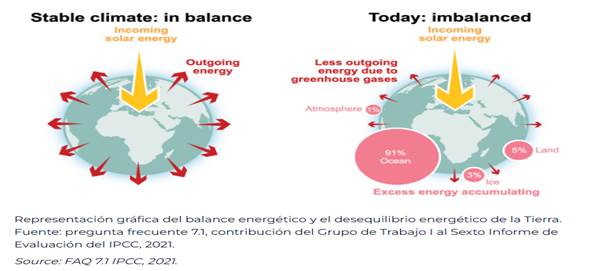
Capitalism is responsible both for the exhaustion of resources and for the production of enormous quantities of waste that daily pollute water, air, and land. The devastation of forests continues: every year 14.6 million hectares of woodland and thousands of species are lost, irreversibly reducing and eroding biological diversity (De la Cuadra, 2015). The loss of forest cover diminishes the planet’s capacity to absorb excess CO₂, thereby intensifying the greenhouse effect and global warming (see Figure 1).
Figure 1.
Earth’s energy imbalance.
The
information generated by scientists from the Intergovernmental Panel on Climate
Change (Masson-Delmotte et al., 2019) indicates that atmospheric carbon dioxide
levels have increased by 32% compared with the nineteenth century, reaching the
highest concentrations recorded in the last 20 million years (see Figure 2).
Figure 2.
Atmospheric carbon dioxide concentration index.
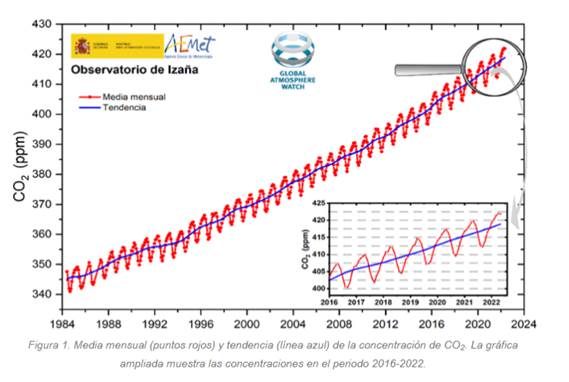
Source: Spanish State Meteorological Agency (AEMET).
The rate of species extinction has increased enormously in recent times (Pedrós-Alió, 2024) due to a variety of factors, all of them linked to an idea of progress based on the enrichment of a small segment of the world’s population at the expense of widespread misery — affecting both its inhabitants (billions of human and non-human lives alike) and the exploitation of land and sea through monoculture agriculture dependent on agrotoxic products, livestock farming, fishing, and pollution. Human activity has reached such a scale that it has triggered the Sixth Great Mass Extinction (Ceballos and Ortega-Baes, 2011).
At present, the pollution-related problems facing the world have not diminished; on the contrary, they are worsening at an ever-accelerating pace because scientific studies and reports continue to be repeatedly ignored by institutional politics. To disregard the overwhelming evidence concerning the catastrophic impacts of the current socioeconomic system constitutes crimes not merely against humanity, but on a far broader scale: a combination of ecocide, zoocide, and genocide, implying an underlying fascism directed against the totality of living beings (Del Val, 2025, pp. 151–153).
The Dark Side of Energy Production, Technological Development, and the Food System
The first source of energy used by human beings was biomass -that is, the combustion of wood (Davis et al., 2026)- which already led to the deforestation of vast forested areas throughout the planet and across history.
The second half of the eighteenth century marked a decisive turning point in production processes due to the use of coal as a new fuel source, triggering the Industrial Revolution, which represented the transition from an essentially agricultural and artisanal economy to a mechanized industrial model. Initially, the Industrial Revolution was assumed to have positive effects on reducing poverty and improving quality of life; however, the supposed benefits of industrialization proved illusory and merely contributed to increasing social inequality (Comín, 2014, p. 399). Nor were the environmental implications of the growing use of this energy source taken into consideration.
Years later, during the nineteenth century, the modern petroleum industry emerged, eventually joined by nuclear energy. With the consolidation of the extractivist model, corporations merged or absorbed one another, creating ever-larger entities concentrated in fewer hands (Eeckhout and Ganuza, 2022), while organizing themselves into lobbies or pressure groups in order to shape legislation in favor of their businesses, principally by reducing environmental requirements.
Extractivism -whether for resource extraction or energy production- requires territorial control, guaranteeing impunity in the dispossession of communities and the degradation of fertile lands, while exporting profits regardless of ecosystem destruction. It is this model that has perpetuated oppression, dispossession, and ecocide with the endorsement of governments, which enact laws ensuring corporations the legal framework required for the intensive extraction of resources and the exploitation of labor power (Dussán, 2017): a legal framework rooted in Roman Law, which privileges property over life itself (Silva-Fernández, 2019).
Fossil fuels -coal, gas, and oil- are the principal emitters of greenhouse gases when subjected to combustion processes (Andrade et al., 2017), while oil spills have caused the deaths of innumerable marine animals. Nuclear energy, for its part, involves unacceptable risks, generates highly contaminating waste that persists for thousands of years, and produces severe environmental impacts through uranium extraction (Coderech and Almirón, 2008).
As a supposed alternative, so-called green or renewable energies have emerged, though in reality they are far less “renewable” than commonly claimed, since they remain heavily dependent upon fossil fuels (Turiel, 2011).
A paradigmatic example is the El Quimbo hydroelectric project in Colombia, described in the book El Quimbo: Extractivism, Dispossession, Ecocide, and Resistance (Dussán, 2017). Communities affected by projects such as El Quimbo, and others of a similar nature, accuse corporations and the State of acting in collusion to appropriate territory through mechanisms such as forced displacement, disproportionate use of force, violations of legal provisions, and compulsory expropriation.
Corporate Strategies for Concealing Ecocide
The company responsible for the El Quimbo dam is Enel Colombia, a subsidiary of the Italian multinational Enel Group. Enel’s subsidiary in Spain is Endesa, which together with Iberdrola, Naturgy, EDP, and Acciona controls the electricity supplied to Spanish households. Naturgy, Iberdrola, and Repsol rank among the ten most polluting companies in Spain (Barrero, 2025). Globally, the corporations responsible for the highest percentages of emissions are Chevron, ExxonMobil, BP, and Shell.
In order to improve their public image, an increasing tendency has emerged toward the practice of greenwashing or “eco-posturing” (Martirosian et al., 2024), a form of advertising aimed at presenting a false “green and sustainable” image to consumers. In practice, this consists of making corporate practices appear more “eco-friendly” than they actually are through promotional campaigns for products or services, despite little or no substantive change, while concealing the environmental impacts generated by their activities.
As a consequence, consumers lack reliable information and may choose products or services that do not positively affect the environment, but instead produce significant impacts that corporations attempt to disguise. These corporations accumulate wealth at the expense of public funds through green image-laundering strategies and ethically questionable business practices.
As private international corporations, they also defend their economic and business interests within Europe. The EU Transparency Register makes it possible to see how much each company invests in lobbying activities and the meetings they hold in order to persuade Members of the European Parliament to shape legislation in their favor. Just three of these companies, together with the employers’ associations Aelec and Eurelectric, spend at least 1.5 million euros annually lobbying within the European Union. Eurelectric, the European electricity industry association, groups together Naturgy, Endesa, and Iberdrola, and generally acts as the primary intermediary with Members of the European Parliament. It spends approximately €100,000 per year and has held 93 meetings with parliamentarians since records began. It pays €10,000 to Rud Pedersen Public Affairs Brussels and another €10,000 to Sustainable Public Affairs in exchange for lobbying services within Parliament (Novoa, 2023).
The
Technological Lobby
The technological lobby is composed primarily of the companies Meta, Apple, Microsoft, Amazon, and Alphabet Inc., currently (March 2026) focused on preventing the European Union from approving any form of regulation concerning Artificial Intelligence (Barrio, 2025).
Technological development has dramatically intensified the extractivism of minerals essential to production processes. One well-known example of the extremely serious impacts associated with technological lobbies is the extraction of coltan in the Congo (Badi, 2020), a mineral necessary for the manufacture of electronic devices.
The Food Lobby
The food lobby is composed primarily of the industrial animal exploitation sector (IAEA) (Del Val, 2023), which is responsible for a highly significant percentage of polluting emissions and severe environmental damage.
The loss of vast areas of fertile land for the creation and maintenance of grazing areas, which began in Prehistory, continues to the present day. Every year enormous territories are intentionally burned for this purpose, regardless of whether the model is intensive or extensive livestock farming, thereby contributing substantially to the current ecological crisis. According to the FAO itself (2006), livestock farming is one of the principal causes of deforestation and, consequently, biodiversity loss.
More than three-quarters of all arable land is used to produce animal-based foods (Ritchie and Roser, 2024), including soybean, grain, and corn cultivation, as well as grazing land devoted to extensive livestock farming. Animal exploitation is therefore one of the leading causes of poverty and inequality worldwide (HSUS, 2009), creating the paradox whereby, while millions of people die from hunger each year, around seven billion terrestrial animals and countless marine animals are fattened for food consumption -especially for populations in the Global North- through the appropriation of ancestral lands from Indigenous populations, lands seized in order to generate economic profit through cultivation primarily intended for forage and animal feed production (Pendrill et al., 2019). Approximately 41% of all tropical land cleared worldwide is devoted to pasture and forage for extensive livestock operations, amounting to roughly 2.1 million hectares annually.
Animality, Hierarchization, and Fascism
The question of animal exploitation possesses an undeniable ethical and justice-based dimension. Strictly speaking, this is because other animals are individuals capable of subjectively experiencing life through pleasant and unpleasant sensations alike. From an anthropocentric Human Rights perspective, the dynamics of violence and domination merely change victims while their internal logic remains unchanged. Consequently, violence directed toward other animals ultimately impacts human beings negatively as well (Campoy, 2025). According to the philosopher Corine Pelluchon:
Animal advocates are anti-speciesist, and their convictions lead them toward veganism. Aware that their struggle forms part of the broader fight against all forms of discrimination — against slavery, racism, and sexism, against the exploitation of human beings by other human beings and of nations by other nations — they do not separate the defense of animals from the defense of human rights. Convinced that the animal cause is also the cause of humanity, and that reconciliation with other animals reconciles us with ourselves. (2018, pp. 80-81).
There are no valid reasons to respect only human beings, nor do we possess genuinely justified grounds for considering human interests more important than those of other animals (Horta, 2012), since we share the capacity to feel, to experience emotions and subjective states, which leads all sentient beings alike to seek pleasant experiences and avoid suffering. The evidence regarding the cognitive and social capacities of other animals is overwhelming (Cabrera, 2025), even among species evolutionarily distant from humans such as fish, mollusks, and crustaceans.
The more we study the behavior of aquatic species, the more surprising and familiar they become, since to their already well-known emotional capacities we must add their social abilities. If culture is understood as the transmission of knowledge, then it becomes evident that culture also exists among other animal species (Caicedo, 2016); indeed, learning to detect dangers proves more advantageous than inheriting such information genetically, since this permits more efficient adaptation.
For centuries the songs of birds, whales, and other cetaceans have been known, along with their role as cultural elements characterizing different species and clans. Numerous fish species have also been documented producing vocalizations resembling grunts or buzzing sounds that constitute a genuine language, similar to birdsong, used in communication, reproduction, feeding, and territorial defense behaviors.
Within schools of fish, just as in elephant herds, wolf packs, or even human societies, individuals acquire wisdom as they age. Longevity therefore becomes vital to group survival. This cultural inheritance enables animals to understand and adapt to their environment while transmitting knowledge to younger members; that is, animals learn individually from their surroundings while also acquiring and passing on social knowledge within the group. Collective memory allows entire clans to know where to find food, shelter, and breeding grounds, especially under adverse conditions. Other animals are therefore capable of assimilating knowledge, and this accumulated wisdom enables them to evolve. Nevertheless, all the information concerning the cognitive and social capacities of other animals has not produced the social impact one might have expected; on the contrary, their exploitation and use have only continued to increase.
Humanity has never been characterized by respect toward other animals; the Enlightenment marked a particularly important turning point in the contempt directed against them. According to the philosopher René Descartes (Rodríguez, 2020), only human beings possess mind, soul, and sentience, while all other animals are little more than mechanical machines responding automatically to stimuli. This conception became foundational to modern animal exploitation by establishing the dualistic divide between science and spirit, human and animal. The dualistic worldview creates a hierarchy, privileging categories, considered rational -mind, reason, science, man, human- over supposedly irrational or emotional categories: spirit, feeling, nature, woman, animal. Contempt toward animality thus became one of the foundations of the system of exploitation.
Other thinkers challenged this anthropocentric vision. In Dialectic of Enlightenment, Theodor W. Adorno and Max Horkheimer (1998) argue that rationality, when used to justify the domination of nature and other animals, ultimately leads to fascism. They analyze how Nazism employed species-based discrimination to justify genocide by reducing certain human beings to an inferior, animalized status.
In Mínima Moralia, Theodor W. Adorno (2001) reflects upon human cruelty, arguing that indifference toward the suffering of others brutalizes society, rendering it capable of atrocities such as those committed at Auschwitz concentration camp. He warns of fascist tendencies within modern society linked to violence and lack of empathy, tendencies also manifested in humanity’s treatment of other animals. Adorno also proposed a fascism-of-personality scale, known as the F-Scale.
Charles Patterson (2009) directly connects animal exploitation in the United States with the Nazi Holocaust through the common root he identifies between the subjugation and extermination of other animals and the genocide perpetrated by the Third Reich. He dedicates a remembrance to Isaac Bashevis Singer by citing one of his most famous reflections:
Deep inside himself, Herman recited an elegy for the rat that had shared part of his life and which, because of him, had left this world. ‘What do they know -all those scholars, all those philosophers, all the leaders of the world- about someone like you?’ They have convinced themselves that man, the worst transgressor among all species, is the king of creation. All other creatures were created solely to provide him with food and clothing, to be tormented and exterminated at his whim. As far as they are concerned, all humans are Nazis; for animals, life is an eternal Treblinka.” Isaac Bashevis Singer, The Letter Writer. (Patterson, 2009, p. 7).
The writer and activist Aph Ko (2023) reflects upon the relationship between speciesism and racism: “Animal” becomes a category into which certain bodies are pushed whenever violence against them must be justified; for this reason, animal liberation should concern all marginalized groups. So long as animals remain oppressed, so long as “animal” remains a degrading category, none of us can truly be free. To animalize certain human collectives means stripping them of value: “Colonization added a racial connotation to ‘animal’ and used this as justification for brutalizing different beings globally” (p. 84).
Angela Davis, feminist and anti-speciesist activist, argues that struggles against oppression must be intersectional because all forms of oppression are interconnected. She strongly advocates introducing a transversal perspective into feminist struggles, maintaining that in a world where oppressions converge and interconnect, solidarity and resistance must likewise emerge in shared and collective form (García, 2023).
In contrast to the unlimited exploitation of sentient beings, veganism (Rodríguez, 2024) is the ethical principle opposed to the use of other animals in any sphere (whether for food, clothing, or entertainment) on the grounds that their complex social and cognitive capacities make them deserving of respect. The more we learn about nature and other animals, the more we must recognize that the traditional justifications placing human beings above other species -and therefore as their masters and owners- lack any genuine scientific basis. A vegan approach must also incorporate a degrowth-oriented and decolonial perspective, with the aim of causing the least possible harm.
Veganism is not a white privilege. Native activist Margaret Robinson (2020) offers a reinterpretation of the principal legends of Mi’kmaq folklore in order to identify parallels connecting anti-speciesist ethics with the Mi’kmaq moral and social understanding of their relationship with non-human animals and with nature.
Margaret Robinson (2020) challenges the stereotype associating veganism with a “First World” privilege belonging to economically comfortable white urbanites, demonstrating that veganism is not only compatible with Mi’kmaq culture, traditions, and identity, but may in fact constitute the only contemporary means through which the Mi’kmaq people can preserve their rootedness against the distorted versions of their traditions returned to them by genocidal colonizers, while remaining faithful to their own history and past, a past, moreover, continually open to reinterpretation:
Shared food practices, values, and rituals of daily life can create bonds among Native peoples that help counter the isolation and individualism of urban life; veganism offers us a sense of belonging to a moral community whose values and worldview become concrete through daily practices aligned with the values of our ancestors, even when they differ from traditional practices, remaining sensitive to changing social and environmental circumstances. By bringing postcolonial and ecofeminist interpretations to our stories, by retelling traditional stories or creating new ones, Native women reclaim authority over our culture. In doing so, we recognize that our oral traditions are not fixed in time and space, but adaptable to the needs of our animal relatives and of the land itself. (Robinson, 2020).
Conclusions
The traditional supremacist worldview has reduced the idea of progress to the economic growth of a series of corporate entities chiefly responsible for environmental destruction, social injustice, the deaths of human and non-human animals alike, and the climatic imbalances already being directly experienced in everyday life.
More than half a century ago, scientific reports were published warning of the environmental risks humanity would face if the same economic model continued unchanged. Their predictions are now being fulfilled with tragic accuracy. As an alternative, it may be argued that quality of life does not consist in limitless consumption, but rather in moving toward a society founded upon respect and consideration for the other inhabitants of the planet.
Moreover, animal exploitation also carries consequences for wild species, since both terrestrial and aquaculture farms occupy territories taken away from wild animals while simultaneously becoming centers for the spread of disease. Given these effects, the concept of veganism itself may prove too narrow, and it may be more inclusive to speak instead of Animal Rights, not merely as the fundamental right to life, but also as the right to enjoy a healthy habitat. This directly connects the question to ecology: an ecology that takes into account both the environment and the well-being of each and every one of its inhabitants, respecting their inherent value.
Since prehistory, the use of other animals has served to sustain a supremacist worldview -classist, racist, and colonial- which culminates in fascism as the ultimate expression of authoritarianism. The belief that there exist “others” whose rights do not deserve respect, and whose existence is determined by the whims of a minority exercising power through violence, has enabled elites to accumulate wealth and authority through genocide, zoocide, and ecocide, with the acquiescence of a majority that remains indifferent in the face of injustice. If the origins of hierarchization -and consequently of fascism- begin with the use and subjugation of other animals, then animal liberation may be understood as the foundation of human liberation itself: the first oppression, the first link in the chain of power.
References
Adorno, T. W. (2001). Mínima Moralia. Taurus.
Adorno, T. W. & Horkheimer, M. (1998). Dialéctica de la Ilustración. Trotta.
Agudelo, N. (2016). La Crisis Ecológica Global: Consideraciones Preliminares. Luna Azul, (43), 1-14. https://doi.org/10.17151/luaz.2016.43.1
Alaminos, V. (2024). La extinción de la megafauna del Pleistoceno. ¿análoga con la actual? [Trabajo de Fin de Máster]. Universidad de Zaragoza. https://zaguan.unizar.es/record/152312
Álvarez, L. (2026). Colonization, Food, and the Practice of Eating. Food Empowerment Project. https://foodispower.org/es/our-food-choices/colonization-food-and-the-practice-of-eating/
Amorós, M. (2017). Contra la nocividad, anarquismo, antidesarrollismo, revolución. Grietas Editores. https://redipaz.weebly.com/uploads/1/3/3/7/13372958/libro-amoros__1_.pdf
Andrade-Castañeda, H. J., Arteaga-Céspedes, C. C., & Segura-Madrigal, M. A. (2017). Emisión de gases de efecto invernadero por uso de combustibles fósiles en Ibagué, Tolima (Colombia). Ciencia y Tecnología Agropecuaria, 18(1),103-112. https://www.redalyc.org/articulo.oa?id=449949161006
Arceo, A., & Álvarez, S. (2023). La necesidad de regular las actividades de "lobbying" en España: Un camino hacia la estandarización de la transparencia. IROCAMM - International Review Of Communication And Marketing Mix, 6(2), 9–22. https://doi.org/10.12795/IROCAMM.2023.v06.i02.01
Badi, M. K. (2020). Extractivismo, conflictos y ecocidio en África: el caso de la cuenca del río Congo (República Democrática del Congo) y del delta de Níger (Nigeria). Estudios Críticos del Desarrollo, X(19), 123-178. https://estudiosdeldesarrollo.mx/estudioscriticosdeldesarrollo/wp-content/uploads/2022/02/ECD19-4.pdf
Barrero, A. (January 29, 2025). Naturgy, Repsol e Iberdrola, las tres empresas más contaminantes de España. Energías Renovables. https://www.energias-renovables.com/panorama/naturgy-repsol-e-iberdrola-las-tres-empresas-20250129
Barrio, M. (July 8, 2025). Los ‘lobbies’ tecnológicos quieren frenar la aplicación de la ley europea de inteligencia artificial. The Conversation. https://doi.org/10.64628/AAO.jfdq6atra
Braga, J. P. (2024). ¿Ha fallado el Estado de Bienestar Social? desde el malestar ciudadano hacia la posibilidad de la imaginación institucional. Astrolabio: Revista Internacional de Filosofía, 1(29), 1–17. https://doi.org/10.1344/astrolabio.v1i29.47978
Cabrera, D. (2025). Las Declaraciones de Cambridge y de New York sobre la conciencia en animales no humanos y su repercusión filosófica. Revista Científica de la Facultad de Filosofía, 22(2), 466-474. https://revistascientificas.una.py/index.php/rcff/article/view/6196/4787
Caicedo, Ó. D. (2016). ¿Cultura animal no humana? Hacia un nuevo concepto de cultura desde la biología evolutiva [Tesis Doctoral]. Universidad de Salamanca. https://hdl.handle.net/10366/132919
Campoy,
D. R. (2025). Conexiones entre la ética animalista y la protección de los
derechos humanos en el marco de los objetivos de desarrollo sostenible. Universitas.
Revista de Filosofía, Derecho y Política, (47), 302-341. https://doi.org/10.20318/universitas.2025.9588
Cartwright, M. (November 17, 2022). Caída de la Compañía Británica de las Indias Orientales. World History Encyclopedia. https://www.worldhistory.org/trans/es/2-2096/caida-de-la-compania-britanica-de-las-indias-orien/
Ceballos, G. & Ortega-Baes, P. (2011). La sexta extinción: la pérdida de especies y poblaciones en el Neotrópico. En J. Simonetti y R. Dirzo (Eds.), Conservación biológica: perspectivas de Latinoamérica (pp. 95-108). Editorial Universitaria.
Cintas, M. (2018). La Desigualdad de Género en la Prehistoria Ibérica: Una Aproximación Multi-Variable [Tesis Doctoral]. Universidad de Sevilla. https://hdl.handle.net/11441/77665
Coderech, M. y Almirón, N. (2008). El espejismo nuclear. Por qué la energía nuclear no es la solución, sino parte del problema. Los libros del lince.
Comín, F. (2014). Historia económica mundial: De los orígenes a la actualidad. Alianza Editorial.
Davis, R., Hatch, M., Hoare, S. et al. (2026). Earliest evidence of making fire. Nature, 649, 631–637. https://doi.org/10.1038/s41586-025-09855-6
De la Cuadra, F. (2015). Buen Vivir: ¿Una auténtica alternativa post-capitalista? Polis, 14(40), 7-19. https://dx.doi.org/10.4067/S0718-65682015000100001
Del Val, J. (2023). 1st liveable futures report: Food of mass destruction—How exploiting animals drives us to extinction. Reverso/MetabodyInstitute. https://metabody.eu/wp-content/uploads/2024/03/1st-LIVEABLE-FUTURES-REPORT-Full-August2023-v.1.1-dec2023.pdf
Del Val, J. (2025). Metacuerpos: Un contrapocalipsis. Filosofía del movimiento y Liberación Terrestre. Reverso/MetabodyInstitute. https://metabody.eu/es/metacuerpos-libro/
Díaz, J. M. (2018). La Carrera de Indias (1650-1700): Continuidades, rupturas, replanteamientos. e-Spania. Revue interdisciplinaire d’études hispaniques médiévales et modernes, 29, texte integral. https://doi.org/10.4000/e-spania.27539
Dorgbetor, I. K., Ondrasek, G., Kutnjak, H., & Mikuš, O. (2022). What if the world went vegan? A review of the impact on natural resources, climate change, and economies. Agriculture, 12(10), 1518. https://doi.org/10.3390/agriculture12101518
Dussán, M. A. (2017). El Quimbo. Extractivismo, despojo, ecocidio y resistencia. Planeta Paz.
https://www.bibliotecaplanetapaz.org/bitstream/handle/bpp/63/El%20Quimbo-%20Extractivismo%2C%20Despojo%2C%20Ecocidio%20y%20Resistencia.pdf?sequence=
Earle, R. (2012). The Body of the Conquistador. Food, Race and the Colonial Experience in Spanish America, 1492-1700. Cambridge University Press. https://doi.org/10.1017/CBO9780511763359
Eeckhout, J. y Ganuza, J. J. (2022). El excesivo poder de mercado de las grandes empresas afecta negativamente a los salarios y aumenta la desigualdad. Instituto Valenciano de Investigaciones Económicas. https://www.ivie.es/es_ES/excesivo-poder-mercado-las-grandes-empresas-afecta-negativamente-los-salarios-aumenta-la-desigualdad/
FAO. (2006). Livestock’s long shadow: Environmental issues and options. Food and Agriculture Organization of the United Nations.
https://www.fao.org/3/a0701e/a0701e00.htm
Fernández, J. M. (1980). Catálogo de 152 documentos de la Mesta del Archivo Histórico Nacional. Archivos Leoneses, XXXIV(68), 329-384. https://pares.mcu.es/ParesBusquedas20/catalogo/description/172318
Gargía, D. P. (2023). Angela Davis y la asignatura pendiente de la interseccionalidad. Paideia: Revista de filosofía y didáctica filosófica, (118), 233-259.
https://dialnet.unirioja.es/servlet/articulo?codigo=9168266
Horta, O. (2012). Tomándonos en serio la consideración moral de los animales: más allá del especismo y el ecologismo. En J. Rodríguez (Ed.), Animales no humanos entre animales humanos (pp. 191-226). Plaza y Valdés.
HSUS. (2009). An HSUS Report: The Impact of Industrialized Animal Agriculture on World Hunger. The Humane Society of the Unites States. https://www.humaneworld.org/sites/default/files/docs/hsus-report-industrialized-animal-agriculture-world-hunger.pdf
IPCC. (2021). IPCC Sixth Assessment Report. Working Group 1: The Physical Science Basis. https://www.ipcc.ch/report/ar6/wg1/resources/frequently-asked-questions/
Ko, A. (2023). El racismo como brujería zoológica. Una guía para escapar. Ochodoscuatro ediciones.
https://ochodoscuatroediciones.org/wp-content/uploads/2023/06/tripas_RAZ.pdf
Martirosian,
K., Santana, C. y Seara, J. D. (2024). Greenwashing: la máscara verde de la
sostenibilidad. Enfoque en los estados financieros de Endesa e Iberdrola
[Trabajo de Fin de Grado]. Universidad de La Laguna, Tenerife. http://riull.ull.es/xmlui/handle/915/38638
Masson-Delmotte, V., Pörtner, H.-O., Skea,
J. … Waterfield,
T. (2019). Calentamiento global
de 1,5°C: informe especial del IPCC sobre los impactos del calentamiento global
de 1,5 ºC con respecto a los niveles preindustriales y las trayectorias
correspondientes que deberían seguir las emisiones mundiales de gases de efecto
invernadero, en el contexto del reforzamiento de la respuesta mundial a la
amenaza del cambio climático, el desarrollo sostenible y los esfuerzos por
erradicar la pobreza: resumen para responsables de políticas: resumen técnico:
preguntas frecuentes. IPCC
(Grupo Intergubernamental de Expertos sobre el Cambio Climático). https://bibliotecasemiaridos.ufv.br/handle/123456789/338
McConnell, J. R., Chellman, N. J., Plach, A., Wensman, S. M., Plunkett, G., Stohl, A., Smith, N., MøllesøeVinther, B., Dahl-Jensen, D., Steffensen, J. P., Fritzsche, D., Camara-Brugger, S. O., McDonald, B. T. & Wilson, A. I. (2025). Pan-European atmospheric lead pollution, enhanced blood lead levels, and cognitive decline from Roman-era mining and smelting. Proceedings of the National Academy of Sciences (PNAS), 122(3), e2419630121.
https://doi.org/10.1073/pnas.2419630121
Meadows, D. H., Meadows, D. L., Randers, J. & Behrens III, W. W. (1972). The Limits to Growth. A Report for the Club of Rome's Project on the Predicament of Mankind. Universe Books. https://archive.org/details/limitstogrowthr00mead
Mira, P. C. (2026). Justiça social e exploração animal: reflexões sobre uma aliança impossível. (Des)troços: Revista de pensamento radical, 6(2), e60783. https://doi.org/10.53981/destrocos.v6i2.60783
Novoa, R. (2023). Radiografía del lobby energético. Alianza contra la Pobreza Energética, Asociación Internacional de Ingeniería Sin Fronteras y Fossil Free Politics.
https://esf-cat.org/wp-content/uploads/2023/10/Radiografia-Lobby-Energetico-ESF-APE-FossilFreePolitics.pdf
Patterson, C. (2009). ¿Por qué maltratamos tanto a los animales? Un modelo para la masacre de personas en los campos de exterminio nazis. Editorial Milenio.
Pedrós-Alió, C. (2024). Biodiversidad ¿Con cuántos seres vivos compartimos la Tierra? CSIC y Catarata.
Pelluchon, C. (2018). Manifiesto animalista. Politizar la causa animal. Reservoir Books.
Pendrill, F., Martin, U., Godar, J. & Kastne, T. (2019). Deforestation displaced: trade in forest-risk commodities and the prospects for a global forest transition. Environmental Research Letters, 14, 055003. https://doi.org/10.1088/1748-9326/ab0d41
Ritchie, H. & Roser, M. (February 16, 2024). Half of the world’s habitable land is used for agriculture. Our World in Data. https://ourworldindata.org/global-land-for-agriculture
Robinson, M. (2020). Veganism and Mi’kmaq legends. En K. Struthers y C. Taylor (Eds), Colonialism and Animality. Anti-Colonial Perspectives in Critical Animal Studies (pp. 107–114). Routledge. https://www.thetedkarchive.com/library/kelly-struthers-montford-and-chloe-taylor-colonialism-and-animality
Rodríguez, S. G. (2020). Descartes y el pensamiento animal: acciones exteriores vs. acciones interiores. Daimon. Revista Internacional de Filosofía, (79), 161-176. http://dx.doi.org/10.6018/daimon.315391
Rodríguez, V. M. (2024). Hacia nuevas relaciones entre humanos y animales: una aproximación sociológica a los discursos y significados de cinco activistas veganos por la liberación animal en la ciudad de Iquique, Chile. Astrolabio. Nueva Época, (33), 217-222. https://doi.org/10.55441/1668.7515.n33.42257
Roebroeks, W., MacDonald, K., Scherjon, F., Bakels, C., Kindler, L., Nikulina, A., Pop, E., Gaudzinski-Windheuser, S. (2021). Landscape modification by Last Interglacial Neanderthals. Science Advances, 7(51), eabj5567. https://doi.org/10.1126/sciadv.abj5567
Salgado, A. (December 16, 2021). El comercio internacional de la lana castellana. Revista Digital. https://acef.cef.es/comercio-internacional-lana-castellana.html
Sánchez-García, C. J., Revelles, F., Burjachs, I., Euba, I., Expósito, J., Ibáñez, L., Schulte, J., Fernández-López de Pablo, J. (2024). What burned the forest? Wildfires, climate change and human activity in the Mesolithic – Neolithic transition in SE Iberian Peninsula. Catena, 234, 107542. https://doi.org/10.1016/j.catena.2023.107542
Shakespeare, W. (2026). La Tempestad. Freeditorial. https://www.suneo.mx/literatura/subidas/William%20Shakespeare%20La%20Tempestad.pdf
Silva-Fernández, R. (2019). La posesión frente al derecho de propiedad: un debate sobre vigencia y pertinencia sin resolver. Revista Eleuthera, 20, 135-154.
https://doi.org/10.17151/eleu.2019.20.8
Turiel, A. (2011). Por qué las renovables no van a resolver la crisis energética [entrada blog]. The Oil Crash.
https://crashoil.blogspot.com/2011/04/por-que-las-renovables-no-van-resolver.html