Revista Internacional de Educación y Análisis Social Crítico Mañé, Ferrer & Swartz.
ISSN: 2990-0476
Vol. 4 Núm. 1 (2026)
The key themes of the ecosocial crisis that activism itself silences: diets, degrowth and demography, or the 3D puzzle of extinction
Los temas clave de la crisis ecosocial que el propio activismo silencia: dietas, decrecimiento y demografía oel puzle de la extinción en 3D
Os temas centrais da criseecossocial que o próprio activismo silencia: as dietas, o decrescimento e a demografia, ou o enigma tridimensional da extinção.
Jaym*/Jaime del Val
Instituto Metabody, Madrid, Spain
Asociación Transdisciplinar Reverso, Madrid, Spain
https://orcid.org/0009-0003-0045-7852
jaimedelval@metabody.eu
Abstract
This article addresses the prevailing confusion and misinformation surrounding the main responses to the ecosocial crisis. It presents a comparative literature review and draws conclusions about the three priority responses, which we call 3D: transition to plant-based diets, deep degrowth, and the demographic taboo of overpopulation, issues systematically excluded from current eco-socio-animal activism. Using anthropological and philosophical arguments, the article questions the predominance of anthropocentric and Eurocentric frameworks in mainstream activism and proposes a “degrowth continuum” that considers zero impact on the biosphere as a maximalist and realistic option. Finally, it briefly explains the reasons for the prevailing systemic double denial of these issues: explicit denial, based on misinformation disseminated by lobbyists, and implicit denial, imposed by widespread human supremacism and the unwillingness of people in wealthy countries to question their privileges and comforts. The set of proposals presented in this article, which focuses on correcting anthropocentric and Eurocentric biases in prevailing discourses within contemporary society and global activism, aims to offer critical intersectional tools to overcome disinformation and the biases of human supremacism, which are presented as a sine qua non for a livable future.
Keywords: Crisis, anthropocentrism, diet, degrowth, overpopulation, extinction, disinformation.
Resumen
El artículo aborda la confusión y desinformación imperante sobre las principales respuestas ante la crisis ecosocial, haciendo un estudio comparado de literatura,y extrayendo conclusiones sobre las tres respuestas prioritarias,que llamamos 3D: transición de Dietas vegetales, Decrecimiento profundo, y el tabú Demográfico de la superpoblación, cuestiones que se excluyen de forma sistemática en el activismo eco-socio-animal actual. Desde argumentos antropológicos y filosóficos se cuestiona la predominancia de marcos antropocéntrios y eurocéntricos en las propuestasdel activismo predominante, y se propone un “continuum decrecentista” que contemple como opción maximalista y realista un impacto cero en la biosfera. Finalmente, se exponen brevemente los motivos por los que impera un doble negacionismo sistémico de estas cuestiones: el explícito, siguiendo la desinformación impuesta por los lobbies, y el implícito, impuesto por el supremacismo humano generalizado y la falta de voluntad de personas de países ricos a cuestionarse privilegios y comodidades. El conjunto de propuestas del artículo, cuyo eje es la corrección de sesgos antropocéntricos y eurocéntricos en los discursos imperantes en la sociedad y el activismo global actuales, está destinado a ofrecer herramientas críticas interseccionales con las que sortear la desinformación y los sesgos del supremacismo humano, lo cual se presenta como condición sine qua non para un futuro vivible.
Palabras clave: Crisis, antropocentrismo, dieta, decrecimiento, superpoblación, extinción, desinformación.
Resumo
Este artigo aborda a confusão e a desinformação prevalecentes em torno das principais respostas à crise ecossocial. Apresenta uma revisão comparativa da literatura e tira conclusões sobre as três respostas prioritárias, que designamos por 3D: transição para dietas baseadas em vegetais, decrescimento profundo e o tabu demográfico da sobrepopulação — questões sistematicamente excluídas do atual ativismo ecossocial e animal. Recorrendo a argumentos antropológicos e filosóficos, o artigo questiona a predominância das perspetivas antropocêntricas e eurocêntricas no ativismo convencional e propõe um “contínuo de decrescimento” que considera o impacto zero na biosfera como uma opção maximalista e realista. Por fim, explica brevemente as razões para a dupla negação sistémica prevalecente destas questões: a negação explícita, baseada na desinformação disseminada pelos lobistas, e a negação implícita, imposta pelo supremacismo humano generalizado e pela relutância das pessoas dos países ricos em questionar os seus privilégios e confortos. O conjunto de propostas apresentado neste artigo, que se centra na correção dos enviesamentos antropocêntricos e eurocêntricos nos discursos predominantes na sociedade contemporânea e no ativismo global, visa oferecer ferramentas interseccionais críticas para superar a desinformação e os enviesamentos da supremacia humana, que se apresentam como condição sine qua non para um futuro habitável.
Palavras-chave: Crise, antropocentrismo, dieta alimentar, decrescimento, sobrepopulação, extinção, desinformação.
Introduction: The House Is Burning and We're Dusting
Faced with an extinction crisis unprecedented in Earth's history, humanity today seems submerged in a multifaceted denialist psychosis: denying the severity of the crisis, its root causes, and the necessary responses. While the house (the planet) is burning, humanity is dusting, fixing leaks, or engaging in lengthy discussions about minor improvements in an imagined future that we are desperately trying to eliminate. Global activism has an anthropocentric and largely Eurocentric bias, avoiding the elephant in the room -human supremacist ways of life based on the complete exploitation of life- while lobbies flood societies with a tsunami of disinformation. This occurs despite the fact that from every corner of modern science, as well as from anthropology and philosophy, among other disciplines, there are scattered cries in the opposite direction, though these cries remain invisible, "hidden at first glance." Here we bring together some pieces from that extensive, fragmented literature, synthesize them, and purge them of anthropocentric biases, among others, in order to offer a clear overview with a new intersectional approach.
Thus, for example, the transition to plant-based diets is recognized as the main response to the ecosocial crisis in more than 100 collected and compared institutional reports (Del Val, 2023). However, this elephant in the room is ignored and silenced in the vast majority of current ecosocial and degrowth movements, starting with large environmental NGOs, which promote serious misinformation by defending extensive livestock farming instead, which is precisely what has the most harmful effects on the climate and biodiversity crisis (Del Val and Mas, 2024).
On the other hand, degrowth often presents a cosmetic discourse based on Eurocentric and anthropocentric ontologies, as if a series of patches could sustain an industrialized civilization and the ubiquitous presence in the biosphere of 8 billion or more sedentary humans, ignoring the devastating impact this has on other life forms. Deep degrowth, in contrast, proposes an urgent dismantling of exploitative civilization, learning from the ways of life and ontologies of Indigenous communities (Yunkaporta, 2023). This, in turn, makes it inevitable to address the taboo of overpopulation from a radically democratic and queer approach to voluntary antinatalism, based on dismantling heteropatriarchy, empowering women, and defending sexual and affective diversity, exposing the link between population growth, growth economy, and human supremacism, since the Neolithic to the present day.
The way in which these three major issues -what we call 3D: Plant-Based Diets, Deep Degrowth, and Demography, and which are central to VegAnarQueer principles- is systematically avoided is proposed as the central problem of our time. This problem is supposedly based on assumptions of human supremacism and the privileges of people in the Global North, as well as the power of lobbies (and on the other the lack of alternative emancipatory discourses and the understandable and ensuing resistance of more vulnerable minoritiies to give away the suicidal narrative of progress and Enlightenment narratives). It reveals a profound, unrecognized anthropocentrism within degrowth, ecosocial and even animal rights activism, and critical intellectual circles, which co-opts discourses on other relational ontologies and on other modes of conviviality for livable futures. This, in turn, is associated with an insufficient recognition of the radical nature of the crisis, its current acceleration, and the scenario of collapse and extinction it poses in the short term, as well as its deep historical causes. Addressing all of this is key to a 3R response: Resistance, Reinvention, and Regeneration.
To address the prevailing confusion and misinformation, we will propose a puzzle of necessary visions and proposals, outlining the central and transversal pieces -the so-called 3D elements-as well as a review of degrowth ontologies associated with a degrowth continuum. Between cosmetic and profound degrowth, where do we choose to position ourselves and why? To answer this, we will synthesize scientific and anthropological literature, challenging anthropocentric biases from a philosophical perspective.
Methodology: Intersectional Critical Metasynthesis
This paper follows an intersectional methodology based on establishing multiple relationships between the vast body of literature I have been studying for over 20 years, both from a philosophical perspective and from the perspective of participation in diverse activist circles. The article's critical approach also stems from my own experience of the shortcomings and problems I have repeatedly observed within this body of work, and on which I have published specific sectoral writings and reports cited here. To this end, I have selected some of the existing sources, paying attention to those that propose a broader methodology, considering the greatest number of factors in impact assessment, or to those considered important references within the literature or activism itself. Texts that, in turn, synthesize broader literature are synthesized, establishing relationships between, often, separate fields, and subjecting them to an anthropological-philosophical critique, a process which I call intersectional critical metasynthesis.
This comparative literature survey has a primary mission: to highlight key themes that are either insufficiently recognized or not sufficiently acknowledged, establishing interconnections between topics that are usually treated separately, and highlighting inconsistencies arising from the lack of intersectional approaches. It then repositions the discussion within an even broader framework of possible ontologies. To this end, anthropology contributes a series of relevant arguments by presenting evidence that challenges the Eurocentric civilizational model and that can serve to broaden the horizons of possible degrowth, while philosophy acts as a filter for anthropocentric biases. Throughout, the study points to a common denominator in all the problems, both in systemic impacts, and in the disinformation that masks them: human supremacism and its dual expression in deeply rooted beliefs and in the active lobbies that sustain them. We talk about a common thread that binds the entire proposal together.
Highway to Climate Hell: or the Dead End on the Highway to Extinction. Under-recognized evidence and dimensions of the crisis.
In July 2022, the UN General Assembly stated that “environmental degradation, climate change, biodiversity loss, desertification, and unsustainable development are among the most pressing and serious threats to the ability of present and future generations to effectively enjoy all human rights” (UNGA, 2022). According to UN reports on climate change (IPCC, 2023) and biodiversity (IPBES, 2019, 24-27; SCBD, 2020, 2-9), and more than 15,000 scientists (Ripple et al., 2017), humanity faces an unprecedented challenge in history, an existential threat to civilization (Lenton et al., 2019, 4; Sprat and Dunlop, 2019). The UN has repeatedly warned of a threat of extinction due to the exponential deterioration of living conditions for humans and millions of other species on Earth caused by human activity. Planetary boundaries have already passed the "safe zone for humanity" (Richardson et al., 2023). Massive threats to human health and life, equality, food security, and peace are already visible and underway due to climate breakdown and ecosystem disruption (IPCC, 2023, 12-18), threats that, far from diminishing, are growing exponentially (Ripple et al., 2020).
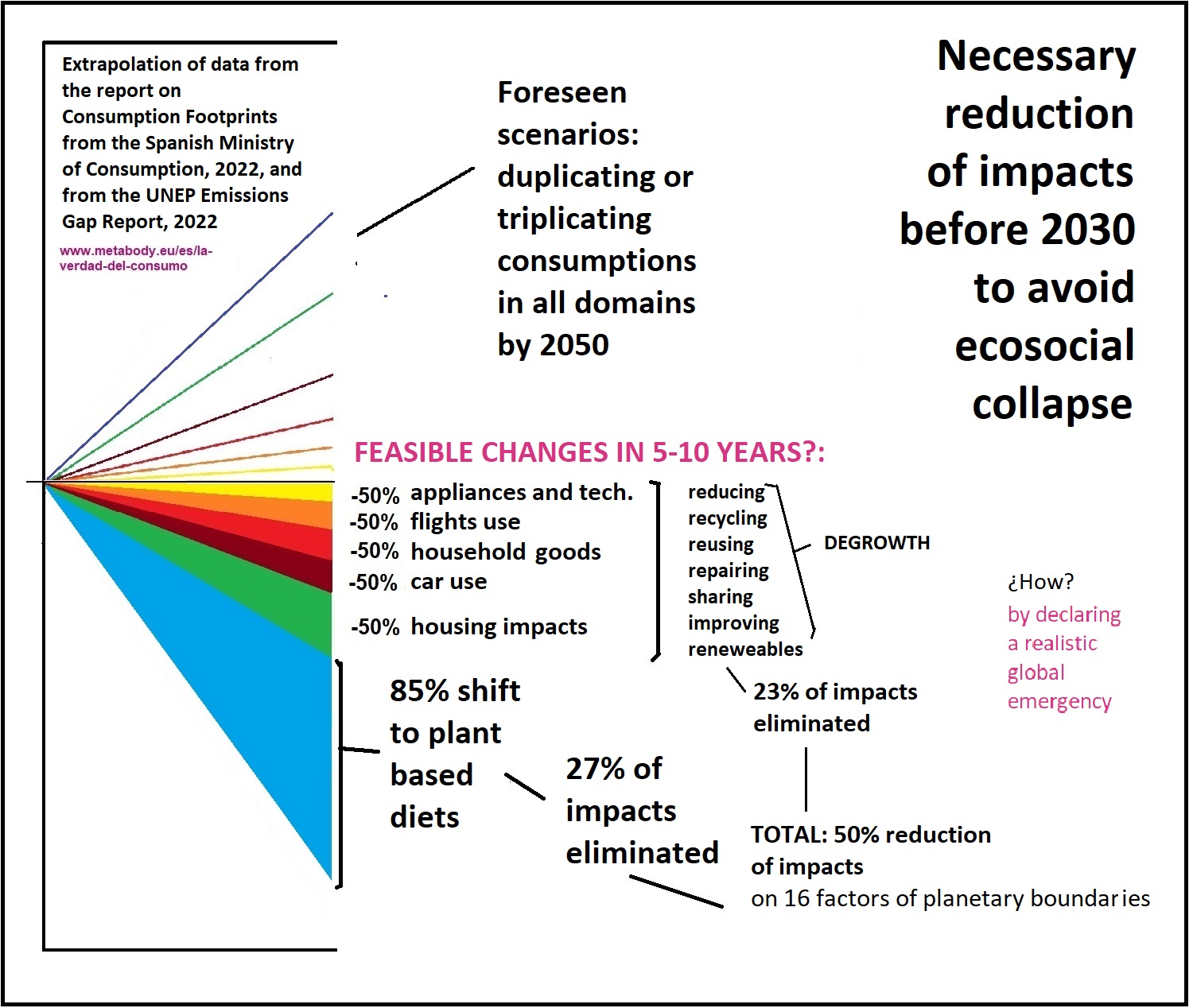
This is largely due to the blatant inaction of states and industries over the past six decades, so that the window of opportunity has now shrunk to just the next five years, or less: 2030 (IPCC, 2023, 21) (Fig. 1), even though the problem has been known for at least 55 years (Meadows et al., 1972). The further we go, the greater the shock measures required, and very soon it will be too late to avoid an ecosocial collapse: it is now or never (Ripple et al., 2020). Instead of mitigating the impacts, the current situation continues its trend of exponentially increasing them, with per capita consumption projected to double by 2050 for a growing population. Current projections suggest this could lead to an increase in the average global temperature of more than 5 degrees Celsius this century: an extinction scenario.
Figure 1.
Necessary reductions by 2030.
According to a recent report from the University of Exeter, current scenarios suggest that 4 billion people are likely to die in the decades following 2050, along with a 50% drop in global GDP, the dissolution of states, and the collapse of social and natural systems (Trust et al., 2025). This is consistent with figures from IPCC reports, which since at least 2021 have warned of 3.6 billion people living in areas highly vulnerable to climate change, and therefore subject to famine, water scarcity, and desertification, among other consequences.
Bioeconomist John Gowdy (2020) even raises the question of whether agriculture can be sustained in the face of the coming climate instability, proposing a return to nomadic hunter-gatherer societies as a realistic alternative (albeit incompatible with current overpopulation). Added to this is the expected collapse of the industrial-digital society due to resource scarcity (Turiel, 2020).
Deep Historical Causes
We propose that the deep roots of the problem are much older than capitalism and industrialization, and lie in the systemic exploitation of other life forms (animals, plants, ecosystems, and materials) that emerged in the Neolithic. This exploitation is associated with a tendency toward homogeneous accumulation -from which property also arose- and broadly speaking, human inequality, with colonialism and capitalism being later phases of this trend. It would not be enough, therefore, to propose having less of the same in order to sustain this type of exploitative civilization. This involves questioning the deep ontology, the worldview associated with cultures of exploitation, and contrasting it with other ontologies, generally indigenous or non-human (post-/metahumanist), giving alternative perspectives.
Numerous anthropologists and historians (Harari, 2015; Kent, 1992; Lee 1965, 1977; Leakey y Lewin, 1977; Sahlins, 1968, 2017; Scott, 2017; Suzman, 2021) agree that agriculture radically worsened the quality of life of hunter-gatherer societies, introducing our entire vocabulary of worry, accumulation, planning, and scarcity, while simultaneously propelling exponential population growth. This growth is associated with forms of organization whose oppression and toxicity have increased in parallel with the rise in the scale of organization and population.
This refers to the anthropological theory of the Original Affluent Society, originating in the 1960s (Sahlins, 1968, 2017), which presents a revolutionary argument that has not yet received due attention, as it overturns the supremacist human narrative that sedentary civilization is better, that there are no alternatives. Suzman (2021) aptly summarizes the key to egalitarianism and respect for the environment in the remaining hunter-gatherer societies, such as the Ju/’hoansi of the San people in the Kalahari in Africa: they never accumulate, they only gather what they need each day, and they do not have sedentary settlements; they do not exploit plants, the land, or other animals. They move with the flows and forms of life, not against them.
This idyllic image often face difficult living conditions where the need to share is not always peaceful. While others, such as Graeber and Wengrov (2022), have sought to defend certain forms of early agriculture, the truth is that, broadly speaking, the image still holds true 50 years later.
The international scientific community, the UN, and many other institutions have been asserting for decades that the main cause of the crisis, even more than fossil fuels, is the food industry, whose impact is roughly 80% related to animal-based foods. However, this central factor, both historically and currently, is also the most silenced, completely absent from national and global agendas.
All of the above resonates with issues such as the centrality of biodiversity and symbiotic alliances in life-sustaining processes, for example, natural plague control and so-called “landscape immunity” (Plowright et al., 2021), where biodiversity ensures that a disturbance receives multiple responses and does not proliferate destructively (Shiva, 2008). The opposite is true in monocultures. Similarly, the regeneration of air, water, or nitrogen and carbon cycles is underpinned by a continuous flow and remixing of matter, already described by Vernadsky in 1926 in his definition of the Biosphere.
Well, since the Neolithic period, ubiquitous monocultures and intensive agglomerations of human and non-human animals, plants, microbes and matter have proliferated, and the biosphere has been covered with ubiquitous fragmentations. All of this goes a priori against the processes that sustain life and highlights the interrelation between planetary health, human health and the Good Living of other animals (Del Val, 2025a, 231).
The Elephant in the Room in 3D: Making Visible the Necessary and Usually Silenced Responses
Based on a comparative literature review, we propose below a summary and quantification of the necessary responses to the crisis, valid both for voluntary individual and collective change and for demands placed on states or the denunciation of their policies. These responses are presented in order of priority according to their impact and urgency, which we will discuss as we proceed, and correspond to the VegAnarQueer[1] and Metahumanist[2] proposals (Del Val 2025a, 188, 352, 357-362).
The 3Ds -Diets, Degrowth, and Demographics- are authentic, intertwined spatiotemporal dimensions, both historical and present, of what we call the extinction puzzle. They are also the three dimensions of the “elephant in the room,” the central pieces of the puzzle, which are ignored following the rule that the more central the problem, the more human supremacism silences it, both explicitly and implicitly.
1. Plant-Based Diets
The transition to plant-based diets is the number one priority in the face of the ecosocial crisis, since animal-based foods are recognized as the main source of ecosystem destruction and carbon sink depletion. Livestock farming alone emits more greenhouse gases (GHG) than transportation, and is therefore the primary cause of the climate crisis, biodiversity loss, planetary boundary transgression, and global pollution. They are also the main source of human disease and social injustice, and of course, of extreme abuse of non-human animals, as documented in the more than one hundred reports reviewed in the report "Foods of Mass Destruction" (Del Val, 2023).
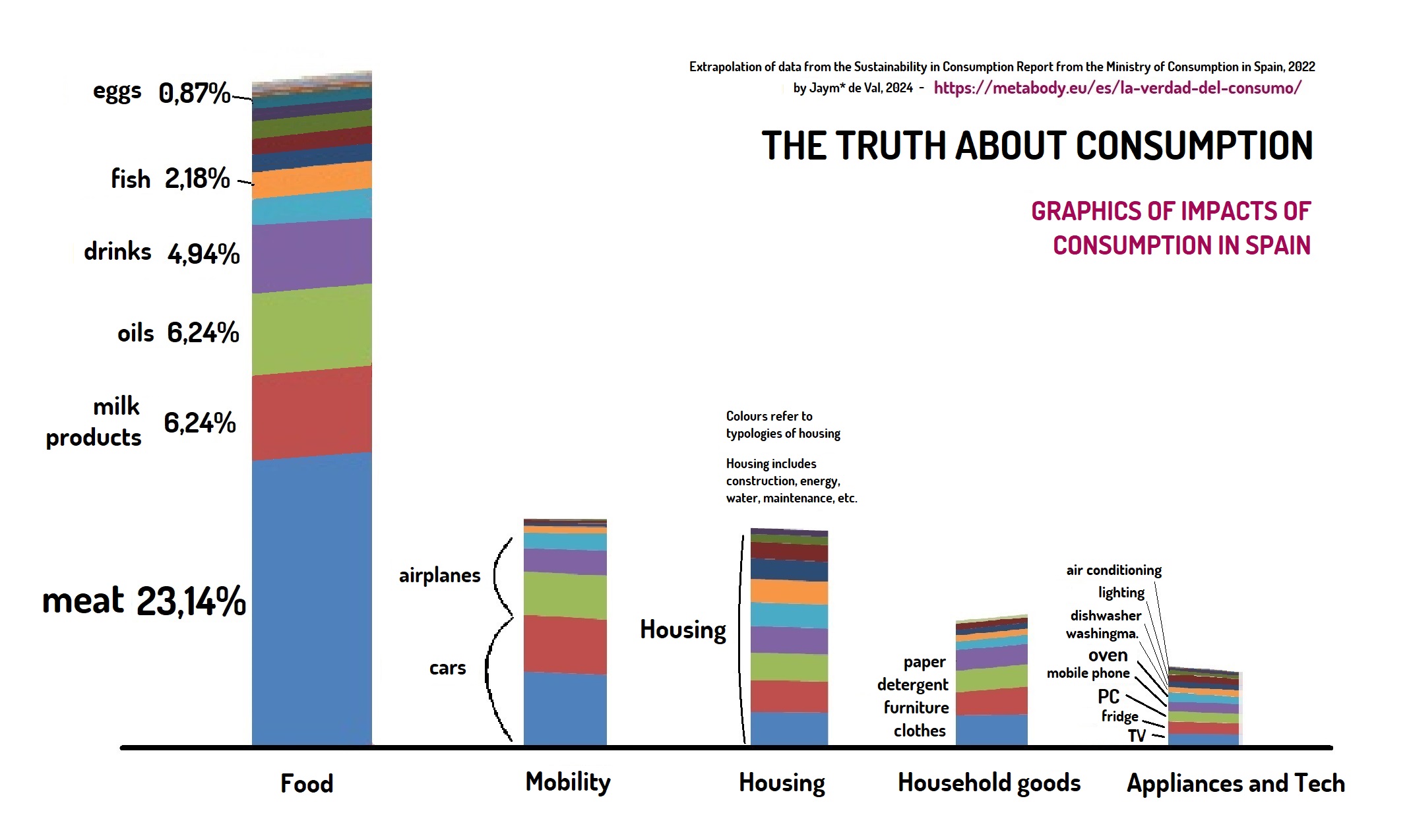
We rely on the 2022 report from the Spanish Ministry of Consumer Affairs (Del Val, 2024d, MC, 2022;): animal-based foods account for the majority of impacts, with meat alone having four times more impacts than aviation or automobiles (Fig. 2), ten times more than clothing, and forty times more than technology. This is a picture that is the inverse of the one proliferating in the disinformation promoted in the media by lobbies and governments, which leads to a kind of reverse rule: the greater the impacts of something, the more it is hidden, the larger the industry and the greater its interests. It should be noted that the aforementioned report likely does not sufficiently consider the impacts of fishing and aquaculture, nor does it address numerous impacts on human health, social justice, or animal suffering, factors which, if considered, would further reinforce the conclusion that the transition to plant-based diets is the most urgent measure.
Figure 2.
Data from the Ministry of Consumer Affairs report, 2022.
Eisen and Brown (2022) suggest that a rapid transition to plant-based diets would allow for a 68% reduction in emissions this century. Alcalá Santiago et al. (2025), for their part, propose that the transition to plant-based diets could reduce impacts on emissions, ecosystems, human health, and resource use by around 50%.
The IPCC itself[3] states that changes in consumer demand are the most powerful drivers, and that a vegan diet would allow for a greater reduction in greenhouse gas emissions than those emitted by global transportation (IPCC, 2019, 488). Furthermore, it seems clear that a global transition to plant-based diets is more feasible in the short term than eliminating all motorized transport worldwide at once. Plant-based diets are possible with fewer crops than currently exist, since nearly half are used to feed exploited animals, forming the basis of a radically inefficient food system that seriously threatens global food security, especially for the most vulnerable populations.
A comparative study of over 60 reports (Del Val, 2023) demonstrates the superior benefits of a 100% animal-free, or vegan, diet in various aspects, including some related to health and inequality that the Ministry of Consumer Affairs report does not include. It also quantifies animal suffering/welfare, which is often absent from other reports, a fact we consider unacceptable given the current scientific, philosophical, and legal recognition of animal sentience. This highlights the anthropocentrism of most studies. Every year, over 100 billion sentient beings are slaughtered on land after a life of unimaginable suffering, 10 times more in aquaculture, and between 30 and 300 times more in fishing (Del Val, 2024b; Waldhorn and Autric, 2022): more than the equivalent of an entire humanity every day. With these adjustments, the transition to plant-based diets emerges as a measure of impact far superior to any other.
This transition must begin with the wealthiest countries, which consume the most, followed by emerging economies, which are rapidly increasing their consumption, and finally, poorer countries. It can only happen if the wall of silence, denial, and widespread misinformation surrounding this issue is broken, thus enabling not only voluntary changes in habits but also changes in laws and policies. In this process, those who depend on the animal-based food industry must be helped to transition to other industries, although none of this is possible without a massive awakening of awareness, currently blocked by lobbying and the prevailing human supremacist ideology.
Food waste is another area where the transition to plant-based diets has the most immediate impact, as it would eliminate 80% of agriculture and almost half of the crops used to feed exploited animals. Furthermore, the offshoring associated with animal products is much greater and involves many more links in the supply chain. Additionally, veganism is associated with a greater awareness of food waste (Jackson & Jackson, 2025) and a stronger connection to agroecology.
Given current overpopulation, it seems unlikely that intensive agriculture can be dispensed within the globalized capitalist system, although this would already entail extraordinary changes. Widespread and global shifts towards local, seasonal, and self-cultivated agroecology, syncretic and regenerative, particularly vegan permaculture (which is more productive and aids ecosystem recovery by restoring biodiversity), combined with rewilding practices that introduce free-ranging herbivores, potentially combined with sanctuaries for released animals, and sustainable or dispersed harvesting. This would go hand in hand with profound degrowth, including demographic decline, and a change in lifestyles. It is unrealistic to feed a humanity whose population has tripled in the last century due to intensive and decentralized agriculture, with local agroecology alone, and half of that population living in ever-expanding cities and desert areas or areas subject to imminent desertification and the catastrophic effects of climate collapse.
The longer-term view points, following Gowdy (2020), to a return to hunter-gatherer societies, a proposal that also includes the anarcho-primitivism of John Zerzan (1994), or even just gatherers (Del Val, 2024c; 2025a), partly due to the improbability of being able to practice agriculture in the coming climate instability.
Although the importance of transitioning to plant-based diets is occasionally acknowledged, within the environmental movement itself it is often marginalized or only minor reductions are proposed. However, it is important to consider that even according to the widely accepted "planetary health diet" (Willet et al. 2019), which would halve global consumption of animal products, countries like Spain, among the world's highest consumers, would need to reduce their consumption by 84% (Greenpeace, 2018, 2020). Furthermore, given the magnitude of the crisis and the urgency of this measure, as well as its benefits for planetary and human health and animal welfare, it is clear that a maximalist goal of 100% reduction should be pursued, starting with wealthy nations.
A non-anthropocentric vision, as is often supposedly defended in degrowth or environmentalist collectives, activist and/or academic dynamics, cannot be just a half-way vision or deny the scale and horror of animal exploitation in food production. Just as there is no room for half-way measures when it comes to human and social issues such as racism, sexism, LGBTQ+phobia, femicides, the Nazi-caused Jewish Holocaust, or the current Palestinian genocide.
Extensive livestock farming is indefensible because it has three times more impacts than intensive farming on the climate and biodiversity crises (FAO, 2006). But environmentalism has aligned itself with a minority scientific literature that denies these facts and defends supposed benefits of this most destructive of all industries (Del Val, 2024e, Del Val and Mas, 2024), which is akin to defending an energy transition based on coal.
2. Deep Degrowth. Our Future as Gatherers
For the degrowth measures, we complement the aforementioned study by the Ministry of Consumer Affairs with others from the degrowth and "Doughnut Economy" fields, as well as the Drawdown Project, also with anthropological studies and research on the lifestyles of indigenous communities. We will add an assessment of the greater difficulty of changing lifestyles than with respect to diet, as well as the greater difficulty of quantifying partial changes, given that total or profound changes are linked to systemic change in the medium and long term.
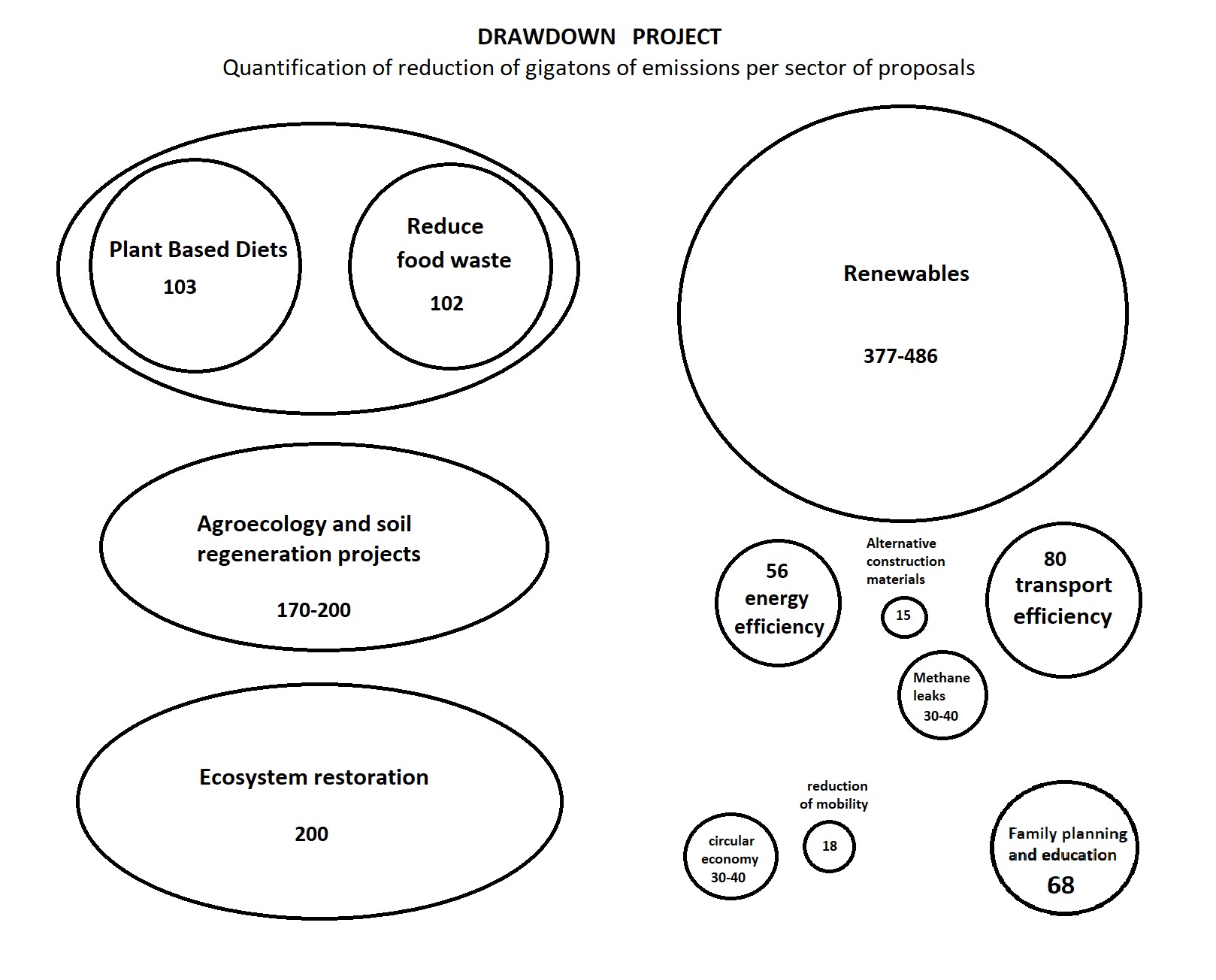
Thus, for example, the Drawdown Project[4] (Figure 3), which was featured in the recent Spanish television series HOPE, considers that nearly half of the solutions to the climate crisis (quantified as the need to eliminate the equivalent of 1400-1500 Gtons of CO2 or equivalent in the coming decades) come from changing the food model and restoring nature (600-700 Gtons). 103 Gtons would be eliminated through the transition to plant-based diets, 102 through the elimination or reduction of food waste, 170-200 through a wide range of proposals for transitioning to regenerative agroecological systems, and 200 through other ecosystem regeneration practices. 370 Gtons would be eliminated through the transition to renewable energy, 56 through improved energy efficiency, 15 through alternative building materials, 80 through efficient transportation, 18 through suburban cities, shared mobility, and cycling, 30-40 through the elimination of methane leaks, 30-40 through a circular economy, and 68 through family planning (education, women's empowerment, and population stabilization). However, we believe this project assumes the maintenance of highly industrialized societies with a human population at least at the current level, without addressing the challenge of the necessary reduction in consumption in wealthier populations and countries. It therefore exhibits an anthropocentric and Eurocentric bias that avoids profound degrowth and the taboo surrounding overpopulation. It assumes a cosmetic degrowth while favoring techno-optimistic solutions and fails to give plant-based diets the central role they play in the scientific literature, especially when quantifying the drastic transitions needed and their crucial importance for restoring nature.
Figure 3.
Drawdown Project
If we examine the impact figures from the aforementioned report by the Ministry of Consumer Affairs (Del Val, 2024d; MC, 2022), we see that 52% comes from food, 17% from mobility, 16% from housing, and 14.7% from household goods and appliances. Regarding food, 62% of the impacts come from animal-based foods, and therefore 32% of the total impacts, which could be eliminated in the very short term. In the other areas of consumption, a similar reduction, of more than half the impacts in each sector, would require a drastic change in lifestyles, reducing consumption of transportation, housing, household goods, and technology by at least 50%. This is only feasible in the medium and long term, unless a global emergency analogous to, or even greater than, World War II or COVID-19 were to occur.
Numerous reports (UNEP, 2010, 82) propose degrowth and changes in demand as the only consistent way to address the gradual elimination of fossil fuels, given the enormous limitations, costs, slowness, and environmental impacts of renewable energies.
But the current trend is toward doubling per capita consumption, including animal products, by 2050, especially in so-called “emerging economies,” due to the narrative of progress and growth that associates prosperity with greater material wealth and more animal exploitation—a trend that is actually unrealistic and incompatible with a livable future.
Degrowth often advocates a counter-narrative based on the idea that “less is more” (Hickel, 2020), that we can live better with less consumption and by regaining a greater focus on lived, communal, and embodied experiences—an idea that we take to its extreme here by connecting it with the proposal of a return to nomadic foraging communities. But proposals like Kate Raworth's "Doughnut Economy" (2012; 2017), or the "humble technologies" proposed by Riechmann et al. (2018) or Turiel (2020) in degrowth contexts, often ignore or silence central issues such as the transition to plant-based diets, as well as overpopulation. All these issues are intertwined with Eurocentric and anthropocentric ontologies, and worldviews that we believe must be fundamentally challenged. Thus, the "Doughnut Economy" assumes an industrialized and omnivorous standard of living for a population like the current one, while here we propose the urgent need for a shift towards Indigenous and especially gatherer-hunter ontologies that introduce a substantial qualitative change in the idea of what it means to live well. Ecofeminism often falls into similar biases, as do large sectors of decolonial discourse. It is in response to these biases that we present the VegAnarQueer proposal.
The more we strive to reduce our impacts, the greater the reduction and the qualitative shift in our way of life. Zero impact would only be achieved with a return to a global population of less than one million, as we will see below. Far from being a utopian proposition, this is proposed in line with Gowdy (2020), as possibly the only realistic way to adapt to the coming collapse. Also as a better way of life that we could have reached by voluntarily dismantling exploitative societies, although it seems too late for that, and humanity appears to have “its foot on the accelerator on the highway to climate hell” and extinction (Guterres, 2022).
3. The Taboo of Overpopulation
The human population has multiplied exponentially in the last century due to intensive and decentralized agriculture, as well as intensive transportation, urbanization, and extractivism. As we have said, it is highly improbable that we can feed the current population with local agroecology, given that more than half live in ever-growing cities and in desert areas or areas subject to imminent desertification. It is also improbable that we can respect planetary boundaries even by drastically reducing current human consumption, starting with wealthy populations and countries, and across all aspects of life.
For a consistent degrowth proposal, it is urgent to confront the taboo of overpopulation from radically new, anarcho-democratic perspectives, empowering women and dismantling heteropatriarchy, defending sexual diversity and new forms of kinship, in opposition to oppressive reproductive models that serve growth economy. Regarding “who” reproduces, a principle of diversity should be followed, and greater restrictions should be imposed on wealthier populations that have the greatest impact on the crisis. This issue is transversal to the entire set of degrowth problems but constitutes one of the greatest taboos because of the way it clashes with foundations not only of social rights but also of human supremacism.
Regarding the demographic issue and the impact of childlessness, we take as our starting point the study by Wynes & Nicholas (2017), which presents childlessness as the measure with the greatest impact, followed by abstaining from airplanes and cars, and adopting plant-based diets. We believe that this reversal of priorities compared to those presented here stems, firstly, from the fact that it addresses only the climate issue, and not other broader damages related to planetary boundaries, as the Ministry of Consumer Affairs study does, and secondly, from the insufficient literature on the issue of diet. Furthermore, the study highlights how all these high-impact measures are absent from current policies.
We consider overpopulation an unavoidable issue because, even from an anthropocentric perspective, it is doubtful that there can be "sustainable" ways of living with 8 billion people. It is false to claim that the problem lies solely with the super-rich.
In this regard, on the one hand, there are degrowth advocates like Hickel and Sullivan (2024), who propose that a good standard of living could be achieved for 8.5 billion sedentary humans by producing 30% of current production levels, thereby eliminating 70% of environmental impacts. This proposal assumes an anthropocentric perspective, focusing solely on human well-being and failing to investigate the underlying unjustification of human expansion.
The footprint of the rich and super-rich is the largest and most urgent to eradicate. Even the poorest populations in industrialized societies (excluding indigenous populations that preserve ancestral ways of life), consume and have a footprint that is around four times more than the one needed in order to avoid catastrophic scenarios, in the climate and ecological crisis (Almazán and Riechman, 2023). The per capita consumption threshold compatible with livable futures is 1.1 tons of CO2 per year, while the 50% of the population with the lowest incomes emit 4.6 tons (Chancelet et al., 2022, 118).[5]
Reputed scientists have spoken out about the taboo surrounding overpopulation as a key factor in the ecological crisis (Crist et al., 2017, 2022), although the discussion on how to address it or the extent to which population growth should be reduced is rarely addressed.
Here we make a “radical” proposal in the sense of being coherent and going to the root of the arguments gathered and synthesized: that the only sustainable threshold is the one we had for 97% of our history, below one million nomadic hunter-gatherer populations. We calculate that the sustainable population threshold must be below one million based on the aforementioned anthropological evidence of better and more sustainable ways of life in hunter-gatherer societies, and on the million-dollar question: when did we begin to create mass extinctions?
Bodhi Paul Chefurka (2019) reviews on this issue, from ecological footprint assessments, which speak of 4 billion; to thermodynamic footprint assessments, which set the limit at the population that existed before the use of fossil fuels, that is, 1 billion. Then comes his calculations of the population density of nomads distributed across 50 million km² of habitable land, which results in a figure of 35 million; and finally, the ecological assessments, which include three different ones by Charles W. Fowler. The first (Fowler and Hobbs, 2003), based on a comparative study of humans and other mammals, also yields a figure of 35 million. The following two are based on studying the sustainable limit for biodiversity. In the first (Fowler, 2008), he sets the limit at 10 million, and in the second (Fowler, 2009), he lowers it to 7 million.[6]
In addition to all this, each of these 8 billion people has a per capita consumption around a hundred of times greater than that of a hunter-gatherer, given the enormous consumption of exosomatic energy. Per capita energy consumption has increased a hundredfold since the Paleolithic era, with approximately 250 million joules per capita per day (Araújo et al., 2021).
This also illustrates just how far the current population is from any sustainable limit: it is on the order of 10,000 times the sustainable limit, more than a million times the limit when adding per capita consumption. This is also consistent with the food chain, which has a large number of plants and herbivores, few carnivores, and very few apex predators. The good news for some is that if we return to a hunter-gatherer lifestyle without hunting, gradually recovering our herbivorous past, then we could be a bit more than a million.
A fundamental criterion for understanding this sustainability threshold is to ask ourselves when we began to become a destructive force in the biosphere, causing mass extinctions instead of contributing to biodiversity as species generally do. This already occurred in the Paleolithic era due to overhunting, starting 45,000 years ago (Bergman et al., 2023). It would be equally wrong to say that all Homo sapiens communities of the Paleolithic created mass extinctions.
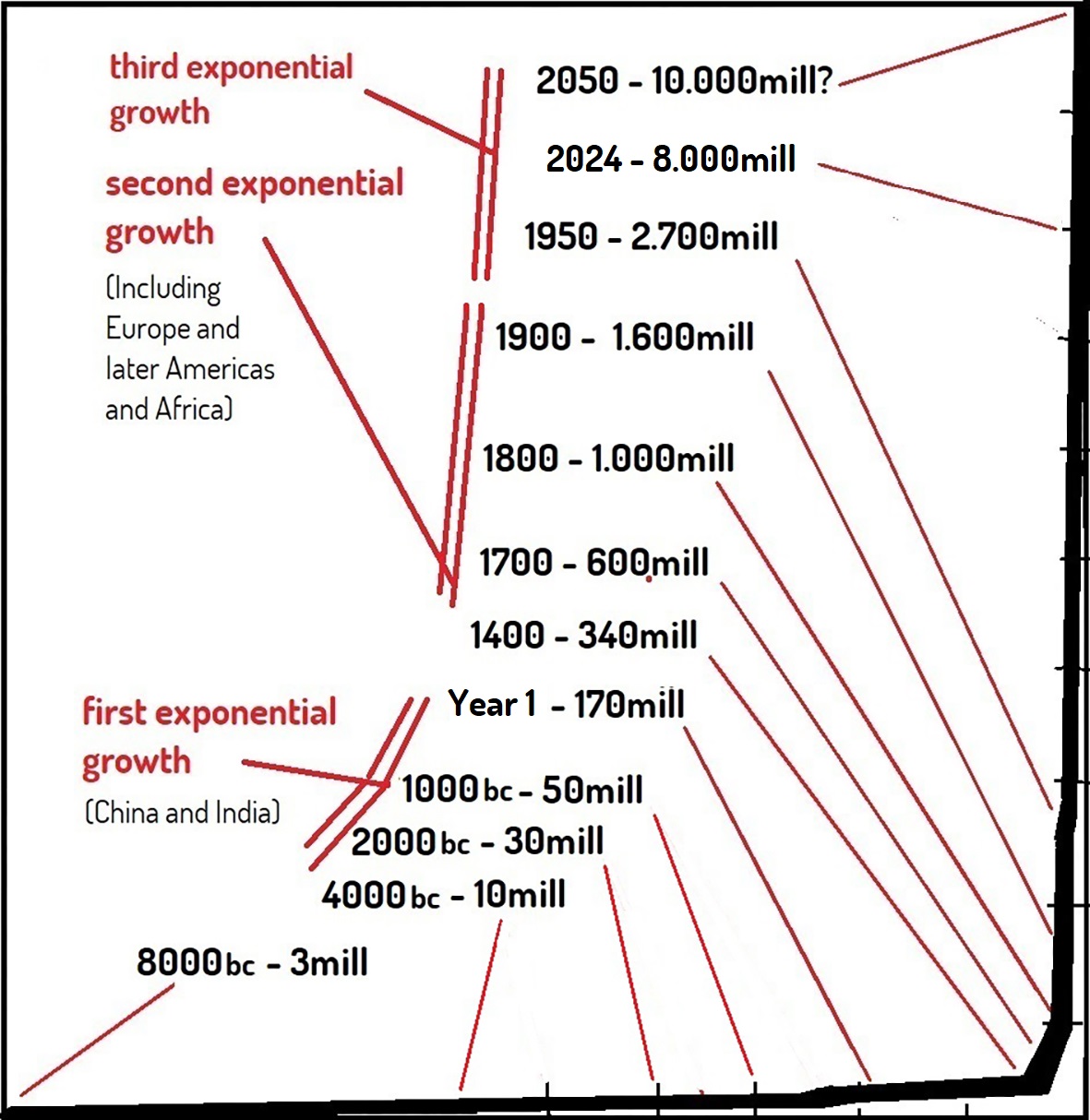
With the Neolithic period, the first exponential growth began, reaching 170 million in year 1, multiplying the population fiftyfold in 10,000 years. Since then, it has multiplied fiftyfold again in an even shorter period of 2,000 years (Figure 4), concentrated in the last century[7]: an unprecedented geological anomaly that has unleashed the fastest mass extinction in Earth's history, currently occurring approximately 100 times faster than the Cretaceous extinction (McCallum, 2015).
Figure 4.
Population increase in the last 10,000 years.
From this broad perspective, the population in the Upper Paleolithic was already excessive. Is important, when differentiating indigenous ways of life and ontologies, that can inspire a livable future, where not even all hunter-gatherer societies would be on the threshold of zero impact and long-term sustainability, but only those that have managed to maintain a non-exploitative relationship with the environment, such as possibly the San communities of the Kalahari in Africa, hence their persistence for tens of thousands of years.
A Livable Future in 3D and the Extinction Puzzle
Let us summarize key pieces of the puzzle of responses to the crisis. These pieces not only play a particularly important role but are also prerequisites for other fundamental transitions, and they correspond to the VegAnarQueer proposal:
1. (Veg) Plant-based diets: a central piece of ecosystem restoration, more readily achievable than global agroecology, and also central to both agroecology and the reduction of food waste, food security, and intersectional, intergenerational, and interspecies social justice.
2. (Anar) Drastic reduction of consumption by shifting towards minimalist or anarcho-primitivist lifestyles, especially in wealthy populations, dismantling the industrial-digital society, and learning from Indigenous communities as the only realistic way to gradually eliminate fossil fuels and other forms of overconsumption that pollute and harm ecosystems. This dismantling of extractive colonialism transcends states, whose raison d'être since the Neolithic has been the management of accumulation based on the ontologies of exploitation, and points toward self-organization and a profound anarchy beyond Western ideologies, closer to those of some indigenous and non-human societies: organizational models based on flock and swarm behavior (Del Val, 2025a, 450; Del Val, 2025b). All of this is associated with a dedomestication of humans themselves and the species they have domesticated, and with a terrestrial decolonization.
3. (Queer) Reducing offspring: a queer approach to voluntary antinatalism, expanding on Donna Haraway's (2020) proposal of “Makekin, not babies!”, that is, toward new modes of kinship not centered on the nuclear family and reproduction. This is also central to an agroecological transition and a profound reduction in consumption and impacts, since the population has grown alongside highly industrialized and delocalized systems.
The proposed hierarchy is based on the previously outlined comparative study of a very broad body of literature, which is usually presented in a sector-specific way. Furthermore, it reformulates the three major problem areas highlighted in much of the literature: food, overconsumption, and overpopulation.
The transition to plant-based diets stands out as the measure with the greatest impact and the only one that would be almost 100% feasible in the short term with the current system. Through individual and collective changes in consumption habits (hence the industry's eagerness to downplay the impacts), and considering that currently, despite minority initiatives toward plant-based diets, we are heading toward a doubling of animal product consumption by 2050, something that is, in fact, impossible, as there is not enough planet (land, water, resources, etc.) to sustain such growth.
Deep degrowth follows as a maximalist proposal based on the idea of reducing consumption and fossil fuels, taking into account that per capita consumption is projected to double by 2050. Drastic reductions imply slower processes toward living well with much lower consumption, or even global rationing emergencies analogous to, and more intense than, the Covid-19 pandemic, which are not being considered by institutions because they run counter to growth economy and the profits of the elites.
We place the demographic issue third, even though it is central to point 2 and the deeper transformations in point 1, because the projected population growth is not currently as rapid (around 20-30%) as the growth in per capita consumption (around 200%), also implying changes in the medium and long term.
In reality, all three elements, especially the demographic issue, are subsumed under the idea of Deep Degrowth, but we focus the latter on point two as an expansion of the idea of “reducing consumption,” examining its deeper implications.
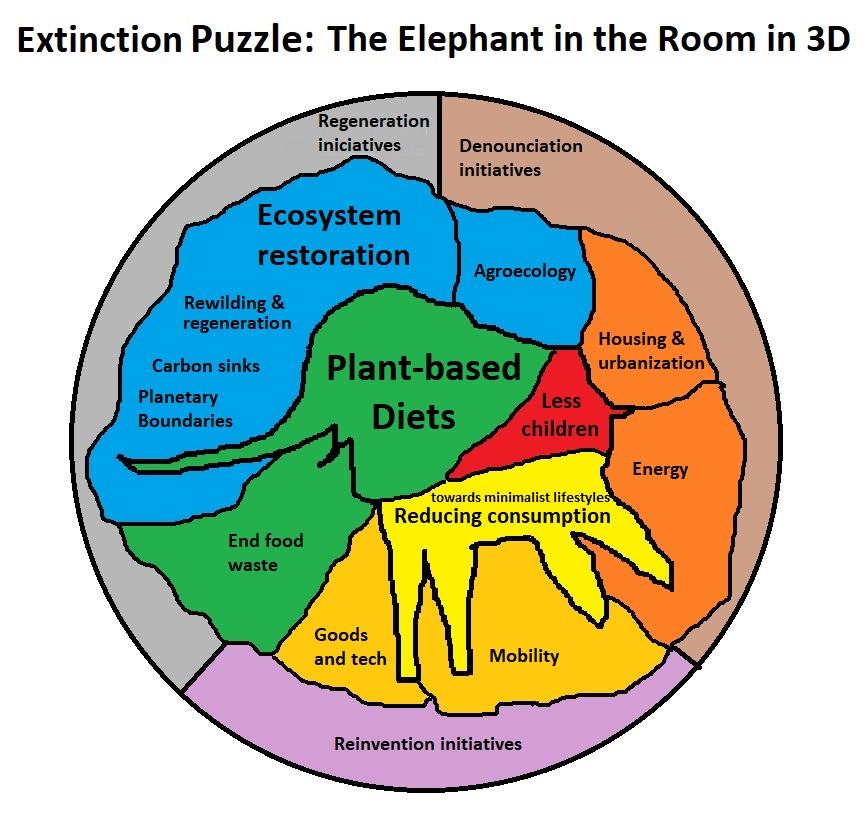
Alongside these three 3D measures, there are other cross-cutting measures that we summarize in the concept of 3R: Resistance, Regeneration, Reinvention, as the basis for a possible 3D/3R social movement and a puzzle of measures to address the crisis (Fig. 5).
1. Resistance, denunciation, dismantling: Participation in initiatives of activism, resistance, denunciation, and the fight against disinformation and the crimes of states, lobbies, and the media. Above all, a profound dismantling and deconstruction of human supremacism and its associated beliefs.
2. Regeneration, reversal: Participation in collective initiatives for ecosystem regeneration, degrowth of consumption, and regenerative agriculture that reverse planetary degradation.
3. Reinvention: participation in collective initiatives that activate transformative practices. Vegan permaculture. The recovery of knowledge about the sustainable harvesting of wild edible and medicinal plants, and of lost sensorimotor capacities. It would need to be reclaimed through a return to techniques of the body and endosomatic energy, as opposed to the excesses of exosomatic techniques and energy, as a basis for modes of community that can regain constructive coevolution with other life forms (Del Val 2025a, 389-454).
Figure 5.
3D “Elephant in the Room” Puzzle of priority measures.
The Degrowth Continuum and Deep Degrowth
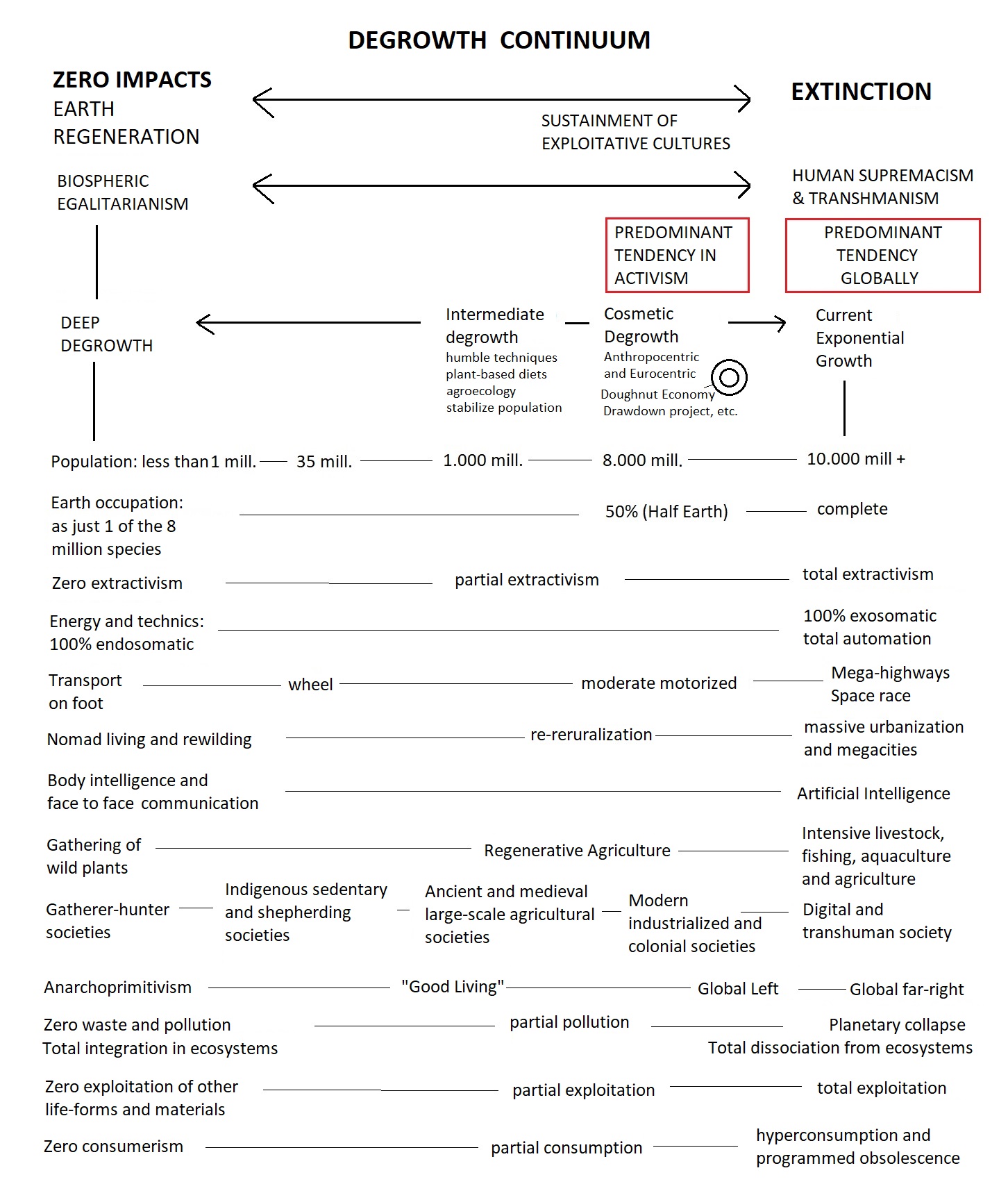
Degrowth models and their implications: from (1) more cosmetic approaches (less meat, renewable energy, and a partial circular economy) that broadly reproduce anthropocentric, Eurocentric, industrialized, and progress-oriented narratives; through (2) a more consistent or intermediate approach (plant-based diets, drastic reduction in consumption, a strong circular economy, and voluntary population stabilization); to (3) a much deeper systemic change, or deep degrowth.
We have the attempt to sustain an industrialized society with cosmetic degrowth, and the return to nomadic societies, with zero negative impact on the planetary environment, as the maximalist horizon of deep degrowth, with numerous intermediate possibilities that must be taken into account and considered in detail, as well as their strategic timeframes and possible provisional coexistence. All of this implies redefining emancipatory narratives and conceptions of what it means to live well, elaborating on how the notion of Buen Vivir (Good Living) is approached from Abya Yala communities (Hidalgo-Capitán et al. 2019), and doing so in a non-anthropocentric way. The degrowth motto, “less is more,” can thus have very diverse understandings that need to be explored by presenting a continuum or spectrum of degrowth levels and modes (Fig. 6), allowing for long-term strategies based on minimalist, maximalist, or intermediate visions, and in any case, highlighting the broad spectrum of possibilities and the profound implications of each.
Figure 6.
Degrowth Continuum.
Given the potential perception that maximalist or even intermediate proposals are utopian or unrealistic, we suggest that they may actually be the most realistic. Sustaining civilizations of exploitation, or surviving the coming collapse along with them, may be both unrealistic and undesirable.
It is crucial, in this process, to correct the prevailing anthropocentric and Eurocentric bias that assumes the maintenance of global industrialized civilization (WEIRD: Western, Educated, Industrialized, Rich, Democratic), and its lifestyles and overpopulation, as the measure of a good, sustainable, and desirable way of life. Instead, we propose, as the benchmark for sustainability and the most desirable way of life, as well as the zero-negative-impact threshold, the way of life that Homo sapiens has had for most of its history. Following anthropological principles, this way of life is not only more desirable but also likely the only realistic one in the face of the impending climate collapse. This is the zero-impact horizon against which to measure the other proposals along the continuum. We consider it essential to recognize that such a scenario is not only possible (it was our reality for most of our history) but, perhaps, the only realistic and desirable scenario toward which we can move.
Three scenarios: short, medium, and long term
The short term involves the current system and population in industrialized societies with 8 billion people; the medium term involves pre-industrial lifestyles and populations of less than 1 billion; and the long term involves pre-agricultural lifestyles and populations of less than 1 million, which would approach zero impact on the biosphere.
These are not utopian proposals but realistic ones, since the same measures proposed for voluntary change can be applied to adapt to a collapse in which industrial and even agricultural society will likely no longer be viable. For the time horizons, we assume possible thresholds for what would be a hypothetical voluntary population reduction with only one offspring per family, which would half the birth rate per generation. However, it is more likely that almost all of humanity will die during this century for having avoided even considering these voluntary changes, with a more accelerated and catastrophic transition toward the long-term scenario:
Short term: Profound change in the current system ---> 2050
Rapid transition to a vegan planet, social, ecological, and animal justice
Decreased consumption and demographic stabilization, 8 billion
Medium term: Profound change toward pre-industrial ways of life ---> 2150
Vegan agroecology, profound degrowth, and a population of 1 billion
Adaptation to climate-ecological collapse
Massive regeneration and rewilding of ecosystems
Long Term: Profound change toward pre-agricultural ways of life ---> 2250
Gathering and nomadic life, one million people
In this continuum of proposals, ranging from the bare minimum required now to maximalist and realistic visions, we see that issues such as transitioning to plant-based diets as much and as quickly as possible are a matter of minimum requirements, and their silencing or denial is possibly the most problematic, and least acknowledged, issue in current global politics. We argue, however, that the same deep-rooted problem underlies the silencing of all these proposals: human supremacism (Del Val, 2025a, 153).
Why are the main measures being silenced in face of the greatest crisis in history? Implicit and explicit double denial, and the urgency of dismantling it.
The greater the proposed systemic change, the greater the clash and conflict with lobbies in the current lobbyocracies, with the privileges of people in wealthy countries, and with anthropocentrism and human supremacism in general. These conflicts are key issues that will require constructive dialogical and pragmatic strategies, with far-reaching consequences for what constitutes a just transition and for whom, considering justice not only intersectional, but also intergenerational (with regard to the livable future), and interspecies (with regard to the rest of living beings), as proposed by the Earth System Justice model (Gupta et al. 2023).
This resistance often entails a double systemic denial of both the severity of the crisis and its root causes and necessary responses. On the one hand, there is explicit denialism, organized and promoted by lobbies, such as the livestock lobby (Del Val and Mas, 2024), and on the other, implicit denialism associated with the human supremacism that permeates populations, as well as the reluctance of privileged people in the Global North to lose their privileges. This results in central issues such as the transition to plant-based diets being silenced or marginalized, as well as profound systemic change, and the taboo of overpopulation: the "3D elephant in the room."
This denialism is strengthened by the tsunami of disinformation and its rise in the age of AI, which makes it even more urgent to counteract it through eco-socio-animal movements. Wealthy and consumerist countries must be at the forefront of questioning their privileges, alongside new emancipatory narratives that demonstrate that with much less, we could live much better.
Numerous reports question the strategies of lobbyists in disseminating disinformation with the support of governments and the media, suggesting that we live in a Lobbycracy (Lauber et al., 2025; Del Val and Mas, 2024). These are complex strategies that must be combated, just as internal strategies for dismantling the prevailing human supremacism within activism and critical intellectual circles are urgently needed.
Conclusions
Broadening the spectrum of possibility emerges as a fundamental task in the face of an unprecedented crisis in Earth's history, and making the unthinkable visible as realistic in the face of a double systemic denial imposed by human supremacism and a rationalist and extractivist Eurocentrism that persists even on the margins of current ecosocial activism.
Bringing together multiple pieces of the puzzle that are usually treated separately and with anthropocentric and Eurocentric biases, we have highlighted what we consider to be three central themes of the crisis. They constitute untouchable taboos to the mentioned supremacism. And the necessary responses that, although they would have been valid to avoid the collapse, may be activated in a minoritarian way during the imminent extinction: transition to plant diets, deep degrowth towards minimalist or anarcho-primitivist ways of life preferably nomadic, and voluntary and queer antinatalism, proposing a theory of deep change (Del Val 2025a, 362). It stops feeding the prevailing anthropocentric and Eurocentric ontologies and human supremacism, and embraces a much broader and more affirmative spectrum of possible transformations, offering new emancipatory post/metahumanist narratives not based on techno-human progress and infinite growth.
Even for those who refuse to embrace such alternatives, this article proposes the need for a shift in perspective, a kind of deep-field view that allows us to reposition the current horizon of human policies and broaden the horizon of possibilities, demonstrating that what is usually proposed as a maximalist and radical option is only a first step. It is also necessary to redefine collapse as a voluntary dismantling of exploitative and sedentary civilizations and their anthropocentric and Eurocentric ontologies.
It is doubtful that the super-rich will survive extinction in their bunkers (Rushkoff, 2023). It is more likely that those of us who relearn to live and co-evolve with ecosystems, terrestrial flows, and other life forms will, recovering a movement lost in sedentary and exploitative societies, reactivating relational ontologies that favor the principles of diversity and symbiosis underlying life (Del Val, 2025a, 227). The premise is simple: contribute to terrestrial biodiversity, as one of the 8 million species, instead of being the cause of the fastest mass extinction ever recorded.
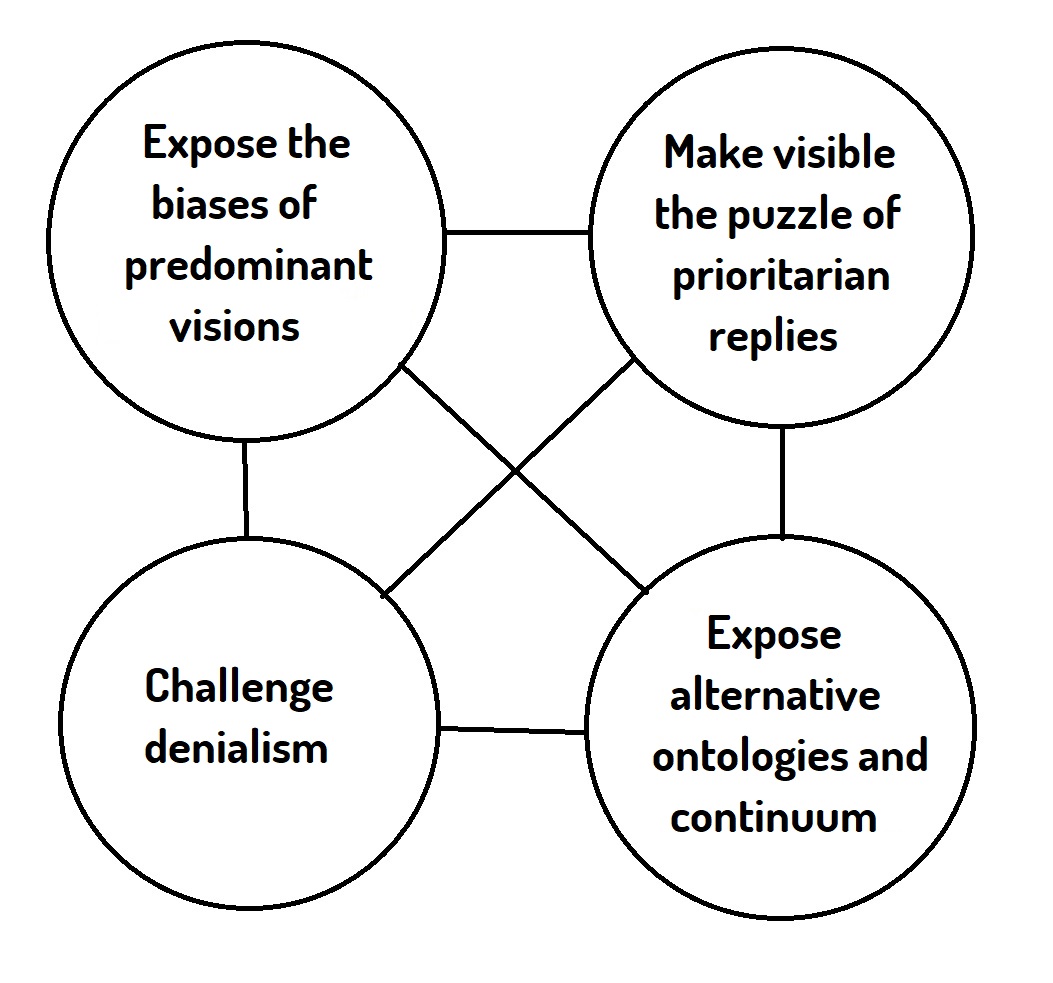
The set of proposals in this article, which focuses on correcting anthropocentric and Eurocentric biases in the prevailing discourses of current society and global activism, aims to offer critical intersectional tools to overcome disinformation and the biases of human supremacism, while visualizing priority responses within a broad landscape of ontologies (Fig. 7).
Figure 7.
Strategy map of this study.
In short, it is about inverting the biblical dogma of Genesis: “Grow, multiply, fill the earth and dominate it,” exposing its apocalyptic telos and its intrinsically oppressive nature, demonstrating that there is no possible emancipation except for all life on Earth. Continuing to patch up the Titanic as it sinks is not an option: let us get the lifeboats out for the transformation.
References
Alcalá-Santiago, Á., Rodríguez-Martín N. M., Casas-Albertos, E., Gálvez-Navas, J. M., Castelló-Pastor, A., García-Villanova, B. & Molina-Montes, E. (2025). Nutrient adequacy and environmental footprint of Mediterranean, pesco-, ovo-lacto-, and vegan menus: A modelling study. Frontiers in Nutrition, 12, 1681512. https://doi.org/10.3389/fnut.2025.1681512
Almazán, A., &Riechmann, J. (2023). Desafíos poliéticos de las transiciones energéticas. Arbor, 199(807), Article a689. https://doi.org/10.3989/arbor.2023.807003
Araújo, F. R. P. d., Pereira, M. G., Freitas, M. A. V., da Silva, N. F., & Dantas, E. J. d. A. (2021). Bigger Is Not Always Better: Review of Small Wind in Brazil. Energies, 14(4), 976. https://doi.org/10.3390/en14040976
Bergman, J., Pedersen, R.Ø., Lundgren, E.J. et al. (2023). Worldwide Late Pleistocene and Early Holocene population declines in extant megafauna are associated with Homo sapiens expansion rather than climate change. Nature Communications, 14(1), 7679.https://doi.org/10.1038/s41467-023-43426-5
Chancel, L., Piketty, T., Saez, E., Zucman, G., &Alvaredo, F. (2022). World inequality report 2022. World Inequality Lab. https://wir2022.wid.world
Chefurka, B. P. (2019). Carrying capacity, overshoot and sustainability. Energy Skeptic. https://energyskeptic.com/2019/bodhi-paul-chefurka-carrying-capacity-overshoot-and-sustainability/
Crist, E., Mora, C., & Engelman, R. (2017). The interaction of human population, food production, and biodiversity protection. Science, 356(6335), 260–264. https://doi.org/10.1126/science.aal2011
Crist, E., Ripple, W. J., Ehrlich, P. R., Rees, W. E., & Wolf, C. (2022). Scientists’ warning on population. Science of the Total Environment, 845, 157166. https://doi.org/10.1016/j.scitotenv.2022.157166
Del Val, J. (2023). 1st liveable futures report: Food of mass destruction—How exploiting animals drives us to extinction. Reverso/Metabody Institute.https://metabody.eu/wp-content/uploads/2023/08/1st-LIVEABLE-FUTURES-REPORT-Full-August2023-1-1-1-1.pdf
Del Val, J. (2024a). Ontohackers: Radical movement philosophy in the age of extinctions and algorithms. Part I. punctum books. https://doi.org/10.53288/0402.1.00
Del Val, J. (2024b). Los océanos se salvan en tu plato. Instituto Metabody. https://metabody.eu/es/los-oceanos-se-salvan-en-tu-plato/
Del Val, J. (2024c). Descolonización terrestre y nuestro futuro como recolectores. En ¡Cuerpo, Máquina, Acción!, 8(10), 20–38. Universidad Nacional de La Plata. http://sedici.unlp.edu.ar/handle/10915/175275
Del Val, J. (2024d). La verdad del consumo. Metabody. https://metabody.eu/es/la-verdad-del-consumo/
Del Val, J. (2024e). Por qué no es defendible la ganadería extensiva. Metabody. https://metabody.eu/es/por-que-no-es-defendible-la-ganaderia-extensiva/
Del Val, J. (2025a). Metacuerpos: Un contrapocalipsis. Reverso–Metabody. https://metabody.eu/es/metacuerpos-libro/
Del Val, J. (2025b). Ontohackers: Radical movement philosophy in the age of extinctions and algorithms. Part II. punctumbooks.
Del Val, J., & Mas, R. (2024). Oculto a primera vista: El lobby ganadero-alimentario en los movimientos ecologistas y climáticos. InstitutoMetabody. https://metabody.eu/es/informe-lobby-ganadero-movimiento-ecologista/
Eisen, M. B., & Brown, P. O. (2022). Rapid global phaseout of animal agriculture has the potential to stabilize greenhouse gas levels for 30 years. PLOS Climate, 1(2), e0000010. https://doi.org/10.1371/journal.pclm.0000010
FAO. (2006). Livestock’s long shadow: Environmental issues and options. Food and Agriculture Organization of the United Nations. https://www.fao.org/3/a0701e/a0701e00.htm
Fowler, C. W. (2008). Maximizing biodiversity, information, and sustainability. Biodiversity and Conservation, 17, 841–855. https://doi.org/10.1007/s10531-008-9327-2
Fowler, C. W. (2009). The human population evaluated by interspecific comparisons (Appendix 6.4). In C. W. Fowler, Systemic management: Sustainable human interactions with ecosystems and the biosphere (Appendix). Oxford University Press.
https://apps-afsc.fisheries.noaa.gov/Publications/misc_pdf/Fowler-book/Appendix06-4.pdf
Fowler, C. W., & Hobbs, L. (2003). Is humanity sustainable? Proceedings of the Royal Society B: Biological Sciences, 270(1533), 2579–2583. https://doi.org/10.1098/rspb.2003.2553
Gowdy, J. (2020). Our hunter-gatherer future: Climate change, agriculture, and uncivilization. Futures, 115, 102488. https://doi.org/10.1016/j.futures.2019.102488
Graeber, D., & Wengrow, D. (2022). El amanecer de todo: Una nueva historia de la humanidad. Ariel.
Greenpeace. (2018). Menos es más. Reducir la producción y consumo de carne para una vida y planeta más saludable. Informe realizado por Greenpeace Internacional sobre el sistema de producción de carne y lácteos en 2050.Greenpeace. https://es.greenpeace.org/es/sala-de-prensa/informes/menos-es-mas/
Greenpeace. (2020). Food for a healthier life and planet. Greenpeace.
https://www.greenpeace.org/static/planet4-eu-unit-stateless/2020/03/bb093564-200310-briefing-food-healthier-life-planet.pdf
Gupta, J., Liverman, D., Prodani, K., et al. (2023). Earth system justice needed to identify and live within Earth system boundaries. Nature Sustainability, 6, 630–638. https://doi.org/10.1038/s41893-023-01064-1
Guterres, A. (2022). “Secretary-General's remarks to High-Level opening of COP27.” UN. https://www.un.org/sg/en/content/sg/speeches/2022-11-07/secretary-generals-remarks-high-level-opening-of-cop27
Harari, Y. N. (2015). Sapiens: De animales a dioses. Debate.
Haraway, D. J. (2020). Seguir con el problema: Generar parentesco en el Chthuluceno. Consonni.
Hickel, J. (2020). Less is more: How degrowth will save the world. William Heinemann.
Hickel, J., & Sullivan, D. (2024). How much growth is required to achieve good lives for all? Insights from needs-based analysis. WorldDevelopmentPerspectives, 35, 100612. https://doi.org/10.1016/j.wdp.2024.100612
Hidalgo-Capitán, A. L., García-Álvarez, S., Cubillo-Guevara, A. P., & Medina-Carranco, N. (2019). Los objetivos del Buen Vivir: Una propuesta alternativa a los Objetivos de Desarrollo Sostenible. Iberoamerican Journal of Development Studies, 8(1), 6–57. https://doi.org/10.26754/ojs_ried/ijds.354
IPBES. (2019). Global assessment report on biodiversity and ecosystem services. IPBES Secretariat.https://doi.org/10.5281/zenodo.3831673
IPBES. Intergovernmental Science-Policy Platform on Biodiversity and Ecosystem Services. (2020). Workshop report on biodiversity and pandemics. IPBES Secretariat. https://doi.org/10.5281/zenodo.4147317
IPCC. Intergovernmental Panel on Climate Change. (2019). Food security. EnClimate Change and Land: IPCC Special Report on Climate Change, Desertification, Land Degradation, Sustainable Land Management, Food Security, and Greenhouse Gas Fluxes in Terrestrial Ecosystems (pp. 437–550). Cambridge University Press. https://doi.org/10.1017/9781009157988.007
IPCC. Intergovernmental Panel on Climate Change. (2023). AR6 synthesis report: Summary for policymakers. EnH. Lee and J. Romero (eds.), Climate Change 2023: Synthesis Report. Contribution of Working Groups I, II and III to the SixthAssessment Report of the Intergovernmental Panel on Climate Change [Core Writing Team,] (1-115). Doi: 10.59327/IPCC/AR6-9789291691647
Jackson, P., & Jackson, M. (2025). The relationship between dietary preference and food waste: An application of the theory of planned behaviour. Journal of Human Nutrition and Food Science, 13(1), 1-12. https://www.jscimedcentral.com/jounal-article-pdf/Journal-of-Human-Nutrition-and-Food-Science/nutrition-13-1194.pdf
Kent, S. (Ed.). (1992). Cultural diversity among twentieth-century foragers: An African perspective. Cambridge University Press.
Leakey, R. E., & Lewin, R. (1977). Origins: What discoveries reveal about the emergence of our species and its possible future. E. P. Dutton.
Lauber, K., et al. (2025). The animal agriculture industry’s role in obstructing climate action. En J. T. Roberts, C. R. S. Milani, J. Jacquet, & C. Downie (Eds.), Climate Obstruction: A Global Assessment(98-138). Oxford Academic. https://doi.org/10.1093/oso/9780197787144.003.0004
Lee, R. B. (1965). Subsistence ecology of !Kung Bushmen. University of California Press.
Lee, R. B. (1979). The !Kung San: Men, women and work in a foraging society. Cambridge University Press.
Lenton, T. M., Rockström, J., Gaffney, O., Rahmstorf, S., Richardson, K., Steffen, W. &Schellnhuber, H. J. (2019). Climate tipping points—Too risky to bet against. Nature, 575, 592–595.https://doi.org/10.1038/d41586-019-03595-0
McCallum, M. L. (2015). Vertebrate biodiversity losses point to a sixth mass extinction. Biodiversity and Conservation, 24, 2497–2519. https://doi.org/10.1007/s10531-015-0940-6
Meadows, D. H., Meadows, D. L., Randers, J. & Behrens III, W. W. (1972). The Limits to Growth; A Report for the Club of Rome's Project on the Predicament of Mankind. Universe Books.https://archive.org/details/limitstogrowthr00mead
[MC] Ministerio de Consumo& European Commission–Joint Research Centre. (2022). Sostenibilidad del consumo en España: Evaluación del impacto ambiental asociado a los patrones de consumo. Ministerio de Consumo.
https://www.miteco.gob.es/es/ceneam/recursos/pag-web/informe-sostenibilidad-consumo-espana.aspx
Plowright, R. K., Parrish, C. R., McCallum, H., Hudson, P. J., Ko, A. I., Graham, A. L., & Lloyd-Smith, J. O. (2021). Land use–induced spillover: A call to action to safeguard environmental, animal, and human health. The Lancet Planetary Health, 5(4), e237–e245. https://doi.org/10.1016/S2542-5196(21)00031-0
Raworth, K. (2012). A safe and just space for humanity: Can we live within the doughnut? Oxfam.
Raworth, K. (2017). Doughnut economics: Seven ways to think like a 21st-century economist. Penguin Random House.
Richardson, K., …Rockström, J. (2023). Earth beyond six of nine planetary boundaries. ScienceAdvances, 9(37), eadh2458. https://doi.org/10.1126/sciadv.adh2458
Riechmann, J., Almazán, A., Madorrán, C., & Santiago Muíño, E. (2018). Ecosocialismo descalzo: Tentativas. Icaria.
Ripple, W. J., Wolf, C., Newsome, T. M., Barnard, P. &Moomaw, W. R. (2020). World scientists’ warning of a climate emergency. BioScience, 70(1), 8–12. https://doi.org/10.1093/biosci/biz088
Ripple, W. J., Wolf, C., Newsome, T. M., Galetti, M., Alamgir, M., Crist, E., Mahmoud, M. I. &Laurance, W. F. (2017). World scientists’ warning to humanity: A second notice. BioScience, 67(12), 1026-1028. https://doi.org/10.1093/biosci/bix125
Rushkoff, D. (2023). La supervivencia de los más ricos. Fantasía escapista de los milmillonarios tecnológicos. Capitán Swing
[SCBD] Secretariat of the Convention on Biological Diversity. (2020). Global biodiversity outlook 5: Summary for policymakers. Secretariat of the Convention on Biological Diversity. https://www.cbd.int/gbo/gbo5/publication/gbo-5-spm-en.pdf
Sahlins, M. (1968). Notes on the original affluent society. In R. B. Lee & I. DeVore (Eds.), Man the hunter (pp. 85–89). Aldine.
Sahlins, M. (2017). Stone age economics (Original work published 1972). Routledge.
Scott, J. C. (2017). Against the grain: A deep history of the earliest states. Yale UniversityPress.
Shiva, V. (2008). Monocultivos de la mente. Fineo.
Spratt, D., & Dunlop, I. (2019). Existential climate-related security risk: A scenario approach. National Centre for Climate Restoration (Breakthrough). http://mycoasts.org/commons/library/2019_Spratt_Dunlop.pdf
Suzman, J. (2021). Trabajo: Una historia de cómo empleamos el tiempo. Debate.
Trust, S., Saye, L., Bettis, O., Bedenham, G., Hampshire, O., Lenton, T. M. &Abrams, J. F. (2025). Planetary solvency: Finding our balance with nature. Global risk management forhuman prosperity. University of Exeter. https://actuaries.org.uk/media/ni4erlna/planetary-solvency.pdf
Turiel, A. (2020). Petrocalipsis: Crisis energética global y cómo (no) la vamos a solucionar. Alfabeto.
UNEP. (2010). Assessing the Envinronmental Impact of Production and Consumption. UNEP. https://www.resourcepanel.org/reports/assessing-environmental-impacts-consumption-and-production
UNGA. United Nations General Assembly. (2022). The human right to a clean, healthy and sustainable environment. United Nations. https://digitallibrary.un.org/record/3982508
Vernadsky, V. I. (1998). Thebiosphere (Publicación original de 1926). Springer.
Waldhorn, D. R., & Autric, E. (2022). Shrimp: The animals most commonly used and killed for food production [Preprint]. OSF Preprints. https://doi.org/10.31219/osf.io/b8n3t
Willett, W., et al. (2019). Food in the Anthropocene: The EAT–Lancet Commission on healthy diets from sustainable food systems. The Lancet, 393(10170), 447–492. https://doi.org/10.1016/S0140-6736(18)31788-4
Wynes, S., & Nicholas, K. A. (2017). The climate mitigation gap: Education and government recommendations miss the most effective individual actions. EnvironmentalResearchLetters, 12, 074024. https://doi.org/10.1088/1748-9326/aa7541
Yunkaporta, T. (2023). Escrito en la Arena. Cómo el Pensamiento Indígena Puede Salvar el Mundo. Herder
Zerzan, J. (1994). Future primitive. Autonomedia.