Revista Internacional de Educación y Análisis Social Crítico Mañé, Ferrer & Swartz.
ISSN: 2990-0476
Vol. 4 Núm. 1 (2026)
Diagnosis of the Costa Rican educational context
Diagnóstico del contexto educativo costarricense
Diagnóstico do contexto educativo da Costa Rica
Francisco Cordero-Méndez
Universidad Estatal a Distancia. Costa Rica.
https://orcid.org/0000-0001-6416-3747
francisco.cordero@uned.cr
Abstract
The following article summarizes, through a literature review, the Costa Rican educational context after more than 40 years of neoliberal hegemony, as studied by various experts from a critical perspective on this hegemony. Neoliberalism has entailed, for public educational institutions, the weakening of public educational institutions, increasing inequality in standardized test results between public and private educational institutions, greater interference by international organizations in the management of educational systems, and constant disagreement between teachers' unions and the hegemonic national project promoted by global elites and their representatives at the local and national levels. Given this scenario, it is concluded that the construction of alternatives for the Costa Rican public education system will necessarily require the configuration of a national project that includes an effort with alliances of global scope, beyond the borders of the Nation-State and that allows it to shake off the hegemony imposed by the power relations of the current world system.
Keywords: Costa Rica, State and education, history of education, educational neoliberalism, educational policy, sociology of education, theory of education.
Resumen
En el siguiente artículo se resume, mediante el recurso a la revisión bibliográfica, el contexto educativo costarricense, después de más de 40 años de hegemonía neoliberal, y según ha sido estudiado por diversos expertos y expertas desde una perspectiva crítica para con esta hegemonía. Realizada la revisión se encuentra que, para los centros educativos públicos, el neoliberalismo ha implicado el debilitamiento de la institucionalidad educativa pública, una ascendente desigualdad en los resultados de las pruebas de rendimiento entre instituciones educativas públicas versus instituciones educativas privadas, una mayor injerencia, por parte de organismos internacionales, en el manejo de los sistemas educativos, y un constante desacuerdo entre los gremios magisteriales y el proyecto-país hegemónico impulsado por las élites globales y sus representantes en el espacio local-nacional. Ante este panorama, se concluye que la construcción de alternativas para el sistema educativo público costarricense necesariamente requerirá la configuración de un proyecto país que incluya un esfuerzo con alianzas de alcance global, allende las fronteras del Estado-Nación, y que le permita sacudirse de la hegemonía impuesta por las relaciones de poder del sistema mundo actual.
Palabras clave: Costa Rica, Estado y educación, historia de la educación, neoliberalismo educativo, política educacional, sociología de la educación, teoría de la educación.
Resumo
Este artigo sintetiza, através de uma revisão da literatura, o contexto educativo da Costa Rica após mais de 40 anos de hegemonia neoliberal, analisado por vários especialistas numa perspetiva crítica dessa hegemonia. A revisão revela que, para as escolas públicas, o neoliberalismo implicou o enfraquecimento das instituições públicas de ensino, o aumento da desigualdade nos resultados dos testes padronizados entre escolas públicas e privadas, uma maior interferência das organizações internacionais na gestão dos sistemas educativos e constantes desentendimentos entre os sindicatos de professores e o projeto nacional hegemónico promovido pelas elites globais e seus representantes a nível local e nacional. Perante este cenário, conclui-se que a construção de alternativas para o sistema de ensino público da Costa Rica exigirá necessariamente o desenvolvimento de um projeto nacional que inclua um esforço conjunto com alianças globais, que ultrapasse as fronteiras do Estado-nação e permita a sua libertação da hegemonia imposta pelas relações de poder do atual sistema mundial.
Palavras-chave: Costa Rica, Estado e educação, história da educação, educação neoliberal, política educativa, sociologia da educação, teoria da educação.
Introduction
Since the 1970s, an ideology of domination has been progressively consolidated, whose paradigmatic foundations emerged from the reaction generated by a group of adversaries of the interventionist state model (Keynesian or socialist). Among its main proponents were economists such as Friedrich Hayek (1988) and Milton Friedman (1982), and it had the support of global elites represented in groups like the Mont Pelerin Society and the Bilderberg Club.
Also known as the "Washington Consensus," this ideology -referred to by various authors as "neoliberalism" (Brown, 2015; Díaz, 2020; Harvey, 2007; Klein, 2008; Miranda, 2019; Molina & Díaz, 2021; Vargas, 2016)- constituted an updating of colonialism in light of the new power relations that emerged in the global context following the consolidation of the United States as the Western hegemon (Wallerstein, 1979), thanks to the outcomes of two world wars that reconfigured the world system around two poles: one formed by the "socialist camp" led by the Soviet Union and the other by the "free world" dominated by the United States.
Neoliberalism is characterized, among other defining features, by a material and conceptual weakening of the State's role as guarantor of access to goods and services considered basic necessities, as well as by a progressive positioning of markets and the private provision of goods and services as central axes of social ordering (Boltanski & Chiapello, 2011; Brown, 2015; Friedman, 1982; Harvey, 2007; Hayek, 1988; Miranda, 2019; Vargas, 2016).
In Costa Rica, the transition from the Welfare State (inspired by Keynesianism) to the Neoliberal State began during the Monge Álvarez administration from 1982 to 1986 (Díaz, 2020; Molina, 2021; Vargas, 2016). This change in the State model has reconfigured the administration of public affairs (Díaz, 2020; Miranda, 2019; Molina, 2021; Vargas, 2016; Vega, 1996), thus structurally affecting educational systems (Arias & Romero, 2019; Caamaño, 2020; Carnoy & Moura, 1997; González, 2015; Valverde, 2015).
Within this historical and geopolitical social context, studies on the consequences that the change in the State model has represented in the educational sphere have encompassed a wide variety of approaches, from economics (Vargas, 2016) to history (Molina & Díaz, 2021), from the functioning of higher education systems (Arias & Romero, 2019; Caamaño, 2020), to the growing conflict that neoliberal transformations have entailed (Alvarado et al., 2021; Cordero, 2021).
However, no effort has yet been made to systematize the diversity of perspectives that would enable a unified view of critical positions regarding the phenomenon of the relationship between neoliberalism and education in the Costa Rican context. The intention of this article is precisely to carry out a bibliographic review that supplies this lack, with the purpose of providing a broad view of the problem without claiming exhaustiveness, but rather with the aim of prompting new reflections on the complexities of current educational environments.
Methodology
For this bibliographic review, the SALSA criteria have been used (Codina, 2020; Grant & Booth, 2009): a process involving Search, Appraisal, Synthesis, and Analysis. Access has been gained to academic scientific databases: JStor, ProQuest ONE Academic, Redalyc, Scopus, and Web of Science, as well as physical bibliographic resources. Peer-reviewed articles and scientific texts containing keywords such as neoliberalism, public education, Costa Rica, or Costa Rican have been selected.
Likewise, for the analysis, definition of categories, and reinforcement of the socio-historical context, scientific literature and journalistic articles have been consulted, along with theoretical and historical inputs provided by books, articles, and conference papers to support the process. Selection criteria have been refined according to the critical positioning toward the chosen topic, which is why research whose approach has been limited to phenomenological description or tacit or explicit prescription issued from hegemonic consensus has not been included in this review.
From this review emerged the draft that served as the core for a conference paper that was shared at the first plenary session of the International Antifascist Education Conference in January 2026. On the recommendation of colleagues, the topics presented were deepened, a process that has resulted in this article. Although this review is far from aspiring to be exhaustive, it does propose an updating of educational problems in Costa Rica in light of the challenges posed by the progressive decline of "Western" hegemony and the transition from a unipolar order -colonial, classist, racist, and neofascist in its roots (Castro-Gómez & Grosfoguel, 2007; Dussel, 1994)- to other forms of world-system ordering (Oropeza, 2017; Karaganov, 2018).
According to what has been found in the review conducted, for the Costa Rican educational system, the consequences of more than four decades of neoliberalism can be summarized into four major effects or categories: the weakening of public educational institutions (Carnoy & Moura, 1997; Salas, 2025; Valverde, 2015), a growing inequality in performance test results between public educational institutions versus private educational institutions (Fernández, 2021; Fernández & Del Valle, 2013; Giménez & Castro, 2017; State of the Nation Program, 2025), greater interference by international organizations in the management of educational systems (Arias & Romero, 2019; Chávez-Salas, 2024; Saxe-Fernández, 2001, 2007; Valverde, 2015), and constant disagreement between teacher unions and the hegemonic country-project promoted by global elites and their representatives in the local-national space (Alvarado et al., 2021; Cedeño, 1995; Cordero, 2021; Molina & Díaz, 2021; Menjívar, 2004).
In the field of educational research in Costa Rica, studies whose central themes revolve around the consequences of the change in the state model in the educational field stand out. To organize the results obtained in this review, the references will be divided according to the categories mentioned in the previous paragraph. Namely: weakening of public educational institutions, growing inequality between public and private education, greater interference by international financial organizations, and constant disagreement between teachers and dominant classes. Finally, other studies related to the topic and carried out from alternative critical perspectives will be added.
Weakening of Public Educational Institutions
Valverde (2015) conducts a comparative study, in the Costa Rican context, between the educational policies of the Welfare State (1950-1984) and those of the Neoliberal State (1984-present), stating that the educational policy of the Welfare State made possible a substantial expansion that placed the country at a very good level of educational development (p. 19), an unprecedented expansion in the country's history in coverage at all levels of the educational system. He mentions especially the cases of preschool education, which went from 0% to 38%, and university education, which went from 3% to 20% (p. 20). Illiteracy was reduced from 21.2% to 6.9% (p. 23), years of schooling doubled from 3.1 in 1950 to 6.5 (p. 23), and public investment in education went from 1.5% in 1950 to 6.2% (p. 30) (Figure 1).
Figure 1.
Education in Costa Rica (1950-1984).
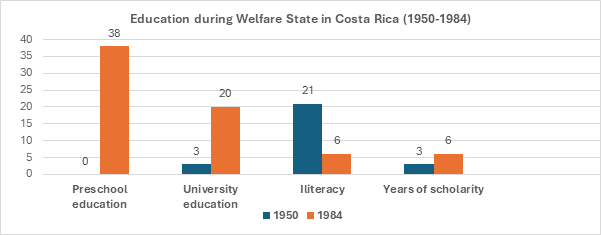
Adapted from La educación en Costa Rica Un análisis comparativo de su desarrollo en los años 1950-2014, by J. M. Valverde (pp.20-23), 2015.
Everything changes from 1984 onward with the imposition of the Neoliberal State. According to Valverde, the combination of crisis and model change led to a reduction in education investment at an annual rate of 2% overall and 3.7% per capita (2015, p. 34), such that by 1990 the state education sector had 21% fewer real resources than it had available in 1979. The effects produced consequences such as the so-called "lost generation" and financial imbalances from which the education sector has not managed to recover to this day (Chávez-Salas, 2024).
According to Valverde, the main beneficiaries of the neoliberal reforms combine a mix of international interests, represented by "big transnational capital," and local interests, represented by "big business owners" (p. 32). This entails a reconfiguration of public management to the detriment of the needs and interests of students, teachers, and educational communities: we moved from a rights-based approach focused on social justice and equality of opportunity to a neoliberal approach centered on market interests (Valverde, 2015, p. 40).
On the other hand, studies likewise point to the flagrant non-compliance with the constitutional mandate (Article 78) to allocate 8% of Gross Domestic Product (GDP) to investment in education, a provision that has never been fulfilled by any government since the reform of Article 78 in 2011; on the contrary, according to an Estado de la Nación report, since 2018 the trend has been downward in this regard, with investment having fallen from 7.40% in 2018 to 5.27% in 2024 (Programa Estado de la Nación, 2024). If the 2018 Tax Reform is taken into consideration, the trend will necessarily be downward, such that by 2029, the Estado de la Nación estimates that GDP investment will reach only 4 percentage points (Figure 2).
Figure 2.
Level of investment.
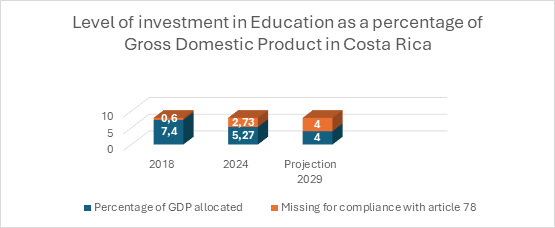
Adapted from Programa Estado de la Nación (2024), prepared by the author
Within this phenomenon, it is possible to identify the discrediting and precariousness suffered by public employees in general and the teaching profession in particular. From the beginning of the implementation of neoliberalism, after the first three administrations of the so-called Neoliberal State, teachers bore the greatest impact of the structural adjustment programs, and felt that they were discriminated against, even more so because they were the explicit targets of measures adopted by three consecutive governments that considered them the main obstacle to improving education (Carnoy & Moura, 1997, p. 7). Just as Carnoy and Moura indicate, due to the irreconcilable conflict between the neoliberal political project and teacher unions, a narrative was positioned by the dominant classes and their media in which teachers, far from being part of the solution, were the most inconvenient "obstacle" to the proposals put forward by the hegemony for the education sector in particular, and for the country project in general. In this conflict, the 1995 strike constituted the most significant rupture of those early years of neoliberalism, while also establishing behavioral patterns, a kind of conflict management script whose guidelines have perpetuated themselves ever since.
In that regard, Cedeño (1995) states: The intense propaganda bombardment, carried out in the days immediately preceding the outbreak of the strike, sought to produce an intimidating effect and at the same time sought to minimize the causes leading to a conflict... The need to combat the supposed privileges that education workers had enjoyed until then was another of the arguments used against the strike (p. 119). Since then, the rhetoric of discrediting has structured the discursive strategies through which the dominant classes have sought to position public opinion against public workers and especially against teacher unions. A review of studies on discourse analysis of hegemonic media shows that they have structured positions contrary to those assumed by teacher unions whenever social tension has led to public protest demonstrations (Brizuela, 2010; Carballo, 2011; Mora, 2021).
Conflictive processes such as the ICE Combo of 2000, which sought the privatization of the telecommunications sector (Menjívar, 2004), the discussions surrounding the Free Trade Agreement with the United States (Vargas, 2006; Raventós, 2018), or the debates over the agreements between the government of Carlos Alvarado and the International Monetary Fund (Cortés, 2025), show that discrediting constitutes another typology of educational deterioration, in this case reflected in the image discursively constructed, from within neoliberal hegemony, of the public school teacher.
Carnoy and Moura (1997) show that, since the 1980s, measures were implemented that would later be replicated by more recent neoliberal administration measures such as teacher salary freezes or substantial cuts to budget lines fundamental to the functioning of public educational institutions. This reconfiguration deepened with the 2018 Tax Reform, a reform that prioritizes the obligation to meet debt requirements with financial institutions over the allocation of resources to the education sector (Molina & Díaz, 2021). This imposition is already showing considerable effects on various needs of public educational systems, as stated by the State of the Nation in its latest reports (State of the Nation Program, 2024, 2025).
I Estudio sobre las condiciones y desafíos de los Docentes y del Magisterio Nacional [First Study on the Conditions and Challenges of Teachers and the National Teaching Profession] (COLYPRO, 2025) records that workload overload, salary dissatisfaction, over-indebtedness, and deficiencies in teaching materials, infrastructure, and digital resources are the adverse circumstances faced day by day by teachers in our country. In 2024, the Ombudsperson's Office reported that the Salary Claims Unit of the Ministry of Public Education (MEP) had more than 69,000 pending files for unpaid or incomplete wages, unjustified deductions, unacknowledged surcharges, non-payment of incentives, among other issues (Martínez, 2024). This figure represents 80% of the total employees working for the MEP and exemplifies the level of institutional negligence that has become entrenched in the ministry's functioning.
The educational system shows signs of deterioration in areas such as evaluation results on international tests, infrastructure, and working conditions of teachers. At the same time, one important report notes the lack of direction in educational policies and cuts to education funding, while the current government -Chaves Robles administration 2022-2026- shows a concern for regulating and supervising dress codes, appearance, and identity expressions, as well as for the elimination of the Comprehensive Affective and Sexual Education Program (Salas, 2025), which the Minister of Education, Ana Katharina Müller, went so far as to call "erotism manuals" (Chinchilla, 2025).
Growing inequality between public education and private education
Another of the consequences concerning the change in the State model and its repercussions on the Costa Rican educational field has focused interest on the issue of inequality. Hidalgo-Capitán and Cubillo-Guevara (2023) indicate that the economic growth of the Neoliberal State has focused its efforts on certain sectors linked to the diversification of exports, but without promoting productive linkages, neglecting other areas of the Costa Rican economy and with regressive fiscal policies, which has led to growth without redistribution, thus affecting the trend consolidated by the Welfare State of reducing poverty and the inequality gap.
The increase in socioeconomic inequality in Costa Rica between 2000 and 2021 can be seen in the evolution of the Gini index, which went from 0.479 in 2000 to 0.501 in 2021... The overall increase in socioeconomic inequality is also seen in the fact that the wealthiest 20% of the Costa Rican population (quintile 5, identifiable with the upper class) has gone from appropriating 53% of income in 2000 to 55.2% in 2021. This increase of 2.2 percentage points in income appropriation by the upper class comes at the expense of quintiles 1 (lower class), 2 (lower-middle class), 3 (middle-middle class), and 4 (upper-middle class), which cease to appropriate, respectively, 0.3, 0.7, 0.6, and 0.6 percentage points of national income] (Hidalgo-Capitán & Cubillo-Guevara, 2023, pp. 6-7) (Figure 3).
Figure 3.
Growth of inequality in Costa Rica 2000-2021
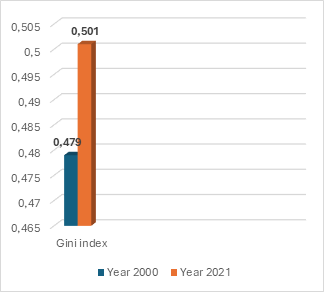
Gini Index Chart for Costa Rica. Source: Hidalgo-Capitán and Cubillo-Guevara (2023). Prepared by the author. In the Gini index, "0" represents a condition of zero inequality, which is why inequality decreases as the index approaches 0.
The scientific literature on the relationships between inequality, poverty, and their effects on education shows that the deficiencies suffered by the most disadvantaged social strata affect indicators such as academic performance, irregular class attendance, dropout rates, a lower quantity and quality of study hours, and even lower expectations of social mobility (Mínguez et al., 2019). Likewise, poverty hinders family support for doing homework at home (Figueroa & Fernández, 2013), and all these conditions can perpetuate themselves over several generations, obstructing the possibilities of social mobility (Erola et al., 2016).
Fernández and Del Valle (2013), as well as Giménez and Castro (2017), developed comparative studies on the inequalities between secondary school students in private educational institutions versus students at the same level in public educational institutions, showing that students with the poorest academic results are precisely those belonging to the lowest-income social strata. Both works trace clues about possible consequences that the introduction of market logics and values may already be producing in the Costa Rican educational field. Fernández and Del Valle (2013) find that the main differences lie in access to resources, particularly computer ownership, internet access, and other information and communication technologies (p. 43). The work of Giménez and Castro (2017) manages to detect that the main cause of comparative divergence consists of "household characteristics," a cause whose determining factors include "household wealth index," "mother's education," and "father's education" (p. 209).
The consequences produced by the SARS CoV-2 pandemic, as catalysts of already growing inequality combined with insufficient educational policies and their effects on student populations, are topics addressed by Fernández (2021). Through data analysis and the use of statistical projections, he demonstrates the need to establish adequate public policies capable of cushioning or reducing the impact of the possible effects brought by the aftermath of a post-coronavirus stage (Fernández, 2021, p. 66).
Deteriorations were detected in passing rates, limited development of competencies and skills, deficiencies and inequity in access to teacher training options, and unequal distribution of resources among educational institutions (Ministerio de Educación Pública, 2024): a public report states a reduction in the resources allocated for essential services such as conditional cash transfers, food, and student transportation. On the other hand, the digital transformation of the service is limited by the lack of internet access and disparities in the availability and usefulness of technological resources (p. 34). The report admits that inequality is not only reflected in access to teaching resources, but that inequality has expanded its range of manifestation to also include access to digital resources: A high proportion of students lack the minimum conditions to learn with technology, whether due to the low availability of computers or tablets, the limited and recreational use of devices, or the lack of skills to operate safely and critically in digital environments. This phenomenon, which especially affects households with lower incomes, located in rural areas or with high student population density, reproduces pre-existing inequalities and creates new forms of exclusion (State of the Nation Program, 2025, p. 109).
The SARS CoV-2 virus pandemic evidenced that deficiencies in access to the internet and devices with the potential to facilitate attendance and monitoring of virtual classes caused what was called an "educational blackout," a phenomenon that significantly affected more than 400,000 students, that is, 40% of the country's student population (State of the Nation Program, 2023).
Curricular inequality is especially pronounced in public educational institutions in rural areas. The Décimo Estado de la Nación found that the number of single-teacher public educational institutions in rural areas with a complete curriculum, according to the parameters established by the Ministry of Public Education, reached only 1.5% for the subject of Industrial Arts or 2.3% for the subject of Home Economics (State of the Nation Program, 2025, p. 114). Despite its importance, the subject of English is only taught in 32.9% of single-teacher public educational institutions in rural areas (State of the Nation Program, 2025, p. 114).
Greater interference by international financial organizations
The phenomenon of interference by international financial organizations in the functioning of educational systems has been one of the defining features of the Neoliberal State model (Arias & Romero, 2019; Chávez-Salas, 2024; Saxe, 2007): this feature seeks to impose "market" logics and values in areas where said logics and values do not arise from the needs and requirements of those areas themselves. As Alvarado (1993) states, the crisis that affected the Costa Rican economy at the beginning of the 1980s not only deteriorated the living conditions of the population but also gave way to the economic policy proposals of international financial organizations... The consequences have been multiple and have affected all spheres of economic, social, and political life in our country. There has been a loss of national sovereignty; international organizations have entrenched themselves in the decision-making of legitimately elected governments (p. 15).
Chávez-Salas (2024) exposes the interest shown in deregulating areas until then dominated by public institutions, not exclusively referring to public education, although special interest is shown in this field. In that sense, the Structural Adjustment Programs (SAP) of the 1980s constituted powerful coercive factors forcing states to yield to pressure from international financial organizations. For Chávez-Salas, this push is accompanied and reinforced by the draconian attitude of local elites when it came to obeying the dictates of the International Monetary Fund, the World Bank, and the United States Agency for International Development, even if these implied austerity measures tending to precarious the conditions of the most vulnerable strata, thereby affecting the very foundations of social stability.
According to Chávez-Salas, the reforms promoted by the Structural Adjustment Programs have especially benefited those interested in profiting from teaching-learning processes. This is due to the exponential expansion that has occurred in the private supply of educational services since the implementation of the first SAP in 1985. In 1980, 1.35% of schools were private; in 1997, 5.8%. Secondary schools represented, in 1981, 12% of the total of these institutions and in 1997, 30%. Regarding higher education, public and private, there was growth in coverage; in 1980, it constituted 15% and in 1995, 19%, although public spending per student decreased during this period. This data is explained by the growth in the number of private universities during the 1980s and 1990s, which went from two private universities at the beginning of the 1980s to fifty in 2000. This exponential increase is reflected in the number of university degrees awarded; while in 1990 these private institutions awarded 22.4% of university degrees, in 2000 it was 63% (p. 80) (Figure 4).
Figure 4.
Public-private education.
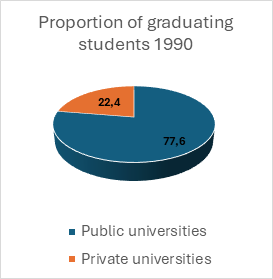
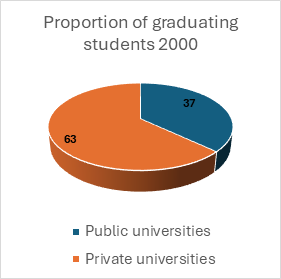
Comparative graph of the proportion of students graduating from private universities versus public universities. Source (Chávez-Salas, 2024), prepared by the author.
The extortionate practices that lie at the root of the financial loans that inaugurated the era of neoliberal states in our region include installing educational practices that are subservient to and in the service of emporiums interested in making education yet another source of investment (Saxe-Fernández, 2007): The World Bank and the International Monetary Fund (IMF) function as instruments for projecting US administration in Latin America, promoting structural adjustment programs and the all-out privatization of public sectors, including Higher Education and Research (p. 31). Precisely, by virtue of its capacity to provide inputs -from the training of new professional cadres, the ability to create knowledge, or to drive improvements in innovation and technological resources-, the university educational system is seen as a kind of "crown jewel" in the hegemonic aspirations materialized in the obligation to place all these inputs at the service of transnational capital: The multinational corporation is installed as an agent that defines not only what is researched, but also how it is researched and what should not be researched. This is done through the organizations used to promote and finance university research, such that the researcher must conform to the parameters established by the transnational apparatus (p. 36).
Arias and Romero (2019) address the issue of the effects produced by the interference of the World Bank in the country's educational systems. Like other studies already mentioned in this review, the authors attribute exogenous factors (Washington Consensus, consolidation of the neoliberal hegemonic project) and endogenous factors (local power groups) as the causal source of the expression of power relations that are present when analyzing the phenomenon of said interference: 2012 represents a turning point in the relations between the World Bank and Costa Rican education. The process of changes initiated since the 1980s has involved conditional loans restriction and redirection of budgets, administrative centralization and verticalization, increased sale of services and tuition prices, creation of foundations (Arias and Romero, p. 10), introduction of market logics and values into the educational field.
Carmen Caamaño has published various articles on the consequences that the change in the State model and interference by financial organizations have had on the functioning of the Costa Rican public university, the new vision of university education expressed by the neoliberal political project in evaluation mechanisms, privatization of patents or copyrights, managerialization, and labor flexibilization (Caamaño, 2020, pp. 107-115). In collaboration with other researchers, Caamaño has also conducted studies on university internationalization (Caamaño & Chacón, 2017) or the rise of outsourcing processes for cleaning staff working at the Universidad de Costa Rica (Caamaño et al., 2021).
The consequences that neoliberal hegemony has on the functioning of public universities have been addressed, in dossier format, by the philosophy journal of the Universidad de Costa Rica in its volume 59, number 155, published in November 2020. Composed of six essays, including the one by Caamaño (2020), the publication addresses topics such as the authoritarian turn of a hegemonic ideology whose postulates force it to implement political-cultural conditions for the attack on the public university" (Ayala, 2020, p. 89). The primacy of the vision of the university educational center subordinated to efficiency criteria above emancipatory education (Corona, 2020), or the historical account of the university as a teaching institution, contrasted with the evolution of capitalism as a form of socioeconomic organization with particular demands and features that, on not a few occasions, have led to confrontation between both developments (Corrales, 2020).
Ortega (2020) emphasizes the unstable character of the capitalist system, reflected in the impossibility of maintaining a balanced tendency rate of profit (Ortega, 2020, p. 172), and in its need to justify new market spaces, previously contested by the Welfare State, including the public university itself. Fragomeno summarizes the progressive transition of access to higher education from a right to a marketable good subject to the vagaries of supply, demand, and purchasing power in a context where it seeks for the University to succumb to the simplistic idea that its function is to prepare people to work in deregulated markets (2020, p. 148).
Constant disagreement between teacher unions and the hegemonic country-project
Salary adjustments, pension management, discussions regarding education financing, university autonomy, and the already mentioned interference of international financial organizations, constitute true tectonic faults that have led to massive protest demonstrations by teachers, students, and union organizations (Cortés, 2025; Molina & Díaz, 2021).
The studies by Alvarado, Cortés, and Saénz (2021) show that conflicts over educational issues make up a large part of the thematic axes of social protest. The presence of education unions and student organizations has stood out in recent processes of debate and political disagreement such as the 2018 Tax Reform, the 2019 Dual Education project, or the discussions around the FEES (Higher Education Fund) in 2017 and 2019. A conflict that extended after the publication of the article in 2022 and 2024 and that shows no signs of ending in the coming years.
From 1995 to 2020 there have been more than fifteen teacher strikes (Cordero, 2021, p. 24), processes that involved educational issues, such as the 2014 strike over salary non-compliance with teachers, or the 2019 movements over the debate on the Dual Education project, but which also included issues that transcended educational problems, such as the 2000 strike known as the "ICE Combo" against the privatization of the telecommunications sector, or the participation of education unions and student organizations in favor of the No vote in the Free Trade Agreement between 2006-2007.
The business sectors have supported and applauded the initiatives against which union protest has risen. This has occurred in cases such as the discussions surrounding the United States-Central America-Dominican Republic Free Trade Agreement (Raventós, 2018; Vargas, 2006), the Tax Reform (Alvarado et al., 2021), or the Dual Education proposal (National Association of Educators, 2019; Camacho, 2023). In the case, for example, of the Dual Education project, the attitude of the Alvarado Quesada administration ignored the expert criteria issued by education professionals (National Association of Educators, 2019), in contrast to the constant dialogue it held with and the attentive ear it showed to the demands of business chambers (Camacho, 2023).
The harmful effects of this conflict have had a particularly strong impact on public educational systems. On the one hand, they have reinforced the deterioration and wear of the teacher's image, as discrediting narratives are used in each conflictive process to weaken (even ignore) union positions against those put forward by neoliberal hegemony, while, on the other hand, they have placed public educational institutions at a competitive disadvantage, because they disrupt the continuity of classes whenever unions have called for protest movements. The State of the Nation refers to this phenomenon when it warns about: The interruptions of the educational cycle that had been dragging on since 2018 and 2019, due to teacher strikes and student protests in opposition to bills discussed in the Legislative Assembly which, together, implied a loss of nearly six months of classes in those years (State of the Nation Program, 2021, p. 90). This same report indicates that the effects on the continuity of educational processes cause the migration of student populations from the public to the private system, such that only the most impoverished strata, who have no other option, remain in public educational institutions: The negative effects of the prolonged 2018 teacher strike on teaching and learning processes, interrupted for many public system students whose households, in most cases, lack the resources to send them to the private system (State of the Nation Program, 2021, p. 31).
The conflict between the dominant classes and teacher unions translates into a new structural crack that weakens the public educational system, as well as an incentive to abandon the system when economic conditions make it possible to migrate to private educational institutions.
Other studies
González (2015) analyzes the National System for Higher Education Accreditation (SINAES), as an entity external to the functioning of Costa Rican public universities, but with a strong and growing influence over them, contrary to the principle of autonomy and the legal guarantees established since the founding of the Universidad de Costa Rica and the subsequent founding of other universities in the public educational system: SINAES has purposes and orientations very different from those stipulated by the guidelines of public universities, its vision does not agree with the UCR Organic Statute, as it has a mercantilist tendency, without concern for essential issues such as equity and contribution to social development (p. 22), and shows no particular interest in including indicators highly valued by the public university vision, such as social action or research.
Economist Luis Paulino Vargas Solís summarizes some of the implications that compromise the Costa Rican educational system after the approval of the agreement with the United States: higher levels of commodification of teaching-learning processes, the imposition of trans nationalizing trends, and the weakening of control, supervision, and management mechanisms by Costa Rican state institutions.
Sociologist Guillermo Miranda Camacho (2019 delves into the theoretical foundations of educational policy design from neoliberalism and its explicit manifestations in pedagogical and curricular proposals. Miranda's approach provides inputs for critically analyzing the educational vision that neoliberalism holds, as well as its effects on the Costa Rican social context.
Conclusions
Neoliberal hegemony have structurally affected the functioning of public educational systems. The Structural Adjustment Programs established coercive mechanisms that caused the first changes in the way the State's role in educational management in Costa Rica was understood. These reforms had the support of ruling elites and business chambers, while facing resistance from educational unions. In that sense, the 1995 strike represented a watershed whose repercussions left their mark on collective memory, while at the same time structuring guidelines and praxis from the established power and its media in the management of conflicts that would be repeated more or less reiteratively in other processes of disagreement, such as the 2000 ICE Combo, the discussions surrounding the 2006-2007 Free Trade Agreement with the United States, the 2018 Tax Reform, or the 2020 agreements with the International Monetary Fund.
In this increasingly conflicting period, education consolidated itself as one of the social spaces with the greatest friction and wear. In fact, the weakening of public institutions shows this wear not only in infrastructural aspects, access to resources, or progressive defunding, but also in the detriment suffered by the figure of the teacher in public educational systems, by virtue of their refractory condition to the reforms proposed by neoliberal hegemony.
Growing inequality is detected with visible effects in comparisons between student populations of public institutions versus their peers in private institutions. A gap that is exacerbated when analyzed by curriculum, performance test results, geographic area, or access to digital resources. This phenomenon further potentiates the weakening of public education by placing it at a competitive disadvantage in offering a quality service, in a reality in which education is conceived yet another service good rather than as a human right and an obligation with responsibility on the part of the State.
Interference by international financial organizations has been manifest since the first Structural Adjustment Program, as already indicated in previous paragraphs. Noteworthy in this regard is the bibliographic richness showing the theme of higher education, a feature that stands out more given that there are few in-depth studies on the consequences that this interference has on the functioning of other levels of the educational system. This scarcity points to possible approaches for future research on the subject. Approaches from educational philosophy, sociology of education, curricular design, or impacts on educational management may be of particular interest, to cite a few examples.
The constant disagreement between teacher unions and the hegemonic country-project promoted by global elites is the consequence, summarized in this review, that has aroused the most interest according to studies carried out from approaches such as the sociological approach of Cedeño (1995) or Alvarado et al. (2021), the historical approach of Menjívar (2004) or Molina and Díaz (2021), or the approach more focused on repercussions in the educational sphere as occurs in the research of Cordero (2021) or the State of the Nation Program (2023; 2024; 2025). From this category, future works may emerge that address the discursive constructions between opposing sides, the more minute and analytical detail of the corrosive effects that this conflict has on the educational system, or the need to propose strategies that help overcome this phenomenon for the benefit of the most disadvantaged social strata and not to their detriment.
It is necessary, within nation-states, to establish alliances configured from community visions that involve union, student, and family associations, but also linkages with local governments, social movements, and political parties with anti-hegemonic affinities. However, given the geopolitical causes underlying neoliberal hegemony, it is determined that solving the problems described by this article must also necessarily involve global-transnational proposals. In that sense, it is not enough to promote the construction of a country-project alternative to the project of submission to the decadent order.
The deterioration of the American empire, and its increasingly harmful consequences for our nations subordinated to its domination, is a fact. The processes of social fascistization, the precarity of politics as a way to manage the complexities of social life, the renunciation of the clarity of discursive reason, and the increasingly frequent recourse to the use of force to settle differences are only symptoms of this loss of hegemony, and their effects increasingly flood daily experience, both in the metropolis/center and in the colonies/peripheries.
The creation of other political projects, rooted in anti-colonial, anti-fascist, and anti-imperialist traditions, will undoubtedly need to involve counter-hegemonic blocs that are constituted from the exercise of critical thinking, but also from creativity, illusion, and hope to establish, as the Zapatista slogan goes, "a world where many worlds fit," free from asymmetries in power relations, racism, supremacism, "manifest destiny" doctrines, the plundering of wealth, the tacit or explicit extermination of entire populations along with their worldviews, and other manifestations of concomitant domination.
References
Alvarado, A., Cortés, S., y Sáenz, R. (2021). La protesta laboral en Costa Rica (2013-2019): actores, repertorios y demandas. Revista de Ciencias Sociales, 4(174), 17-40. https://repositorio.iis.ucr.ac.cr/handle/123456789/1000
Arias, L. D., y Romero, J. P. (2019). La mercantilización de la educación en Costa Rica: las universidades públicas en la mira de los organismos internacionales. Humanidades, 9(1), 1-34. https://www.redalyc.org/jatsRepo/4980/498061642010/index.html
Asociación Nacional de Educadores. (August 7, 2019). ANDE se manifestó contra educación dual, por la defensa de la CCSS y de las pensiones del Magisterio. https://www.ande.cr/noticia/P5RmP5RmS9Hs
Ayala, R. (2020). Neoliberalismo, salto autoritario y universidad pública. Revista de Filosofía de la Universidad de Costa Rica, 49(155), 73-99. https://revistas.ucr.ac.cr/index.php/filosofia/article/view/44618/44489
Boltanski, L., y Chiapello, È. (2011). Le nouvel esprit du capitalisme. Gallimard.
Brizuela, A. (2010). Las construcciones política y de mundo en dos artículos editoriales del periódico La Nación. Rev. Artes y Letras, 34(2), 117-125. https://archivo.revistas.ucr.ac.cr//index.php/kanina/article/view/707/770
Brown, W. (2015). Undoing the Demos: Neoliberalism’s Stealth Revolution. Zone Books.
Caamaño, C. y Chacón, F. (2017). Internacionalización neoliberal de la Educación Superior Pública. En M. N. Ruiz (Comp.), Transformación educativa, sustentabilidad y prácticas emancipatorias (pp. 283-299). FronterAbierta. https://repositorio.iis.ucr.ac.cr/handle/123456789/355
Caamaño, C. (2020). La universidad-empresa en América Central: el caso de la UCR. Revista de Filosofía de la Universidad de Costa Rica, 49(155), 101-120. https://revistas.ucr.ac.cr/index.php/filosofia/article/view/44619/44491
Caamaño, C., Dinartes, A., y Villena, S. (2021). ¿Vienen con los edificios? “Modernización” y trabajo precario en la Universidad de Costa Rica. Revista Ciencias Sociales, 173, 79-103. https://revistas.ucr.ac.cr/index.php/sociales/article/view/51887/52029
Camacho, S. (2023). Influencia de las políticas educativas globales en los procesos educativos nacionales: El caso de la modalidad educativa dual en Costa Rica. Revista Actualidades Investigativas en Educación, 23(1), 1-30. https://www.scielo.sa.cr/scielo.php?script=sci_arttext&pid=S1409-47032023000100432
Carballo, P. (2011). Análisis del discurso mediático sobre el sistema educativo público. Rev. Ciencias Sociales, 3-4(133-134), 75-90. https://www.redalyc.org/articulo.oa?id=15323589006
Carnoy, M. y Moura, C. (1997). ¿Qué rumbo debe tomar el mejoramiento de la educación en América Latina? Propuesta Educativa, 17, 1-63. https://publications.iadb.org/es/publicacion/15917/que-rumbo-debe-tomar-el-mejoramiento-de-la-educacion-en-america-latina
Castro-Gómez, S. y Grosfoguel, R. (2007). El giro decolonial. Reflexiones para una diversidad epistémica más allá del capitalismo global. Siglo del Hombre Editores.
Chinchilla, D. (February 21, 2025). Así tergiversó el Gobierno las guías de afectividad y sexualidad del MEP. Doble Check. https://radios.ucr.ac.cr/-/asi-tergiverso-el-gobierno-las-guias-de-afectividad-y-sexualidad-del-mep
Codina, L. (2020). Cómo hacer revisiones bibliográficas tradicionales o sistemáticas usando bases de datos académicas. Rev ORL, 11(2), 139-153. https://doi.org/10.14201/orl.22977
COLYPRO. (2025). I Estudio sobre las condiciones y desafíos de los Docentes y del Magisterio Nacional. https://www.colypro.com/docoficiales/i-estudio-sobre-las-condiciones-y-desafios-de-los-docentes-y-del-magisterio-nacional/
Cordero, F. (2021). Clase gobernante y magisterio en la Costa Rica del Estado Neoliberal desde 1980 al 2019. ConTexto U, 6, 22-28. https://campusestudiantiluned.com/revistas/volumen-vi-edicion-trimestral
Corona, J. (2020). La universidad frente al paradigma eficientista de la educación neoliberal y tecnocrática. Revista de Filosofía de la Universidad de Costa Rica, 49(155), 121-136. https://revistas.ucr.ac.cr/index.php/filosofia/article/view/44620/44493
Corrales, A. (2020). La universidad pública bajo ataque neoliberal. Revista de Filosofía de la Universidad de Costa Rica, 49(155), 137-146. https://revistas.ucr.ac.cr/index.php/filosofia/article/view/44622/44495
Cortés, S. (2025). Una aproximación a la canalización neoliberal y conservadora del descontento social en Costa Rica (2019-2020). Reflexiones, 104(1), 127-158. https://www.scielo.sa.cr/scielo.php?script=sci_arttext&pid=S1659-28592025000100132
Díaz, D. (September 13, 2020). Los neoliberalismos costarricenses. Página Abierta. https://copper-rust.squarespace.com/blog/los-neoliberalismos-costarricenses
Dussel, E. (1994). 1492, El encubrimiento del otro. Hacia el origen del mito de la modernidad. Plural Editores.
Fernández, A. (2021). Desempleo, pobreza y desigualdad en Costa Rica durante la pandemia por el COVID-19: Consideraciones para una recuperación resiliente. Konrad-Adenauer-Stiftung. https://www.kas.de/es/web/costa-rica-und-panama/einzeltitel/-/content/desempleo-pobreza-y-desigualdad-en-costa-rica-durante-la-pandemia-por-el-covid-19
Fernández, A. y Del Valle, R. (2013). Desigualdad educativa en Costa Rica: la brecha entre estudiantes de colegios públicos y privados. Análisis con los resultados de la evaluación internacional PISA. Revista CEPAL, (11), 37-57. http://repositorio.cepal.org/handle/11362/35932
Fernández, C., García, O., y Galindo, E. (2017). Escuela o barbarie. Entre el neoliberalismo salvaje y el delirio de la izquierda. Akal.
Figueroa, M. J., y Fernández, D. (2014). Los deberes escolares: incidencia en la vida de la comunidad escolar. Padres y Maestros, 358, 44-48. https://www.academia.edu/88592922/Los_deberes_escolares_incidencia_en_la_vida_de_la_comunidad_escolar
Friedman, M. (1982). Capitalism and Freedom. The University of Chicago Press.
González, M. (2015). La inconstitucionalidad y la inconveniencia de la acreditación del SINAES para la Universidad de Costa Rica. [Ponencia]. Simposio: La Calidad de la Educación Universitaria, Ciudad de la Investigación, Universidad de Costa Rica.
Grant, M. J., y Booth, A. (2009). A typology of reviews: an analysis of 14 review types and associated methodologies. Health Information and Libraries Journal, 26(2), 91–108. https://doi.org/10.1111/j.1471-1842.2009.00848.x
Harvey, D. (2007). A brief history of neoliberalism. Oxford University Press.
Hayek, F. (1988). The fatal conceit. The errors of socialism. Routledge.
Hidalgo-Capitán, A. L., y Cubillo-Guevara, A. P. (2023). El progreso social de la Costa Rica del siglo XXI. El desvanecimiento del “sueño tico”. América Latina, Hoy, 93, 1-24. https://doi.org/10.14201/alh.30242
Karaganov, S. (2018). The new cold war and the emerging greater Eurasia. Journal of Eurasian Studies, 9(2), 85-93. https://doi.org/10.1016/j.euras.2018.07.002
Klein, N. (2008). The shock doctrine. The rise of disaster capitalism. Metropolitan Books.
Martínez, L. (June 11, 2024). Defensoría se fue a revisar expedientes a la Unidad de Reclamos del MEP y encontró 69 mil reclamos por atrasos salariales. Semanario Universidad. https://semanariouniversidad.com/pais/defensoria-se-fue-a-revisar-expedientes-a-la-unidad-de-reclamos-del-mep-y-encontro-69-mil-reclamos-por-atrasos-salariales/
Menjívar, M. (2004). Acciones colectivas en Costa Rica al final del siglo XX: entre la continuidad y el orden. Revista de Ciencias Sociales, 4(106), 55-67. https://revistacienciassociales.ucr.ac.cr/images/revistas/RCS106_107/05MENJIVAR.pdf
Miranda, G. (2019). Política educativa en la era neoliberal: Una propuesta de aproximación crítica. Editorial Universidad Nacional de Costa Rica.
Mínguez, R., Romero, E., y Gregorio, A. (2019). Fracaso escolar y familias vulnerables. Un estudio cualitativo. Revista Boletín REDIPE, 8(9), 23-41. https://doi.org/10.36260/rbr.v8i9.813
Molina, I. (April 26, 2021). Las divisiones del Partido Liberación Nacional. Del pasado y del presente. https://delpasadoydelpresente.wordpress.com/2021/04/26/las-divisiones-del-partido-liberacion-nacional/
Molina, I., y Díaz, D. (Eds). (2021). El gobierno de Carlos Alvarado y la contrarrevolución neoliberal en Costa Rica. Centro de Investigaciones Históricas de América Central.
Mora, S. (2021). La construcción mediática de los sindicatos en la huelga contra el Plan Fiscal del año 2018 en Costa Rica. Revista de Ciencias Sociales, 4(174), 59-74. https://www.redalyc.org/journal/153/15372527005/html/
Oropeza, A. (2017). Del Atlántico al Pacífico. Reconstruyendo el orden global. Universidad Nacional Autónoma de México.
Ortega, A. (2020). ¿Destruir la universidad? Revista de Filosofía de la Universidad de Costa Rica, 49(155), 161-179. https://revistas.ucr.ac.cr/index.php/filosofia/article/view/44625/44499
Ministerio de Educación Pública. (2024). Informe de Auditoría sobre la Eficiencia y Eficacia del Servicio de Educación Secundaria Académica Diurna 2024. https://cgrfiles.cgr.go.cr/publico/docs_cgr/2024/SIGYD_D/SIGYD_D_2024017868.pdf
Raventós, C. (2018). Mi corazón dice No: El movimiento de oposición al TLC en Costa Rica. Editorial de la Universidad de Costa Rica.
Salas, N. (December 9, 2025). Cierre educativo con retrocesos y tensión en políticas públicas, según Cide. UNA Comunica. https://www.unacomunica.una.ac.cr/index.php/diciembre-2025/6529-cierre-educativo-con-retrocesos-y-tension-en-politicas-publicas-segun-cide
Saxe-Fernández, J. (2001). Globalización, poder y educación pública. Economía y sociedad, 6(15), 83-99. https://www.revistas.una.ac.cr/index.php/economia/article/view/1495/1415
Saxe-Fernández, J. (2007). Banco Mundial y la enseñanza superior en América Latina. Universitas, 9, 29-42. https://www.redalyc.org/pdf/4761/476150828003.pdf
State of the Nation Program. (2021). Octavo Estado de la Educación. Programa Estado de la Nación.
State of the Nation Program. (2023). Noveno Estado de la Educación. Programa Estado de la Nación.
State of the Nation Program. (2024). Impacto de la Regla Fiscal en la Educación Costarricense en la próxima década es analizado por el Informe Estado de la Educación. Programa Estado de la Nación. https://estadonacion.or.cr/impacto-de-la-regla-fiscal-en-la-educacion-costarricense-en-la-proxima-decada-es-analizado-por-el-informe-estado-de-la-educacion/
State of the Nation Program. (2025). Décimo Estado de la Educación. Programa Estado de la Nación. https://estadonacion.or.cr/wp-content/uploads/2025/08/PEN_Decimo_Informe_estado_educacion_IEE_2025.pdf
Valverde, J. M. (2015). La educación en Costa Rica Un análisis comparativo de su desarrollo en los años 1950-2014. Internacional de la Educación para América Latina. https://ei-ie-al.org/sites/default/files/docs/educacion-cr_web.pdf
Vargas, L. P. (2006). Entre la vida y el mercado. Tratado de Libre Comercio Estados Unidos-Centroamérica-República Dominicana (TLC-EUCARD). Implicaciones para la educación. Editorial Universidad Estatal a Distancia.
Vargas, L. P. (2016). El proyecto histórico neoliberal en Costa Rica (1984-2015). Devenir histórico y crisis. Rupturas, 6(1), 147-162. https://dialnet.unirioja.es/servlet/articulo?codigo=5559812
Vega, M. (1996). Cambios en la sociedad costarricense en las décadas de los ochenta y noventa. Anuario de Estudios Centroamericanos, 22(2), 129-146. https://revistas.ucr.ac.cr/index.php/anuario/article/view/3164
Wallerstein, E. (1979). El moderno sistema mundial. Siglo XXI Editores.