Revista Internacional de Educación
y Análisis Social Crítico Mañé, Ferrer & Swartz.
ISSN: 2990-0476
Vol. 3 Núm. 2
(2025)
The
subsidised education as a factor
of educational inequality: a situated approach from school choice in A Coruña, Spain
La educación concertada como factor de desigualdad educativa: una mirada situada
desde la elección escolar en A Coruña, España
A educação
subvencionada como fator
de desigualdade educacional: um olhar situado a partir da escolha escolar na Corunha,
Espanha
Antía
Salgueiro Basadre
Faculty
of Sociology. University of A Coruña (España).
https://orcid.org/0009-0005-9747-7108
a.salgueiro@udc.es
Águeda Simais Lorenzo
Faculty
of Sociology. University of A Coruña (España).
https://orcid.org/0009-0001-9136-3178
agueda.simais@udc.es
Abstract
This research analyzes the role of subsidized education as a factor
of educational inequality in the municipality of A Coruña, Spain, within the
dual public–subsidized system. From a sociological and territorial perspective,
it examines how school choice, influenced by families’ economic, cultural, and
symbolic capital, reinforces processes of social and territorial segmentation.
A mixed-method approach was adopted, combining surveys of 400 families with
children in primary education and semi-structured interviews with professionals
from public and subsidized schools. Statistical and discourse analysis reveal a
significant association between school ownership and socioeconomic profile,
with subsidized schools concentrating middle and upper-middle-class students,
showing greater geographical mobility and access to extended services. Factors
such as proximity, school zoning, the range of complementary activities,
religious ideology, and differential information strategies shape an active choice pattern for more affluent
families, as opposed to choices conditioned by proximity and availability for less advantaged sectors. The results
confirm that, far from
correcting inequalities, the subsidized model reproduces them through symbolic,
territorial, and economic mechanisms, reinforcing the internal homogeneity of schools and segmenting the education
system. The need for redistributive policies and equitable territorial planning
to ensure real equality of opportunity is discussed.
Keywords: subsidized education, educational inequality, school choice,
socio-educational segregation, educational policies.
Resumen
Esta
investigación analiza el papel de la educación
concertada como factor de desigualdad educativa en el municipio de A Coruña, España, en el marco del
sistema dual público–concertado. Desde una perspectiva sociológica y
territorial, se examina cómo la elección escolar, influida por el capital
económico, cultural y simbólico de las familias, refuerza procesos de segmentación social
y territorial. Se adopta un
enfoque metodológico mixto, combinando encuestas a 400 familias con hijos/as en
Educación Primaria y entrevistas semiestructuradas a profesionales de centros
públicos y concertados. El análisis estadístico y discursivo revela una
asociación significativa entre titularidad del
centro y perfil socioeconómico, con la concertada concentrando alumnado de
clases medias y medias-altas, y mostrando mayor movilidad geográfica y acceso a
servicios ampliados. Factores como la proximidad, la zonificación escolar, la
oferta de actividades complementarias, el ideario religioso y las estrategias
informativas diferenciales configuran un patrón de elección activa para
familias con más recursos, frente a elecciones condicionadas por la cercanía y disponibilidad para los
sectores menos favorecidos. Los resultados confirman que, lejos de corregir
desigualdades, el modelo concertado las reproduce mediante mecanismos
simbólicos, territoriales y económicos, reforzando la homogeneidad interna de
los centros y segmentando el sistema educativo. Se discute la necesidad de políticas redistributivas
y de planificación territorial equitativa que garanticen una igualdad de
oportunidades efectiva.
Palabras clave: educación
concertada, desigualdad educativa, elección escolar, segregación
socioeducativa, políticas educativas.
Resumo
Esta pesquisa
analisa o papel da educação subvencionada como
fator de desigualdade educacional no município da Corunha, Espanha, no âmbito do
sistema dual público–subvencionado. A partir de uma perspectiva sociológica e
territorial, examina-se como a escolha da escola, influenciada pelo capital
econômico, cultural e simbólico das famílias, reforça processos de segmentação
social e territorial. Adotou-se uma abordagem metodológica mista, combinando inquéritos a 400 famílias com filhos/as no ensino primário e
entrevistas semiestruturadas com profissionais de escolas públicas e
subvencionadas. A análise estatística e discursiva revela uma associação
significativa entre a titularidade da escola e o perfil socioeconômico, com as
escolas subvencionadas concentrando alunos de classes médias e médias-altas,
apresentando maior mobilidade geográfica e acesso a serviços ampliados. Fatores
como proximidade, zoneamento escolar, oferta de atividades complementares,
ideário religioso e estratégias de informação diferenciadas configuram um
padrão de escolha ativa para famílias com mais recursos, em contraste com
escolhas condicionadas pela proximidade e disponibilidade para os setores menos
favorecidos. Os resultados confirmam que, longe de corrigir desigualdades, o
modelo subvencionado as reproduz por meio de mecanismos simbólicos,
territoriais e econômicos, reforçando a homogeneidade interna das escolas e segmentando
o sistema educativo. Discute-se a necessidade de políticas redistributivas e de
planejamento territorial equitativo que garantam uma igualdade de oportunidades
efetiva.
Palavras-chave: educação
subvencionada, desigualdade educacional, escolha escolar, segregação
socioeducacional, zoneamento escolar, políticas educativas.
Introduction
The Spanish education system has historically consolidated itself as a model
structured around three distinct networks -public,
state-subsidized, and private- whose coexistence produces a heterogeneous and often unequal
educational landscape. In addition to public schools,
which are fully funded and administered by the
state, the subsidized network comprises privately owned institutions financed with public funds (Muñoyerro 2022) and
predominantly managed by religious organizations. Alongside these, the
unsubsidized private sector encompasses diverse educational projects, including denominational schools, elite institutions with high tuition
fees, and, in some cases, single-sex schools, configurations that further
intensify inequalities in access and social composition. This institutional
framework, legally established by Organic Law 8/1985 on the Right
to Education (LODE) and subsequently reinforced by
Organic Law 2/2006 on Education (LOE) and Organic Law 3/2020, which amends the
LOE (LOMLOE), has prompted substantial debate regarding its implications for
educational equity and territorial cohesion. Numerous studies argue that the
subsidized sector functions as a structural mechanism of social differentiation
by enabling selection practices that reinforce educational segregation
(Soriano, 2015; Roca, 2022).
Similarly, Zancajo, Verger, and Fontdevila (2022) demonstrate that
the Spanish subsidized-school model, as shaped over recent decades, is
systematically associated with higher levels of school segregation and with the
consolidation of distinct educational circuits between the public and
subsidized networks.
Within this context, school choice emerges as a social practice
conditioned by unequal
resources. As highlighted by
Bourdieu (2001), Bernstein
(2001), and Coleman
(1988), family decisions
are mediated by economic,
cultural, and symbolic capital and operate within a broader logic of social
reproduction that privileges certain groups over others. In the case of
subsidized schools, symbolic prestige, student
homogeneity, and a wide range of services
function as key attractors for middle- and upper-middle-class families, whereas
families with lower educational or economic capital tend to opt for the public
sector, often due to proximity or limited viable alternatives.
A growing body of research, both national and
local, has shown how these processes contribute to the segmentation of the
school landscape. In A Coruña, Spain—the setting of this study—the geographical
distribution of schools aligns with patterns of household income and
educational attainment, generating areas of higher and lower demand depending
on their social composition (Alegre & Benito, 2012; Gómez, 2024). This
dynamic is closely linked to the school zoning model, which, far from
guaranteeing equal access, may exacerbate inequality if not accompanied by
redistributive corrective mechanisms (Villa, 2020; Roca, 2022).
Building on this critical perspective, the present study
examines the role of the subsidized sector
as a driver of educational
inequality, focusing on the municipality of A Coruña. The analysis combines
quantitative data from surveys administered to families with children in primary education
and semi-structured interviews with professionals working at this
educational stage. This mixed-methods design allows for triangulation of
results, capturing both statistical patterns and the discourses, practices, and
meanings underlying family decision-making.
The overarching aim is to analyze how the organization of the
public–subsidized system shapes educational equity and how the logic of school
choice contributes to the reproduction of social and territorial inequalities.
Key factors considered include socioeconomic status, access to information,
geographical proximity, religious orientation, and the range of services
offered—all of which act as differential determinants in the school selection
process. Through this sociological and territorial lens, we seek to contribute to a critical
understanding of the education system and to offer insights for rethinking
policies that foster equity, social justice, and the effective right to quality
education for all.
Legal Framework
and Evolution of the State-Subsidized Model in Spain
The current configuration of the Spanish education system is the
outcome of a historical process of legislative
reforms that have consolidated a dual model based on the coexistence of public and state-subsidized (concertada) schools.
Although initially conceived as complementary, this structure has generated
significant tensions in terms of equity by introducing mechanisms of public
funding for privately owned
institutions—most of them with a religious orientation—which has ultimately
contributed to educational segmentation (Soriano, 2015; Roca, 2022).
The first major transformation occurred with Law 14/1970,
of 4 August, the General
Law on Education and Financing of the Educational Reform (LGE), which
established compulsory and free Basic General Education and, for the first
time, defined the typology of schools, distinguishing between public and private. However,
it was the LODE that formally introduced the category of state-subsidized
schools by allowing certain private institutions to access public funding.
Although this model
originally aimed to expand educational provision in areas with
insufficient public supply, its development has produced structural effects
that extend well beyond its initial intentions.
Subsequently, Organic Law 10/2002, of 23 December, on the Quality of Education (LOCE)
and, later, the LOE,
consolidated the presence of the state-subsidized network, recognizing its role
within a mixed system and reaffirming the principle of free compulsory
education. With the approval of the LOMLOE, the legal framework incorporates
measures intended to strengthen the public sector, although without
fundamentally altering the dual structure. The LOMLOE
emphasizes that subsidized schools must ensure principles
of inclusion, free access, and non-discrimination; however, these objectives
are frequently undermined by school practices that generate exclusionary effects, as noted by Roca (2022), Villa (2020), and
Cuartero Cobo (2023).
The current legal framework seeks to balance two competing
principles: freedom of school choice, recognized in Article 27 of the Spanish
Constitution, and the need to ensure equal opportunities. Nonetheless, numerous
studies show that this balance is difficult to sustain in practice. Research by Soriano (2015), Roca (2022), and
Cuartero Cobo (2023) documents how certain state-subsidized schools impose
indirect barriers to access, such as “voluntary” financial contributions,
symbolic requirements linked to the school’s religious ethos, or educational projects configured in exclusionary
terms—mechanisms that operate as concealed filters in the admission process.
In this regard, the evolution of the legal framework can be
summarized in Table 1, which outlines the key milestones that have shaped the
public–subsidized model.
Table 1
Regulatory chronology of the public–subsidised (concerted) school model
|
YEAR1
|
REGULATION
|
KEY CONTENT
REGARDING THE DUAL
MODEL
|
|
1970
|
Law 14/1970,
General Education and Financing of the
Educational Reform (LGE)
|
Compulsory and free basic
education (EGB);
public/private school typology.
|
|
1978
|
Spanish Constitution (Art. 27)
|
Recognises the right to education, freedom
of teaching and freedom to
create schools; guarantees free basic education.
|
|
1985
|
Organic Law 8/1985 on the Right to Education (LODE)
|
Formally introduces concerted schools; public
funding for private schools that meet requirements.
|
|
2002
|
Organic Law 10/2002 on the Quality of Education
(LOCE)
|
Strengthens the institutional recognition of the subsidised
(concerted) sector.
|
|
2006
|
Organic Law 2/2006
on Education (LOE)
|
Integrates
previous regulations; reaffirms the role of concerted schools as complementary to public schools.
|
|
2020
|
Organic Law 3/2020 amending the LOE (LOMLOE)
|
Strengthens the
public network and
principles of inclusion and
non-discrimination.
|
Source: own elaboration.
At the European level, Spain stands out for its high proportion of
enrolment in state-subsidized schools, particularly at the primary education
stage. According to Turienzo and Manso (2022), only Belgium surpasses this
percentage within the European Union. This configuration is especially
pronounced in autonomous communities such as Madrid, Navarre, Catalonia, and
the Basque Country, where the subsidized sector accounts for more than 40% of
the educational offer. In other regions, such as Galicia, the presence of the
subsidized network is lower in relative terms, but its impact remains
significant, as illustrated by the case of A Coruña, where the distribution of
schools reflects and reproduces differentiated social and economic patterns
(Gómez, 2024).
From a critical perspective, authors such as Alegre and Benito
(2012) have examined how the normative evolution of the subsidized-school model
has contributed to shaping a dualized education system, in which differences
between public and subsidized schools stem not only from their ownership
structures but also from profound divergences in the social composition of
their student bodies, the services they offer, and the symbolic capital
associated with each sector.
Although the system’s regulatory design is formally grounded in
principles of equality, it has not been accompanied by effective
redistributive policies capable of counteracting processes of selection and
social differentiation. As Villa (2020) warns, the absence
of robust oversight
mechanisms in admission procedures, the leniency shown
in monitoring compliance with the principle of free education in subsidized
schools, and the weak supervision of public funds have enabled these
institutions to operate according to a logic of educational marketization,
competing with public schools in terms of prestige and demand. As discussed by Casares
& Vidal (2024), this dynamic conflicts with the obligations of free
provision, inclusion, and non-discrimination that the regulatory framework of school subsidies explicitly imposes,
highlighting the gap between the legal framework and actual schooling practices.
This gap between regulation and practice is further compounded by
recent evidence on the role of education policies in generating inequality. Turienzo
and Manso (2022)
show that certain
public policy decisions -particularly those
related to the configuration of educational provision and to the criteria for accessing publicly funded schools- can
become mechanisms that reproduce socio-educational inequalities by reinforcing
student stratification. In a complementary, territorially focused analysis,
Turienzo and Manso (2023) demonstrate that the distribution of students between
public and subsidized networks varies sharply across autonomous communities,
and that these variations are linked to unequal levels of socioeconomic
segregation. Both studies underscore that the Spanish subsidized-school model
functions as a space in which public policies interact with family dynamics,
consolidating persistent patterns of school segmentation.
Consequently, an analysis of the legal framework of the subsidized model cannot be limited to tracing
its legislative milestones but must instead be understood as a structural
process that has shaped an institutional architecture conducive
to segmentation. Far from being
neutral, this regulatory framework has enabled the emergence of institutional and family practices
that deepen educational and territorial
inequalities—issues that will be further explored in the following sections
through the empirical study conducted in the municipality of A
Coruña.
State-Subsidized Education
and Socio-Educational Segmentation
The Spanish education system, characterized by the coexistence of
public and state-subsidized (concertada) networks, has generated extensive
debate regarding its effects on equity and social segmentation.
State-subsidized education, funded with public resources but managed by private
entities, is viewed from various sociological perspectives as a space where
pre-existing social inequalities are reproduced and intensified (Bourdieu,
2001, pp. 131–165; Bernstein, 2001, pp. 137–168).
Drawing on data from PISA 2022, Torrecilla and Borruel (2024)
confirm that state-subsidized private schools are among the main drivers of
socioeconomic segregation in Spain, disproportionately concentrating the most
advantaged students while enrolling fewer students in vulnerable situations.
According to Bourdieu (2001, pp.
131–165), the education system operates as a mechanism of social
reproduction in which families’ cultural and symbolic capital translates into
differentiated educational opportunities. State-subsidized schools tend to
attract middle- and upper-class students whose families value the symbolic
prestige and social homogeneity associated with these institutions, thus
fostering selection and exclusion processes that may not always be explicit
but that manifest
through institutional and social practices. Bernstein (2001, pp.
137–168) complements this perspective by examining how pedagogical discourses
and school structures reproduce inequalities through cultural and normative codes that hinder the inclusion of
students with lower levels of cultural capital.
Empirically, Alegre, Benito, and González (2008) have shown how school zoning policies
contribute to educational
segregation by allocating students according to territorial criteria that
mirror socioeconomic inequalities. In cities such as A Coruña, this phenomenon
results in an unequal distribution of students between public and
state-subsidized schools, with marked territorial segmentation aligned with
families’ socioeconomic and educational levels (Alegre & Benito, 2012;
Concello de A Coruña, 2016). This spatial segregation can intensify educational
exclusion by concentrating students with fewer resources in certain areas and
those with greater opportunities in others.
Cladellas et al. (2013)
add that the availability of extracurricular activities and complementary services in state-subsidized schools is
another factor that attracts families with greater capital, further reinforcing
segmentation. Colás and Contreras
(2013), for their part, highlight
the importance of family
participation in school governance—a factor typically stronger in the
subsidized sector and one closely
linked to families’ cultural and economic capital—which contributes to
maintaining disparities between the two networks.
Studies on the Spanish model consistently point out that, although
the current legislation (LOE, 2006; LOMLOE,
2020) establishes principles of free access, inclusion, and non-discrimination,
in practice subsidized schools impose covert
barriers, such as voluntary financial contributions or religious-based admission criteria, which
restrict access for certain groups (Soriano, 2015; Roca, 2022). This reveals
an inherent tension within the dual system, which combines freedom of choice
with equity requirements, but which often perpetuates dynamics of exclusion and
social selection.
From a critical perspective, state-subsidized education not only reflects existing
social inequalities but reinforces them through the creation
of differentiated educational spaces that reproduce the social and cultural divisions present in society
(Berger & Luckmann, 1966, pp. 65–97; Bourdieu, 2001, pp. 131–165). This process unfolds
within a context
of globalization and social transformation in which the symbolic capital associated with
certain schools acquires strategic value for families (Castells, 2000).
Moreover, educational privatization policies that promote
competition between public and private schools
reinforce inequality and social segmentation within the education
system. This model, grounded in school choice and
meritocratic principles, undermines equity and negatively affects cohesion and
educational outcomes (Rodríguez, Guzmán & Martín, 2022).
In conclusion, the Spanish state-subsidized model contributes to
socio-educational segmentation through symbolic, territorial, and economic
mechanisms that reinforce social reproduction
and hinder territorial and
social cohesion. In cities such as A Coruña, these dynamics highlight the need
for educational policies that not only guarantee formal equality but also
address the structural causes of
segregation, promoting inclusion and genuine equity in access to quality
education for all (Alegre, Benito & González, 2008; Villa, 2020).
In this same vein, Rodríguez-Martínez, Guzmán, and Martín-Alonso (2024) emphasize that education
policies inspired by market-oriented logics often translate
into internal practices
of standardization and stratification within schools,
increasing the likelihood that the state-subsidized sector will consolidate
advantageous positions for specific social groups.
Territorialization of Inequality: School Access and Zoning
The territorial distribution of schools not only reflects
pre-existing social inequalities but also contributes to their consolidation.
In the municipality of A Coruña, school zoning -understood as the mechanism that determines priority
access to schools based on family residence- emerges as a key device in shaping educational access and, consequently, in reproducing or mitigating social inequality.
Territorial analysis shows that A Coruña, despite its small
geographical size (37.8 km²), has a high population density (6,511.8
inhabitants/km²), which increases pressure on the educational network and
accentuates differences between neighbourhoods. These differences are not
merely demographic but primarily
socioeconomic: while districts such as 03 (A Grela, Os Mallos, Sagrada Familia)
register an average gross household income of €71,746, others
such as 06 (Eirís, A Pasaxe,
Monelos) do not reach €35,000 (National
Statistics Institute [INE], 2022). This disparity directly
affects the educational opportunities available to families.
In this context, school zoning may operate as an ambivalent
mechanism. While it is presented as a planning tool intended to organize access
equitably, its implementation can reinforce segregation when assigned zones coincide with socioeconomically homogeneous territories. Although designed
to ensure fairness in access, such an arrangement may consolidate existing
inequalities by overlapping with territorial disparities.
Recent studies in other Spanish urban contexts point in the same
direction. Iglesias-Pascual, Merchán, and Benassi
(2025) show that, in the city of Seville, the spatial distribution of the
state-subsidized sector reproduces neighbourhood-level inequalities,
reinforcing segmentation between schools according to the socioeconomic profile
of their surroundings.
Moreover, educational provision
is not evenly distributed across districts. Some, such as Monte Alto or
Cidade Vella, have up to six public
schools, while others
have only two and exhibit
a greater presence of state-subsidized schools
(Concello da Coruña, 2016). Of the 50 primary schools registered in A Coruña, 27 are public
and 23 state-subsidized. Although this proportion may appear balanced, its meaning becomes clear only when examined in relation to
their geographic location and the social profile of their student populations.
This spatial configuration encourages dynamics of concealed
selection. Families with greater
cultural and economic capital tend to reside
in areas with a higher
density of subsidized schools, which grants them greater capacity to choose
within the district. Families with fewer resources, by contrast, are more
constrained by geographical proximity as their only viable criterion. This contrast becomes
more pronounced when distinguishing between “active choosers” (informed
families with higher education levels and mobility) and “conventional
choosers,” who prioritize proximity and safety due to limited resources or
information (Gómez, 2024).
Furthermore, current legislation (LOE and LOMLOE) assigns
substantial weight to proximity in admission processes when places are
insufficient. Although in principle this criterion should promote equity, in practice it can become
a factor of segregation if not accompanied by fair territorial planning. As Gómez (2024) and Soriano (2015) warn,
zoning operates as a “black
box,” as its application is not
clearly regulated nor is its underlying logic transparent.
Multiple studies corroborate this
ambivalence. Villa (2020),
for example, demonstrated that expanding school
choice increased segregation, while zoning based on proximity reduced it.
Similarly, Alegre, Benito, and González (2008) found that when only one school is assigned to a zone,
segmentation is reinforced;
conversely, areas with diverse school types may foster inclusion.
Ultimately, the analysis of A Coruña reveals how the territorialization of school access can consolidate inequalities unless
structural conditions are addressed. Zoning,
far from being
a neutral tool,
responds to a social and political logic that must be critically reviewed
from the perspective of spatial justice.
In the absence of effective redistributive mechanisms and equitable
planning, the current system risks reinforcing the socio-educational
segmentation that shapes the city.
School Choice
as a Social Practice (Through
the Lens of Habitus)
School choice cannot be understood as a purely individual or neutral
decision. Research in the sociology of education has shown that this practice
is deeply influenced by families’ social
position, by the type and
volume of capital they possess, and by the dispositions incorporated throughout their life trajectories—that is, their habitus
(Bourdieu, 1979, pp. 169–222). This perspective makes it possible to analyse how educational decisions
reflect, reproduce, and even deepen structural inequalities.
From this standpoint, the education system operates as a space of
social reproduction in which families mobilize their economic, cultural, and
symbolic resources to maintain or improve their social position (Bourdieu, 1979, pp. 169–222; Bernstein, 2001,
pp. 137–168). Middle- and upper-class families, endowed with greater cultural
and relational capital, tend to use school choice as a strategy of distinction. Their decisions
rely both on their interpretation of pedagogical discourses and on the symbolic
value attributed to particular schools—often state-subsidized
institutions—perceived as homogeneous, demanding, and socially selective
(Soriano, 2015; Roca, 2022).
In contrast, families with fewer cultural and economic resources usually make choices
conditioned by proximity,
tradition, or availability of places, prioritizing accessibility over
pedagogical considerations.This differentiation produces patterns of concealed
school segmentation, where each type of family occupies a distinct educational
space, not as a consequence of abstract free choice, but of their
real capacity to exercise that choice (Soriano, 2015).
Gómez (2024) develops this argument by identifying two profiles of choosers: “active” choosers, who plan school selection in advance,
handle information about the system, and are willing to travel if necessary; and “conventional” choosers, who adjust their
decisions to the immediate environment and their available resources. This classification shows that
freedom of choice is not exercised equally across social groups; it is mediated
by structural inequalities that shape the schooling experience from the outset. Similar findings emerge in other quasi-market
systems. In a study conducted in Milan, Cordini (2024) demonstrates that
upper-middle-class families deploy complex strategies of information seeking and mobility to access schools perceived as
advantageous, while households with
fewer resources tend to limit their choice to the nearest school or to options
they know directly.
Symbolic capital, in this context, is expressed through
a school’s reputation, the social composition of its student body, its educational ethos, and its academic
record. As Coleman (1988) argues, homogeneous social networks generate trust,
cohesion, and indirect advantages, leading many families to seek environments
that mirror their own sociocultural profile. This logic of homophily, present
throughout the schooling process, reinforces stratification between schools
and contributes to socially closed educational
environments. Recent studies on “school profiling” strengthen this conclusion:
Zwier (2024) shows that the public construction of a school’s
image helps sort students by socioeconomic level, attracting
families differently according to their resources and expectations.
Likewise, Alegre, Benito, and González (2008) analyse how zoning
policies, although designed to regulate access based on proximity, ultimately
enable families with greater resources to “choose by opting out of the zone” and to access schools they consider more advantageous. In this sense, zoning
does not correct inequality; it may legitimize it if not accompanied by
redistributive mechanisms.
All of this is compounded by the lack of transparency in admission
criteria in some state-subsidized schools, which can function as mechanisms of
indirect social selection. Economic contributions, symbolic requirements, or
educational projects ideologically aligned with particular social groups may operate as undeclared filters that
restrict access for certain families (Roca, 2022; Villa, 2020).
In sum, school choice is a structured social practice in which
family habitus and the unequal distribution of capitals shape differentiated
trajectories. This segmentation is neither accidental nor marginal: it is
embedded in the structural functioning of the
dual education system,
where freedom of choice, far from mitigating
inequalities, tends to reproduce them under the guise of institutional neutrality.
Methodology
This research adopts a mixed-methods approach with a sociological
and interpretative orientation, structured through a concurrent design with
data triangulation (Zapparoli, 2003; Ugalde & Balbastre, 2013). This framework enables
an examination of the public–state-subsidized duality
as a central structure in educational segmentation, integrating
statistical patterns and institutional discourses to provide a situated
understanding of the phenomenon in the municipality of A Coruña.
In the quantitative component, we designed a structured survey addressed to families with children in Primary Education, collecting
information on school ownership, geographical proximity, parents’ educational
level and income, religiosity, access to services, and information channels.
Sampling was stratified by school
ownership, ensuring proportional representation of the three educational networks. Data collection combined face-to-face and digital
formats, ensuring voluntary participation and anonymity in accordance with
Organic Law 3/2018, of 5 December, on the Protection of Personal Data and the
guarantee of digital rights (LOPDGDD), and Regulation (EU) 2016/679 of the European Parliament and of the Council,
of 27 April 2016 (GDPR).
For the qualitative component, semi-structured interviews were
conducted with professionals from public and state-subsidized schools: teachers,
management teams, and non-teaching staff. The selection of this group of
informants was based on two considerations: (1) although Soriano (2015)
recommended interviewing families from each social
class within each school type,
this study opted
to capture the internal institutional perspective, incorporating expert knowledge on admission dynamics, social composition, and family
strategies observed in daily practice; and (2) family perceptions were obtained
extensively and representatively through
the survey, while
the qualitative interviews provided a deeper analysis of institutional functioning and its
interaction with family profiles. This design enabled us to triangulate
information, linking institutional narratives with statistical patterns and
situating the interpretation within a critical framework of school
segmentation.
Quantitative data were analysed using descriptive statistics and
inferential testing, including contingency tables and multiple correspondence
analysis (MCA). ANOVA was applied with a significance level of 1% (p < 0.01), ensuring
the robustness of the findings,
based on a sample size of
n = 400 and an absolute
error of 4.9%.
Qualitative analysis was conducted through
inductive thematic coding
(Conde, 2010), identifying discursive regularities related to prestige, social
segmentation, student composition, and family strategies in school choice.
The research design follows a descriptive–interpretative strategy
with a critical sociological orientation,
grounded in a concurrent mixed-methods design with methodological
triangulation. The overarching aim is to analyse how the structure of the
education system -particularly the public-state-subsidized
duality- affects school equity and how the logic of school choice contributes
to reinforcing social and territorial inequalities.
The study was conducted in the municipality of A Coruña, a context
characterized by high urban density, social heterogeneity, and a significant
presence of the state-subsidized network. The variables and methodological
approach build on previous research carried out in the same city by Soriano
(2015) and Roca (2022), allowing the findings
to be contrasted with analogous studies within the
same territorial and social framework.
On the quantitative level, the survey was administered to a stratified random
sample based on school
ownership (public, state-subsidized, private),
ensuring proportional representation of each educational network. The variables
included indicators of economic, cultural, and symbolic capital, as well as
measures of geographical proximity and access
to information. Table
2 presents the distribution of the
sample according to school
ownership, reflecting the structure of the school
system in the municipality
of A Coruña.
Table 2
Sample design by type of school
|
STRATUM
|
PROPORTION (Ni/N)
|
SAMPLE SIZE
(Ni)
|
|
Students in public
education
|
0,550
|
220
|
|
Students in subsidised (concerted) education
|
0,350
|
140
|
|
Students in private
education
|
0,100
|
40
|
|
Total
|
1,000
|
400
|
Source: own elaboration based
on IGE data.
In the qualitative component, the semi-structured interviews conducted with professionals from public
and state-subsidized schools provided an in-depth understanding of the phenomenon from within the institution, capturing direct
experiences regarding social composition, admission practices, and interactions
with families. Table 3 presents the technical details of the interviewees,
including their role, school of origin, and interview date.
Table 3
Technical
data sheet of the people interviewed
|
CODE
|
ROLE
|
SCHOOL
|
DATE
|
|
School custodian – Public school
|
School custodian
|
CEIP Manuel Murguía
|
30/03/2025
|
|
Teacher 1 – Public school
|
Teacher
|
CEIP Emilia
Pardo Bazán
|
04/04/2025
|
|
Teacher 2 – Public school
|
Teacher
|
CEIP San
Pedro de Visma
|
08/04/2025
|
|
Teacher
3 – Subsidised school
|
Teacher
|
CPR
Plurilingüe Compañía de María
|
09/04/2025
|
|
Teacher
4 – Subsidised school
|
Teacher
|
CPR Esclavas del Sagrado
Corazón de Jesús
|
09/04/2025
|
|
Teacher
5 – Subsidised school
|
Teacher
|
CPR Esclavas del Sagrado
Corazón de Jesús
|
09/04/2025
|
These results confirm what Bourdieu (1979, pp. 169–222) and
Bernstein (2001, pp. 137–168) proposed regarding the role of cultural and
economic capital in social reproduction: school choice reflects and reinforces
pre-existing hierarchies. Coleman (1988) adds that homogeneous networks
generate social capital that benefits those
who share the same profile,
increasing the attractiveness of selective environments.
On the qualitative level, several teachers described families in the
state-subsidized sector as “more demanding” and with “greater capacity for
planning and making demands,” suggesting a habitus oriented toward the
optimization of opportunities. One interviewee from this type of school
went so far as to state: “Students or clients, call them what you like,” referring to the market logic within education
highlighted by Zancajo, A., Bonal, X., & Verger, A. (2014), which directly
shapes social composition.
The segmentation observed is not only economic but also symbolic:
state-subsidized schools are perceived as homogeneous spaces with a defined
school culture, attracting families seeking
socially selective and “safe” environments. This pattern reinforces the
logic of homophily described by Coleman (1988) and anticipates the territorial
and mobility-related differences analysed in the following section.
Geographical Proximity and Territorial Inequality
Distance to the school is one of the factors most valued by
families, especially within the public network: 79.40% of public-school
students live less than 1 km from their school, compared with 20.00% in the state-subsidized sector and only 0.60% in the private
sector. As distance
increases, the relative weight
of the state-subsidized network grows: among
those living more than 10 km from their
school, 56.50% attend a subsidized institution, compared with 8.70% in the
public sector.
Regarding the importance attributed to proximity in school choice,
66.04% of public-school families report taking it into account, whereas
in the state-subsidized network this proportion drops
to 31.13%. The private sector
exhibits an inverse pattern, with only 2.83% valuing proximity and 40.26% declaring that they do not consider it at
all.
Tabla 5
Distribution of students
by school ownership, assessment of proximity, and distance from home
|
|
|
PUBLIC
|
PRIVATE
|
SUBSIDISE D
|
CHI-SQUARE AND SIGNIFICANCE LEVEL
|
|
When choosing your child’s school, do
you take into account the fact that it is close to your home?
|
Sí
|
66,04%
|
2,83%
|
31,13%
|
132,29
|
<,001
|
|
No
|
12,99%
|
40,26%
|
46,75%
|
|
|
|
NS/NC
|
0,00%
|
0,00%
|
0,00%
|
|
|
|
What is the distance
between your home and the chosen
school?
|
Less than 1
km
|
79,40%
|
0,60%
|
20,00%
|
158,72
|
<,001
|
|
Between 1
and 5 km
|
49,10%
|
5,70%
|
45,10%
|
|
|
|
Between 5
and 10 km
|
11,90%
|
50,00%
|
38,10%
|
|
|
|
|
More than 10
km
|
8,70%
|
50,00%
|
38,10%
|
|
|
Source: own elaboration.
These data show that the state-subsidized sector combines a high
degree of geographical mobility with an economic profile that allows families
to assume such mobility, positioning itself between the strict proximity of the
public sector and the selectivity of the private sector. Qualitative
testimonies support this interpretation: several teachers from public schools
noted that “proximity and school transport make all the difference,” whereas in the state-subsidized sector
“it is common to see families
crossing half the city.”
This pattern reflects the territorial segmentation of A Coruña,
where subsidized schools are located predominantly in medium- to high-income
areas, concentrating educational supply and symbolic prestige. School zoning,
conceived as a mechanism for equitable planning, operates in practice
as a structure that
reinforces inequalities. As Gómez (2024) and Villa (2020) warn, without
redistributive corrective mechanisms, zoning tends to reproduce
territorial hierarchies and consolidate differentiated circuits.
In this sense, the mobility patterns observed confirm what Bourdieu
(1979, pp. 169–222) and Bernstein (2001, pp. 137–168) argue about the role of
cultural and economic capital in social reproduction: school choice reflects
and reinforces pre-existing hierarchies. Moreover, as Coleman (1988) points
out, homogeneous networks generate social capital that benefits those who share
the same profile, reinforcing the attractiveness of selective environments and
contributing to school segmentation.
Services, Work–Family Balance,
and Social Reproduction
The availability of school services -canteen, early-morning
programmes, transport, and extracurricular activities-
is a
key factor in school choice,
especially among middle-
and upper-middle-class families. A total of 45.75% of families
identified the canteen as the most valued service, followed by extracurricular
activities (19.5%) and early-morning programmes (14%). These data indicate
that schools do not merely fulfil an academic function;
they also operate
as family-organisation spaces,
assuming part of the care function within a
context of high labour-market
rigidity.
Interviews with teachers suggest that the value attributed to these
services extends beyond their immediate usefulness and is linked to the capital they help reproduce. As one teacher
from a state-subsidized school
explained: “Some families want a school that fills the child’s entire day with
productive things.” This logic of time optimization corresponds to the class
habitus described by Bourdieu (2001, pp. 131–165) and to the strategies of
distinction expressed through the pursuit of complementary educational
opportunities.
The data also show that many families in the state-subsidized and
private sectors express a strong belief that the school’s range of activities and services will play a decisive role in their
children’s future
professional trajectories. This perception aligns with Coleman’s (1988) concept
of instrumental social capital, insofar as these
activities are understood as a pathway to generating long-term competitive
advantages—either through the acquisition of specific skills or the creation of
social networks.
The quality and variety of the offer are also perceived as differentiating factors
between sectors. While public schools provide basic services regulated
by the administration, state-subsidized schools
design expanded and tailored programmes aimed at a specific family
profile, reinforcing their appeal. As a subsidized-school principal
acknowledged: “We design our activities as an attractive product that positions
us in the city.” This approach illustrates the penetration of market logics in
education (Ball, 2003), where competition to attract students is presented
under the guise of freedom of choice, contributing to the segmentation of the
educational system.
This logic is reinforced by recent
evidence from Save the Children, which shows that fees, associated expenses, and certain
admission criteria in the state-subsidized sector effectively limit
access for the most vulnerable students, restricting
their real freedom to choose a school (Echazarra, 2024).
Religiosity, Ethos, and Symbolic Capital
It was found that 62.10% of families
who identify with a religion
enrol their children
in the state-subsidized sector, compared with 27.60% who do so in the
public sector. Likewise, 64.40% of students who take Religion as a subject are
enrolled in state-subsidized schools, indicating that the religious ethos is
present not only institutionally but also in curricular practice. These data
suggest that, beyond active religious practice, the religious ethos functions
as a symbolic filter that attracts families with a particular socio-cultural
profile and contributes to the internal homogeneity of these schools.
Interviews with teachers confirm that many families, even if they
are not practising believers, choose state-subsidized schools “for tradition, for values, or
for cultural affinity.” This symbolic dimension of choice aligns with
Durkheim’s (2002, pp. 68–96) view of the school’s moral and socializing
function, understood as a space that reinforces a group’s internal cohesion. At
the same time, Roca (2022) warns that the religious ethos can become a
mechanism of selective exclusion, limiting internal diversity and reproducing
homogeneous social patterns.
In the case of certain religious state-subsidized schools located in
high-income areas, this lack of diversity may result in students not being
exposed to heterogeneous social realities, thereby
affecting their preparation to navigate diverse social and professional
contexts. This situation reflects Bourdieu’s (2001, pp. 131–165) argument on
social reproduction, whereby school dynamics perpetuate belonging to particular
social circles and reinforce symbolic boundaries between groups.
Information, Social Networks, and Active Choice
Families use different channels to gather information about schools:
institutional websites and other online searches (29.75%) were the most
frequently cited, followed by social media (24%), visits and open days (18.75%), and word of mouth (14.75%). As Bourdieu
(2001, pp. 131–165)
argues, access to and use of these resources are conditioned by the cultural
and digital capital
available: families with higher levels of such capital combine multiple sources and develop an
active choice process, whereas others rely mainly on face-to-face channels or
their immediate environment.
Along these lines, Coleman (1988) notes that networks of trust and
recommendation operate as social
filters, reinforcing ties among families with similar profiles and fostering
homogeneous environments. State-subsidized schools amplify this effect through
more intensive communication strategies -constant presence on social media,
updated websites, dissemination of activities- while the public sector relies
on more limited institutional channels.
As Castells (2000) warns, the ability to access, select, and process
information is an unequal resource
that, in the school context, not only guides
family decisions but also symbolically constructs a school’s
prestige. This symbolic
construction is, again, linked to what Bourdieu
and Passeron (1996, pp. 95–108) describe as social
reproduction: differential visibility and access to information reinforce the
position of state-subsidized schools in the educational marketplace and contribute to maintaining the
social segmentation previously discussed,
something that Roca (2022) also identifies in the case of A Coruña.
After analysing separately the dimensions involved in school choice,
it becomes pertinent to integrate all the
variables into a multivariable model that enables the observation of joint
relational patterns.
Overall School-Choice Profile: Multiple Correspondence Analysis
Multiple correspondence analysis (MCA) allowed us to integrate the main variables involved in school choice -economic, cultural,
symbolic, and territorial capital- and represent them within a single factorial
space. The first two dimensions of the model explain 14.7% of the variance,
which is sufficient to identify the dominant relationships between family
profiles and school networks.
Figure 1
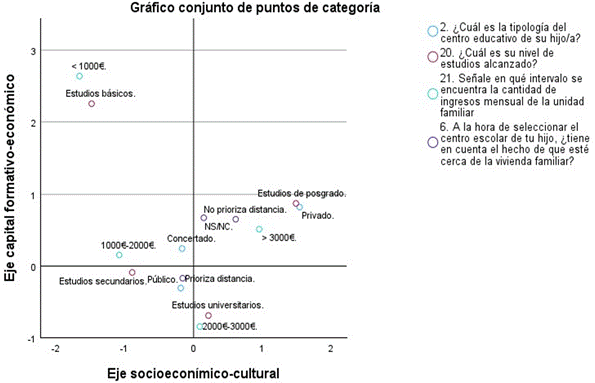 Family profiles
and school choice:
a multiple correspondence analysis.
Family profiles
and school choice:
a multiple correspondence analysis.
In the graph, the horizontal axis (X) represents socioeconomic–cultural capital, where negative values are associated with lower income
and educational levels, and positive
values with higher
income and elevated
educational capital. The vertical axis (Y) captures
formative–economic capital, differentiating between profiles with low
qualifications and limited economic resources (lower part) and those with high educational attainment and greater
economic capacity (upper part). The position of the
public-school profile in the lower-left quadrant reflects residential
proximity, lower income, and medium–high cultural capital; meanwhile, the state-subsidized profile, located in the central
quadrant, combines intermediate economic
and cultural resources
with active choice
strategies and greater geographical mobility. The private-school profile,
in the upper-right quadrant, concentrates the highest capital
on both axes, evidencing its more exclusive character.
This configuration confirms Bourdieu’s (2001) argument regarding
social reproduction: school choices
reflect and reinforce structural inequalities, and in the case of the
state-subsidized sector, its intermediate position between the public and
private sectors enables it to attract families with sufficient resources to exercise strategic choice, though not to
the level of economic exclusivity associated with the private sector. Thus, the
apparent freedom of choice
becomes a mechanism that consolidates differentiated circuits and segments the dual
education system.
Conclusions and Discussion
The findings allow us to affirm that the study’s objectives have
been achieved, providing a situated understanding of how the
public–state-subsidized duality in A Coruña affects educational equity and how
the logic of school choice contributes to reinforcing social
and territorial inequalities. The internal
coherence of the study rests on the articulation between the theoretical
framework -with key references such as Bourdieu (2001), Bernstein (2001), and
Coleman (1988)- the mixed-methods design, and the critical interpretation of
the results.
From a critical and emancipatory perspective, it becomes evident
that state-subsidized education, far from functioning as a compensatory mechanism, operates as a
device of social reproduction, indirectly
selecting its student body through
variables such as economic, cultural, and symbolic capital (Bourdieu, 1986; Roca, 2022).
School zoning, rather than correcting inequalities, consolidates them by overlapping with socioeconomically
homogeneous territories (Gómez, 2024; Villa, 2020), and expanded services,
religious ethos, and communication strategies reinforce internal
homogeneity and the symbolic
prestige of these schools (Durkheim, 2002; Coleman, 1988).
Among the most relevant contributions, the study demonstrates, based
on local empirical evidence, that the state-subsidized sector occupies a
strategic intermediate position between the public and private networks,
attracting families with sufficient resources to engage in active choice but
without reaching the economic
exclusivity characteristic of private schooling. It also highlights how school-choice dynamics are shaped by patterns of homophily
and territorial segmentation, offering evidence that can inform the rethinking
of educational planning and resource redistribution policies.
Nevertheless, the study presents certain limitations.
Representativeness is restricted to the municipality of A Coruña, which limits
the generalisability of the findings to other
contexts. Moreover, by not
conducting direct interviews with families, the study narrows the understanding
of the subjective dimension of school
choice, although this limitation is partially compensated through quantitative
data and the insights provided by school professionals.
Regarding future lines of inquiry, there is fertile ground for
inter-municipal comparative studies analysing how zoning policies and control
mechanisms over the state-subsidized sector can reduce socio-educational
segregation. However, Fontdevila and Zancajo (2025) show that pro-equity
redesigns of educational quasi-markets only produce substantive effects when accompanied by strict
regulation of admission processes, funding,
and the balanced distribution of vulnerable students across school networks. It would also be pertinent to examine the long-term impact
of these dynamics on academic and professional
trajectories, in order
to assess whether
“freedom of choice”
contributes to social mobility or perpetuates stratification, as
anticipated by Bourdieu (2001) and Coleman (1988).
In sum, the findings invite us to question the current dual model
and to design redistributive and spatial-justice-oriented policies that ensure
educational equity becomes a real right rather than an unfulfilled promise.
References
Alegre, M. Á., Benito, R., & González, I.
(2008). Procesos de segregación y polarización
escolar: La incidencia de las
políticas de zonificación escolar. Profesorado, Revista de Currículum y Formación del Profesorado, 12(2),
1-26. https://revistaseug.ugr.es/index.php/profesorado/article/view/20456
Alegre, M. Á., &
Benito, R. (2012). ¿En qué se fijan las familias a la hora de escoger la
escuela de sus hijos? Factores de elección y descarte escolar en la ciudad de
Barcelona. Profesorado, Revista de Currículum y Formación del Profesorado,
16(3), 59-79. https://revistaseug.ugr.es/index.php/profesorado/article/view/19996
Berger, P. L. & Luckmann, T. (1991)
[1966]. The social construction of reality: A treatise in the sociology of
knowledge. Penguin Books.
Bernstein, B. (2001)
[1990]. La estructura del discurso pedagógico. Morata.
Bourdieu, P., & Passeron, J.-C. (1996)
[1979]. La reproducción: Elementos para una teoría del sistema de
enseñanza. Editorial Laia, S.A.
Bourdieu, P. (2001) [1986]. Poder,
derecho y clases sociales. Editorial
Desclée de Brouwer
S.A. Bourdieu, P. (1979) [1988]. La distinción: Criterios y bases
sociales del gusto. Taurus.
Casares, A. B. & Vidal, C. (2024). Equidad
e igualdad de oportunidades educativas: gratuidad, inclusión, no discriminación
y escolarización equilibrada en la regulación de los conciertos educativos. Save the Children.
https://www.savethechildren.es/sites/default/files/2024-09/Informe_juridico_externo_escuela_concertada.pdf
Castells, M. (2000).
Globalización, sociedad y política en la era de la información. Bitácora urbano-territorial, 4(1), 42-53.
https://revistas.unal.edu.co/index.php/bitacora/article/view/18812
Cladellas, R., Muntada, M. C., Badia, M., &
Gotzens, C. G. (2013). Extracurricular activities and
Academic Performance in Elementary School Students.
EJIHPE: European Journal
of Investigation in Health, Psychology and Education, 3(2),
87-97. https://doi.org/10.3390/ejihpe3020008
Colás, P. S., & Contreras, J. A. (2013). La
participación de las familias en los centros escolares de Educación Primaria. Revista de Investigación Educativa, 31(2), 499.
https://doi.org/10.6018/rie.31.2.171031
Coleman, J. S. (1988). Free
Riders and Zealots: The Role of Social Networks. Sociological
Theory, 6(1), 52-57. https://doi.org/10.2307/201913
Concello de A Coruña. (2016). Análisis del
conjunto del área urbana desde una perspectiva
integrada. En Eidus Coruña: Modelo de desarrollo urbano de la
ciudad de A Coruña 2017- 2023. https://www.coruna.gal/descarga/1453613949220/EIDUS_Coruna.pdf
Cordini M. (2024). Which School? Criteria
and Priorities Driving Households’ Agency in School Choice in a Quasi-market Educational System. The Case of Milan. Italian Journal of Sociology of Education, 16(3),
79-103. https://doi.org/10.14658/PUPJ-IJSE-2024-3-4
Cuartero, M. M. (2023). La segregación en la
escuela concertada. Un análisis a través de las actividades complementarias. EUNOMÍA.
Revista en Cultura de la Legalidad, (24), 49-68. https://doi.org/10.20318/eunomia.2023.7655
Durkheim, É. (2002 [1925]).
La educación moral. Ediciones Morata.
Echazarra, A. (2024). Por una
escuela concertada inclusiva. Save the
Children.
https://www.savethechildren.es/sites/default/files/2024-09/Por_una_escuela_concertada_inclusiva_Informe_STC.pdf
Fontdevila, C., &
Zancajo, A. (2025). Examining pro-equity redesigns of educational quasi-markets: a mechanism-based approach to their effects. Journal of
Educational Administration and History,
0, 1-20. https://doi.org/10.1080/00220620.2025.2538455
Gómez, J. M. (2024). Zonificación escolar,
proximidad espacial y segregación socioeconómica. REIS: Revista Española de Investigaciones Sociológicas, (168), 35-54.
https://doi.org/10.5477/cis/reis.168.35
Iglesias-Pascual, R., Merchán-Hernández, C., & Benassi, F. (2025). Subsidised private
education and public
education. A reflex of the neighbourhood inequalities in Seville (Southern Spain).
Cities, 166, 106246.
https://doi.org/10.1016/j.cities.2025.106246
Instituto Nacional de Estadística (2022). Atlas
de distribución de renta de los hogares
(ADRH). Datos sobre
renta media por hogar por distrito en A Coruña [Base
de datos interactiva]. https://www.ine.es/jaxiT3/Datos.htm?t=30989#_tabs-tabla
Ley 14/1970, de 4 de agosto, General de
Educación y Financiamiento de la Reforma Educativa (LGE). Boletín Oficial del
Estado, 187, BOE-A-1970-852.
Ley Orgánica 8/1985,
de 3 de julio, reguladora del Derecho a la Educación (LODE). Boletín Oficial
del Estado, 159, de 4 de julio de 1985. https://www.boe.es/eli/es/lo/1985/07/03/8/con
Ley Orgánica 10/2002, de 23 de diciembre, de
Calidad de la Educación (LOCE). Boletín Oficial del Estado, 307, de 24 de
diciembre de 2002. https://www.boe.es/eli/es/lo/2002/12/23/10
Ley Orgánica 2/2006, de 4 de mayo, de Educación
(LOE). Boletín Oficial del Estado, 106, de 4 de mayo de 2006. https://www.boe.es/eli/es/lo/2006/05/03/2/con
Ley Orgánica 3/2020, de 29 de diciembre, por la
que se modifica la Ley Orgánica 2/2006, de 3 de mayo, de Educación (LOMLOE).
Boletín Oficial del Estado, 340, de 30 de diciembre de 2020. https://www.boe.es/eli/es/lo/2020/12/29/3
Muñoyerro, P.
(2022). La educación concertada en España: origen y recorrido histórico. Historia
de la Educación, 41(1), 405-425. https://doi.org/10.14201/hedu2022405425
Roca, J. A. (2022). Mamá, papá, ¿por qué voy
a este cole? Características del proceso de elección
del centro educativo en el municipio de A Coruña. [Trabajo de Fin de Grado no publicado]. Universidad de A Coruña.
Rodríguez, C., Guzmán E. & Martín D.
(2022). Educational policies of privatization in Spain and their
impact on equity. Education Policy Analysis Archives, 30(115), 1-24. https://doi.org/10.14507/epaa.30.6865
Rodríguez-Martínez, C., Guzmán-Calle, E.,
& Martín-Alonso, D. (2024). Equity in Dispute: From
Education Policies to School Practices of Stratification and Standardization. REICE.
Revista Iberoamericana sobre Calidad, Eficacia y Cambio en Educación, 22(4),
23-41. https://doi.org/10.15366/reice2024.22.4.001
Soriano, P. (2015). Elección del centro
escolar en el municipio de A Coruña:
tipologías, diferencias de clase social y motivaciones
[Trabajo de Fin de Grado, Universidad de Coruña]. Repositorio RUC.
http://hdl.handle.net/2183/15424
Torrecilla, F. J. M., & Borruel, C. M. G.
(2024). Los centros privados concertados como factor de segregación escolar por
nivel socioeconómico en España. REICE: Revista Iberoamericana sobre Calidad,
Eficacia y Cambio en Educación, 22(3), 5-22.
https://doi.org/10.15366/reice2024.22.3.001
Turienzo, D., & Manso, J. (2022). Cuando
las políticas públicas se transforman en mecanismos (re)productores de
desigualdad educativa: el caso español en el acceso al sistema escolar. Foro
de Educación, 20(1), 240-264. http://dx.doi.org/10.14516/fde.898
Turienzo, D., & Manso, J. (2023). La
escolarización en centros sostenidos con fondos públicos: una comparativa
autonómica. Revista Española de Educación Comparada, (43), 377-399. https://doi.org/10.5944/reec.43.2023.33327
Ugalde, N., & Balbastre-Benavent, F.
(2013). Investigación cuantitativa e investigación cualitativa: buscando las
ventajas de las diferentes metodologías de investigación. Ciencias Económicas, 31(2), 179-187. https://doi.org/10.15517/rce.v31i2.12730
Villa, A. Z. (2020). Elección de escuela,
movilidad y segregación escolar
del alumnado vulnerable en Barcelona. REICE: Revista Iberoamericana sobre Calidad,
Eficacia y Cambio en Educación, 18(4), 197-218.
https://doi.org/10.15366/reice2020.18.4.008
Zancajo, A., Bonal, X., &
Verger, A. (2014). Mercados educativos y segmentación de la oferta
escolar: efectos sobre las desigualdades educativas en Chile.
Témpora: Revista de historia y sociología
de la educación, 17, 11-30.
https://ddd.uab.cat/pub/artpub/2014/173884/tempora_a2014m10n17p11iSPA.pdf
Zancajo, A., Verger, A., &
Fontdevila, C. (2022). La educación concertada en España. Reformas en clave
de equidad desde una perspectiva internacional. Fundació Jaume Bofill y
Bonalletra Alcompàs.
https://fundaciobofill.cat/es/publicaciones/la-educacion-concertada-en-espana-reformas-en-clave-de-equidad-desde-una-perspectiva-internacional
Zapparoli, M. (2003).
Concepciones teóricas metodológicas sobre investigación. Girasol: revista de la escuela de estudios generales, 5,
191-198.
Zwier, D. (2024). Be True to Your School: School Profiling and School Sorting by
Socio-Economic Status. Social Science
Research, 132, 103239. https://doi.org/10.1016/j.ssresearch.2025.103239