Revista Internacional de Educación y Análisis Social Crítico Mañé, Ferrer & Swartz.
ISSN: 2990-0476
Vol. 4 Núm. 1 (2026)
We work for war: the military-industrial Complex in your city
The ERiS Case in Forlì (Italy)
Trabajamos para la guerra: el complejo militar-industrial en tu ciudad. El caso ERiS en Forlì (Italia)
Trabalhamos para a guerra: o complexo militar-industrial na sua cidade. O Caso ERiS em Forlì (Itália)
No ERiS Campaign
Forlì, Italy
noeris.noblogs.org
eris@anche.no
Abstract
This paper brings together and articulates a series of texts produced by the No ERiS Campaign concerning the ERiS Project (Emilia-Romagna in Space), an initiative promoted in the Emilia-Romagna region (Italy) by the Thales Alenia Space consortium alongside seven Emilian-Romagnan companies, with the support of the Fondazione Cassa dei Risparmi and the Municipality of Forlì, through the Mercury Foundation. The project envisages the construction of a nanosatellite antenna production hub on public land in the Ronco district of Forlì, with an estimated investment of 25 million euros funded mainly through public resources. The texts analysed denounce the military nature of the project, challenge the promoters’ narrative -who present the project as exclusively for civil use, never acknowledging its military dimension-, document the chain of institutional and corporate responsibilities, and report on the collective resistance actions deployed in response. The article situates itself within the tradition of critical and emancipatory science, understanding that transformative knowledge necessarily passes through the articulation of voices that, through direct action and counter-information, challenge hegemonic consensus and make structures of power visible.
Keywords: Militarism, arms industry, social movements, military technology, collective resistance, Thales Alenia Space, political corruption.
Resumen
El presente trabajo reúne y articula un conjunto de textos producidos por la Campaña No ERiS en torno al Proyecto ERiS (Emilia-Romagna in Space), una iniciativa promovida en la región de Emilia-Romaña (Italia) por el consorcio Thales Alenia Space, junto a siete empresas emiliano-romagnolas, con el apoyo de la Fondazione Cassa dei Risparmi, y el Ayuntamiento de Forlì, a través de la denominada Fundación Mercury. El proyecto contempla la construcción de un polo de producción de antenas para nanosatélites sobre terrenos públicos del barrio Ronco de Forlì, con una inversión estimada de 25 millones de euros, financiados mayoritariamente con fondos públicos. Los textos analizados denuncian la naturaleza militar del proyecto, cuestionan el discurso de los promotores -que presentan el proyecto como de exclusivo uso civil, sin reconocer en ningún momento su dimensión bélica-, documentan la cadena de responsabilidades institucionales y corporativas, e informan de las acciones de resistencia colectiva desplegadas en respuesta. El artículo se inscribe en la tradición de la ciencia crítica y emancipadora, entendiendo que el conocimiento transformador pasa necesariamente por la articulación de voces que, desde la acción directa y la contrainformación, cuestionan los consensos hegemónicos y hacen visibles las estructuras de poder.
Palabras clave: Militarismo, industria de armamentos, movimientos sociales, tecnología militar, resistencia colectiva, Thales Alenia Space, corrupción política.
Resumo
Este trabalho compila e articula uma série de textos produzidos pela Campanha No ERiS a respeito do Projeto ERiS (Emilia-Romagna no Espaço), uma iniciativa promovida na região da Emilia-Romagna, na Itália, pelo consórcio Thales Alenia Space, juntamente com sete empresas da Emilia-Romagna, com o apoio da Fondazione Cassa dei Risparmi (Fundo de Poupança) e da Prefeitura de Forlì, por meio da Fundação Mercury. O projeto prevê a construção de um centro de produção de antenas para nanossatélites em terreno público no distrito de Ronco, em Forlì, com um investimento estimado em 25 milhões de euros, financiado principalmente com recursos públicos. Os textos analisados denunciam a natureza militar do projeto, questionam o discurso de seus promotores -que apresentam o projeto como sendo exclusivamente para uso civil, sem jamais reconhecer sua dimensão militar-, documentam a cadeia de responsabilidade institucional e corporativa e relatam as ações de resistência coletiva realizadas em resposta. O artigo insere-se na tradição da ciência crítica e emancipadora, entendendo que o conhecimento transformador envolve necessariamente a articulação de vozes que, por meio da ação direta e da contra-informação, questionam os consensos hegemônicos e tornam visíveis as estruturas de poder.
Palavras-chave: Militarismo, indústria de armamentos, movimentos sociais, tecnologia militar, resistência coletiva, Thales Alenia Space, corrupção política
1. Introduction
In the context of the current European rearmament cycle (Martí, 2026; Santopinto, 2025; Zirión, 2025), driven by the escalation of international armed conflicts, and the geostrategic pressures crossing the continent, we are witnessing a proliferation of local and regional initiatives oriented towards the production of military or dual-use technologies (Bazoobandi, 2026; Díaz, 2025; European Institute of Innovation and Technology, 2025). These initiatives are frequently presented under the umbrella of economic development and technological innovation, raising urgent questions about the relationship between the civilian productive fabric, the arms industry, and the democratic responsibilities of public institutions.
The ERiS Project in Forlì (Emilia-Romagna, Italy) constitutes a paradigmatic example of this phenomenon (Bondi, 2025). Through a consortium led by Thales Alenia Space -a joint venture between the French company Thales (67%) and the Italian company Leonardo (33%)-, the project aims to install a design and manufacturing hub for nanosatellite antennas on public green land in the Ronco district of Forlì. The project’s promoters -the Municipality, the Fondazione Cassa dei Risparmi, the Emilia-Romagna Region and the consortium companies- have never acknowledged the military dimension of these technologies: they speak directly of ‘civil use’, without even employing the concept of ‘dual use’. This denial is not naivety but deliberate disinformation, and it constitutes the central axis of the critical analysis proposed in this article.
The texts investigated as a primary source of knowledge, produced by the No ERiS Campaign (figure 1), some of them between January and February 2026, offer a critical reading of this process from within the affected community. This paper consciously situates itself within the tradition of critical and emancipatory science (Paris, 2025), understanding that transformative knowledge necessarily passes through the articulation of voices that -through direct action and counter-information- challenge hegemonic consensus and render visible the structures of power.
Figure 1.
No ERiS Campaign logo.

2. Methodology
2.1 Research design
This article adopts a militant and participatory research methodology, framed within the tradition of action research and knowledge production from social movements (Cea-Madrid y Castillo, 2021; Fals, 1987; Freire, 1970; Lenette, 2022; Martínez y Palomera, 2025; Millar et al., 2025; Tubridy, 2023). The texts analysed were produced directly by the No ERiS Campaign as tools of counter-information and citizen mobilisation, and their analysis does not seek to distance itself from that origin but to make it explicit and theorise it.
The primary sources used include communiqués, blog articles and direct action materials produced by No ERiS between January and February 2026, accessible at noeris.noblogs.org. These primary sources are contrasted with journalistic and documentary sources of a public nature: minutes of the Forlì municipal council, regional press reports, and investigations by organisations specialised in monitoring the arms industry (Centro per la Pace "Annalena Tonelli", 2024; Facchini, 2025).
Through the perspective of decolonial research, and with the aim of contributing to the debates surrounding epistemic violence, the methodology we use is practically impossible to replicate. It adapts to the terrain, a unique space in time. It is not about obtaining dozens, hundreds, or thousands of data points to be aseptically interpreted and published in high-impact journals that no one reads.
Everything is about understanding that there are a thousand research methodologies, other theorists of scientific knowledge beyond those instilled in rigid universities. We do not submit to scientific dictatorship under any circumstances: we stand for freedom in all aspects of life, the freedom of the earth and of those who inhabit it, and science at the service of war, genocide, and death is our direct enemy (Brahimi and Abid, 2026; Hernández, 2021; Merkle, 2023; Moskvitin, 2026; Shaw and García, 2025).
The methodology of critical research is not about following the lines established in departments and universities that have no connection whatsoever, not only with laying the foundations for a better world, but also with dismantling a criminal and terrorist system. Even less so when that system is the one that finances the research: neither the state nor capital are shooting themselves in the foot.
3. The ERiS Project: description and context
3.1 Institutional origins and consortium composition
The ERiS Project (Emilia-Romagna in Space) was officially presented in October 2025 in Rome, at the Ministry of Enterprises and Made in Italy, with the presence of the Vice-President of the Emilia-Romagna Region, the Mayor of Forlì, and the Councillor for Economic Development, alongside the representatives of the consortium companies. The initiative groups seven regional firms -Bercella, Curti, Nautilus, NES, NPC SpaceMind, Poggipolini and Tex Tech- under the leadership of Thales Alenia Space, with the academic participation of the CIRI Aerospazio laboratory of the University of Bologna.
The project envisages the construction of a nanosatellite antenna production hub on an 8400 m² plot of municipal land in the Ronco district of Forlì, currently zoned as a rural environmental mitigation buffer area. The transfer of the land from the Municipality to the Mercury Foundation -an entity created by the Fondazione Cassa dei Risparmi and the Municipality- was approved unanimously at the municipal council on 14 October 2025 for the sum of 53000 euros. The total cost of the project amounts to approximately 25 million euros, to be financed through public funds from development contracts and the National Recovery Plan (PNRR).
3.2 The ‘civil use’ narrative: a concealment more serious than euphemism
It is telling that the project’s promoters -the Municipality, the Fondazione Cassa dei Risparmi, the Emilia-Romagna Region and the consortium companies- have never once used the concept of ‘dual use’. Their discursive strategy goes further: they present the project directly as one of ‘civil use’, with no acknowledgement whatsoever of its military dimension. The Fondazione Cassa dei Risparmi has gone as far as stating that “it is often the use made by human beings that turns a technology into a weapon” (Il Rovescio, 2026), transferring the moral responsibility to the end user and entirely eliding that of the producers.
This denial is even more serious than an appeal to dual use: it is not a euphemism that implicitly acknowledges the military dimension, but a direct concealment. The No ERiS Campaign dismantles this claim by documenting that all the companies in the ERiS consortium sell products to the defence sector, and that satellite technologies have proven to be a determining factor in contemporary conflicts such as the war in Ukraine. To speak of ‘civil use’ in this context is not naivety: it is deliberate disinformation (NoERiS, 2026).
4. The military-industrial complex: the consortium companies
4.1 Thales and Leonardo: the Franco-Italian axis of the arms industry
Thales, the eleventh largest arms manufacturer globally and fourth in Europe, largest European defense electronics company (Pretel, 2024), maintains close collaborations with Israeli companies such as Elbit Systems, IAI and Rafael Advanced Systems -the main suppliers of the Israeli army- (Enciso, 2023; Global Defense Corp, 2026), to which it has supplied components for combat drones for years. Thales also provides facial recognition and biometric data management services to Frontex and the Israeli state for border control operations in the West Bank (Amnistía Internacional, 2023; Business and Human Rights Centre, 2025; The New Arab Staff, 2026).
Leonardo, Italy’s military giant whose largest shareholder is the Ministry of Economy and Finance with approximately 30% of the capital, is the third largest arms company in Europe by turnover and the leading producer and exporter of armaments in Italy (Pettibone, 2026). In November 2024, it signed a joint venture in Dubai with Edge, the United Arab Emirates’ aerospace and military technology group, a country that has armed the RDF militias responsible for massacres in Sudan (Facchini, 2025).
4.2 The consortium companies: profiles and responsibilities
Bercella supplies critical components for the missile systems of MBDA, the world's leading European consortium in their design and manufacture for land, naval, and air forces. Founded as a joint venture, its ownership is structurally distributed among three giants of the aerospace and defense industry: Airbus (37.5%), BAE Systems (37.5%), and Leonardo (25%). It produces weapons of mass destruction, such as long-range air-to-air missiles, used in international conflicts. Curti, from Castelbolognese, designs unmanned aerial navigation systems and civil and military drones; it is a supplier of Leonardo for helicopters and military vehicles, and exports parts for self-propelled howitzers (Centro per la Pace "Annalena Tonelli" – Forlì, 2024). NPC SpaceMind, co-owned by Ecor -a Leonardo supplier in missile manufacturing- and by Curti, designs and produces drones and nanosatellites for military use, and in 2021 won a tender under the Italy-Israel Cooperation Agreement together with Elbit Systems.
Poggipolini, from San Lazzaro, converted from the luxury car sector to the military sector, acquired the US military company HPF in 2024 and became a supplier of Lockheed Martin, Northrop Grumman, SpaceX and Blue Origin, as well as of Leonardo, participating in the supply chain for the F-35 fighter jets. The University of Bologna, through CIRI Aerospazio, completes the consortium, illustrating the progressive interweaving of the academic sphere with the defense industry (2026).
5. Institutional responsibilities and public funding
One of the most significant aspects of the ERiS case is the way in which public institutions -both local and regional and national- become active agents in the militarisation of the territory. The Municipality of Forlì has ceded public land to the Mercury Foundation, with the positive vote of all municipal groups, including the abstention of the Democratic Party (PD), whose representatives even advocated for expanded urban development on the surrounding land (Sesto Potere, 2025).
The Emilia-Romagna Region has pledged funding to the project, and the central government has been called upon to provide PNRR funds. This convergence between right wing and left wing in the management of interests linked to the arms industry reveals the limits of conventional political debate. The use of public funds -including those of the PNRR, originally conceived for post-pandemic healthcare and social reconstruction- to finance military infrastructure constitutes an operation of regressive redistribution of social resources towards the war sector.
Land use also deserves attention: the land in question was zoned as an environmental mitigation area, close to the Ronco river, in a city that in May 2023 suffered a devastating flood whose causes included soil sealing, and uncontrolled land consumption.
The fight against so much injustice, and the desire to devastate the earth for the benefit of the death industry, could not be delayed, to the extent possible for those who are not part of the political class and do not manage millions of euros (see figure 2 and 3).
Figure 2.
Demonstration of the No ERiS Campaign with a banner "We talk about war! NO città dell'aerospazio, NO produzione di morte!", Forlì (Collettivo Samara, 2026).
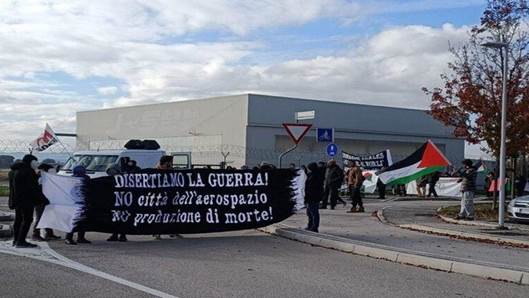
Figure 3.
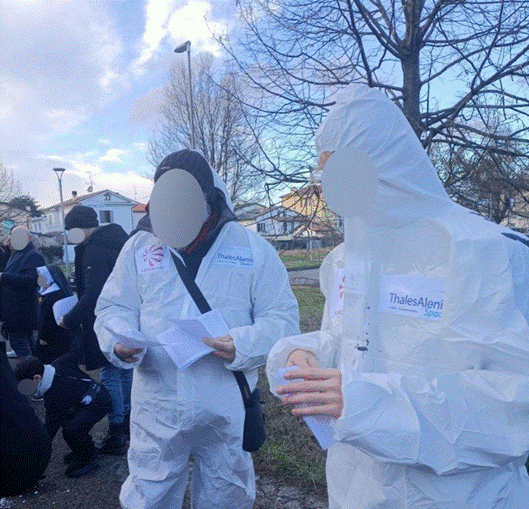
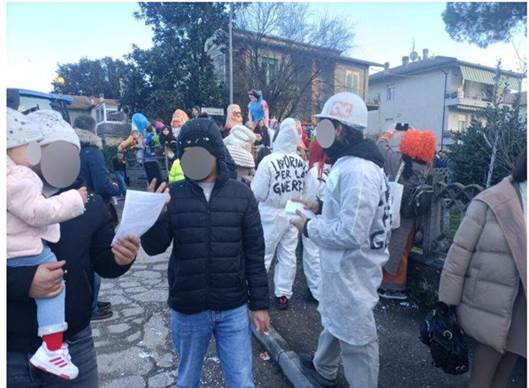
Activists wearing overalls with Leonardo Spa and Thales Alenia Space logos distributing leaflets. Awareness‑raising action “Il Carnevale dell’Aeroporto”, Ronco district, Forlì, January 25, 2026 (Collettivo Samara, 2026).
6. Collective resistance and counter-information
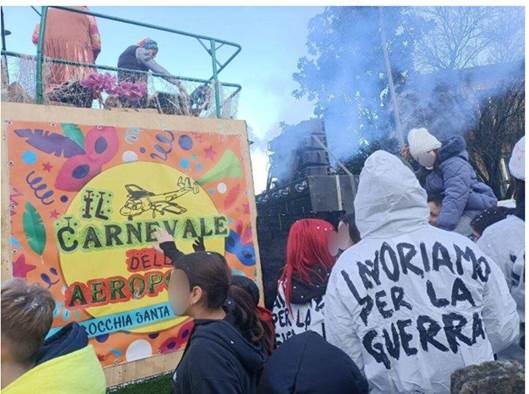
In response to the ERiS project, a resistance movement has emerged in Forlì, organised around the No ERiS Campaign, whose activity combines the production of rigorous counter-information with public direct action. Among the initiatives documented are the organisation of thematic evenings of debate and political education, a public demonstration against the project, and a street theatre intervention. In the carnival of January 25, 2026, in the Ronco district, around ten people dressed in overalls bearing the logos of Leonardo and Thales Alenia Space. They distributed hundreds of copies of a leaflet which, speaking ironically in the name of the ‘specialised technicians’ of the consortium, pointed out without euphemism the military function of the technologies produced (figures 4, 5, 6 y 7).
Figure 4.
Group of activists seen from behind with the inscription “Lavoriamo per la guerra”, Ronco district, Forlì, 25 January 2026 (Collettivo Samara, 2026).
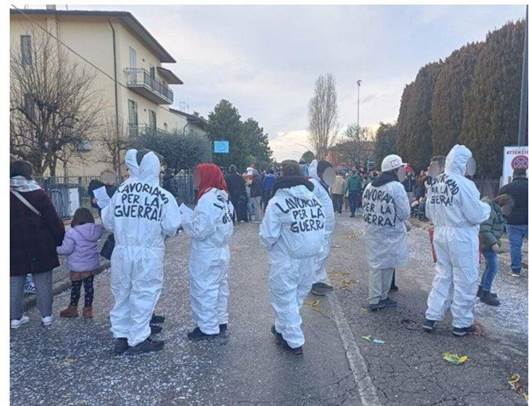
Figure 5.
Activists with “Lavoriamo per la guerra” overalls at the Ronco district carnival, Forlì, 25 January 2026 (Collettivo Samara, 2026).

Figure 6.
Activists alongside a carnival float, Ronco district, Forlì, 25 January 2026 (Collettivo Samara, 2026).
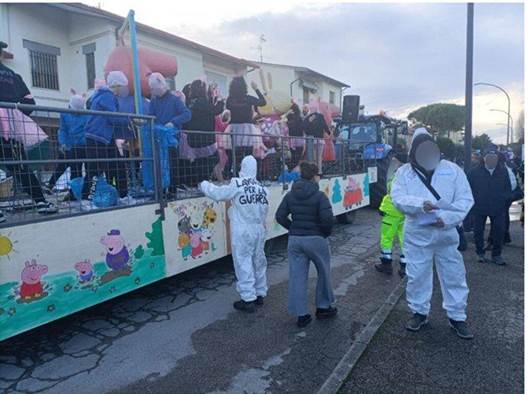
Figure 7.
Activists wearing white work overalls next to the float “Il Carnevale dell’Aeroporto” during the awareness‑raising action, Ronco district, Forlì, January 25, 2026 (Collettivo Samara, 2026).
Significantly, these actions were systematically ignored by local media, illustrating the role of hegemonic media in managing consent for projects of this kind. The counter-information practice of the campaign, which documents, analyses and disseminates the corporate profiles of the consortium companies, their links to international conflicts and their chains of responsibility, constitutes in itself a form of critical knowledge production (see figure 8).
Figure 8.
Activists distributing leaflets among participants at the Ronco district carnival, Forlì, 25 January 2026 (Collettivo Samara, 2026).
The question underlying all of No ERiS’s resistance is profoundly political and ethical in nature: can ‘job creation’ -the recurring argument used to make any industrial project acceptable- serve as moral justification for participation in production chains for war technology? (Calvo, 2025, 2026; Stop Fuelling War, 2026). The campaign’s answer is unequivocal: no.
7. Conclusions and discussion
The ERiS case invites reflection on how global processes of militarisation materialise in concrete territories, often in medium-sized cities that do not identify themselves as part of the military-industrial complex. They are, in fact, functional nodes of it. The installation of military technology hubs in university cities and regional economic development zones reproduces, at a local scale, the logic of ‘permanent war’: an economy whose accumulation dynamic depends on the continuous production of instruments of destruction.
The No ERiS experience is also a methodological contribution: knowledge produced from within social mobilisation possesses its own epistemic value. This phenomenon is not unique to Forlì: the ordinary militarisation of territory, financed with public money and legitimised with the discourse of progress and employment, is a process that replicates itself across multiple European cities. The ERiS case can thus be read as a case study of a structural phenomenon, and the No ERiS response as a model of replicable collective resistance.
The ERiS Project in Forlì synthesises some of the most characteristic tensions of the present historical moment. The articulation between regional economic development and the arms industry. The use of public funds for military purposes. The deliberate denial of the military dimension of the technologies produced, and the emergence of collective resistance movements that challenge these dynamics from a critical ethical and political perspective.
The texts produced by the No ERiS Campaign (2025, 2026a) offer valuable material for thinking through these processes: they document facts, identify those responsible, articulate arguments and narrate resistance practices. Their publication in the framework of a critically oriented academic journal broadens the conversation on one of the most urgent challenges of our time: how to build a more just and peaceful world when the production of violence is financed with public money, legitimised with the discourse of progress, and installed in our neighbourhoods.
NO ERiS. NO WAR CITADEL, NEITHER IN FORLÌ NOR ANYWHERE ELSE.
References
Amnistía Internacional. (May 2, 2023). Las autoridades israelíes utilizan tecnología de reconocimiento facial para afianzar el apartheid contra las personas palestinas. Amnistía Internacional. https://www.es.amnesty.org/en-que-estamos/noticias/noticia/articulo/israel-utiliza-reconocimiento-facial-para-afianzar-apartheid-contra-palestinos/
Bazoobandi, S. (2026). How Autonomous Weapon Systems Threaten International Humanitarian Law. GIGA Focus Global, 4, s. / p. https://doi.org/10.57671/gfgl-26042
Bondi, M. (October 21, 2025). Aerospazio, ecco ‘Eris’: il progetto per far diventare Forlì capitale delle antenne satellitari. Il Resto del Carlino. https://www.ilrestodelcarlino.it/forli/cronaca/aerospazio-eris-progetto-antenne-satellitari-njlm80a1
Brahimi, A. y Abid, Y. (2026). Paul Feyerabend and Epistemological Pluralism: Beyond Methodological Anarchism. Pegem. Journal of Education and Instruction, 16(1), 479-495. https://www.pegegog.net/index.php/pegegog/article/view/4722
Business and Human Rights Centre. (March 13, 2025). Israel/ OPT: Sales by majority state-owned Thales to Israel between 2018-2023 likely to have been used in strikes on Palestinian civilians, finds NGO; incl. co. comments. Business and Human Rights Centre. https://www.business-humanrights.org/en/latest-news/israel-opt-sales-by-majority-state-owned-thales-to-israel-between-2018-2023-likely-to-have-been-used-in-strikes-on-palestinian-civilians-finds-ngo-incl-co-comments/
Calvo, J. (October 28, 2025). Fabricar armas no genera apenas empleo: los datos desmontan el mito. Centre d’Estudis per la Pau J. M. Delàs. https://centredelas.org/actualitat/fabricar-armas-no-genera-apenas-empleo-los-datos-desmontan-el-mito/
Calvo, J. (2026). La falacia del empleo de la industria militar. Economistas sin Fronteras. https://ecosfron.org/la-falacia-del-empleo-de-la-industria-militar/
Cea-Madrid, J. C. y Castillo, T. (2021). Enloqueciendo la academia: Estudios Locos, metodologías críticas e investigación militante en salud mental. Revista Latinoamericana de Metodología de las Ciencias Sociales, 11(2), e097. https://doi.org/10.24215/18537863e097
Centro per la Pace "Annalena Tonelli" – Forlì. (June 6, 2024). Curti va alla guerra. Inchiesta di Weapon Watch, di Linda Maggiori. Centro per la Pace "Annalena Tonelli" – Forlì. https://centropaceforli.wordpress.com/2024/06/06/curti-va-alla-guerra-inchiesta-di-weapon-watch-di-linda-maggiori/
Collettivo Samara. (2026). Fotografías de la acción de contrainformación “Il Carnevale dell’Aeroporto”, barrio Ronco, Forlì, 25 de enero de 2026. Imágenes inéditas.
Díaz, E. (January 21, 2025). Tecnologías espaciales de doble uso y material de defensa. Infoespacial. https://www.infoespacial.com/texto-diario/mostrar/5140967/tecnologias-espaciales-doble-material-defensa
Enciso, S. W. (December 17, 2023). Harms Dealers: Thales in partnership with Israel Aerospace and Elbit. Wage Peace. Disrupt War. https://wagepeaceau.org/2024/04/11/harms-dealers-thales-in-partnership-with-israel-aerospace-and-elbit/
European Institute of Innovation and Technology. (2025). Digital and defence innovation for Europe’s strategic autonomy. https://28digital.eu/fileadmin/2025/ecosystem/downloads/28D_Digital-Defence-Report-DEF-WEB.pdf
Facchini, D. (October 1, 2025). Leonardo ammette l’export di armi in Israele e fa cadere la maschera del governo. Altreconomia. https://altreconomia.it/leonardo-ammette-lexport-di-armi-in-israele-e-fa-cadere-la-maschera-del-governo/
Fals, O. (1987). The application of participatory action-research in Latin America. International Sociology, 2(4), 329-347. https://doi.org/10.1177/026858098700200401
Freire, P. (1970). Pedagogía del oprimido. Siglo XXI.
Global Defense Corp. (April 20, 2026). Rafael delivers advanced airborne laser weapon system to Israeli Air Force. https://www.globaldefensecorp.com/2026/04/20/israel-2/
Hernández, J. M. (July 27, 2021). La dictadura del inglés en la ciencia: el 95% de los artículos se publica en esa lengua y solo el 1% en español o portugués. El País. https://elpais.com/ciencia/2021-07-27/la-dictadura-del-ingles-en-la-ciencia-el-95-de-los-articulos-se-publica-en-esa-lengua-y-solo-el-1-en-espanol-o-portugues.html
Il Rovescio. (January 10, 2026). Forlì: I padroni mentono! Il progetto ERiS è un progetto di guerra! Il Rovescio. https://ilrovescio.info/2026/01/10/forli-i-padroni-mentono-il-progetto-eris-e-un-progetto-di-guerra/
Lavrilleux, A. (March 13, 2025). Arms sales to Israel: France’s Thales supplying equipment for armed drones since 2018. Disclose. https://disclose.ngo/en/article/arms-sales-to-israel-frances-thales-supplying-equipment-for-armed-drones-since-2018
Lenette, C. (2022). Participatory Action Research: Ethics and Decolonization. Oxford Academic. https://doi.org/10.1093/oso/9780197512456.001.0001
Martí, C. (2026). Impacto del rearme europeo sobre la base tecnológica e industrial de defensa española. Revista del Instituto de Estudios Económicos, 1, 29-38. https://www.ieemadrid.es/sites/ceoe-iee/files/content/file/2026/01/15/25/revista-del-iee-n.o-1-2026.-la-industria-de-seguridad-y-defensa-en-espana_2.pdf
Martínez, R. and Palomera, J. (2025). Militant Research and Public Policy: From Action to Reform and from Reform to Action. Tijdschrift voor Economische en Sociale Geografie (Journal of Economic and Human Geography), 116, 391-408. https://doi.org/10.1111/tesg.70015
Merkle, L. (2023). Epistemological Anarchism Against Epistemic Violence? A Rereading of Paul Feyerabend towards the Decolonisation of Academic Knowledge Production. Journal Für Entwicklungspolitik, (XXXIX)1/2, 122-138. https://doi.org/10.20446/JEP-2414-3197-39-1-122
Millar, G., Volonterio, M., Cabral, L., Peša, I., & Levick-Parkin, M. (2025). Participatory action research in neoliberal academia: An uphill struggle. Qualitative Research, 25(2), 478-498. https://doi.org/10.1177/14687941241259979
Moskvitin, V. A. (2026). The epistemological anarchism of Feyerabend in the paradigm of post-classical science. Philosophical Thought, 1, 39-60. https://doi.org/10.25136/2409-8728.2026.1.77819
NoERiS. (November 29, 2025). Che la lotta sia autorganizzata!! Una proposta per lottare contro la Cittadella Leonardo-Thales a Forlì. NoERis. https://noeris.noblogs.org/2025/11/29/hello-world/
NoERiS. (January 26, 2026). Lavoriamo per la guerra! NoERis. https://noeris.noblogs.org/2026/01/26/lavoriamo-per-la-guerra/
NoERis. (January 23, 2026a). Forlì: la cassa dei risparmi mente. Il progetto eris è un progetto di guerra. NoERis. https://noeris.noblogs.org/2026/01/23/forli-la-cassa-dei-risparmi-mente-il-progetto-eris-e-un-progetto-di-guerra/
Paris, W. (2025). What Does Critical Theory Have to Do with Self-Emancipation? New German Critique, 52(2-155), 11-39. https://doi.org/10.1215/0094033X-11793026
Pettibone, R. (March 19, 2026). Italy Consolidates Defense Industry as Leonardo Absorbs Iveco’s Military Vehicle Business. Defense and Security Monitor. https://dsm.forecastinternational.com/2026/03/19/italy-consolidates-defense-industry-as-leonardo-absorbs-ivecos-military-vehicle-business/
Pretel, E. A. (October, 24, 2024). El auge de Thales, entre líneas: "Hemos disparado la producción de radares y munición por cinco". El Confidencial. https://www.elconfidencial.com/empresas/2024-10-24/thales-defensa-produccion-radares-municion_3989917/
Sánchez, D. (June 2, 2023). Investigadores y universidades intentan escapar de la 'dictadura de los papers'. eldiario.es. https://www.eldiario.es/sociedad/investigadores-universidades-escapar-dictadura-papers_1_10213709.html
Santopinto, F. (March 12, 2025). The ReArm Europe Plan: Squaring the Circle Between Integration and National Sovereignty. IRIS, the French Institute for International and Strategic Affairs. https://www.iris-france.org/en/the-rearm-europe-plan-squaring-the-circle-between-integration-and-national-sovereignty/
Sesto Potere. (October 9, 2025). Aerospazio, il Comune di Forlì cede alla Fondazione Mercury i terreni per lo sviluppo e la ricerca di antenne satellitari. Sesto Potere. https://sestopotere.com/aerospazio-il-comune-cede-alla-fondazione-mercury-i-terreni-per-lo-sviluppo-e-la-ricerca-di-antenne-satellitari/
Shaw, J. y García, D. (2025). Special section: Feyerabend’s philosophy of science. HOPOS: The Journal of the International Society for the History of Philosophy of Science, 15(2), 498-506. https://doi.org/10.1086/736919
Stop Fuelling War. (2026). The economic importance of the arms industry. Stop Fuelling War. https://www.stopfuellingwar.org/images/Briefings-EN/2/7_BRIEFING_PAPERS_ENGLISH_ECONOMIC2.pdf
The New Arab Staff. (March 16, 2026). EU-funded AI systems ‘exacerbate’ human rights violations in the Arab region: report. The New Arab Staff. https://www.newarab.com/news/eu-funded-ai-systems-exacerbate-human-rights-violations
Tubridy, F. (2024), Militant Research in the Housing Movement: The Community Action Tenants Union Rent Strike History Project. Antipode, 56, 1027-1046. https://doi.org/10.1111/anti.13014
Università di Bologna. (2026). CIRI Aerospazio. Università di Bologna. https://centri.unibo.it/aerospace/en
Zirión, I. (March 20, 2025). Una reflexión crítica sobre el rearme de Europa como estrategia de paz y seguridad. Euskal Herriko Unibertsitatea. https://www.ehu.eus/es/web/campusa/-/una-reflexion-critica-sobre-el-rearme-de-europa